

.svg)

.png)
You have twenty minutes and an empty text box. That is the situation this page is for.
Most post-idea lists solve the empty box by handing you a hundred prompts and letting you guess which ones are worth your twenty minutes. We went the other way. We pulled every post type and every format out of our dataset of 3 million-plus LinkedIn posts, ranked them by what they actually returned between March 2025 and February 2026, and kept the nine ideas that survived.
Three of the ideas we used to recommend did not survive. One of them is a LinkedIn feature that no longer exists. You will find all three at the bottom, with the numbers that killed them.
What the data says before you pick an idea
Two things shape whether an idea is worth your time: the type of post you write, and the format you publish it in. They are different levers, and our data says something different about each.
Start with format. Every number here is median performance for personal profiles, March 2025 through February 2026, indexed against the median post.
Source: AuthoredUp analysis of 3M+ LinkedIn posts, personal profiles, March 2025 – February 2026.
Documents are the only format that clears the median on both reach and engagement.
Images are close behind and carry the highest engagement multiplier of anything on the list, which is part of why they are now 57% of everything posted.
Reshares return roughly a quarter of a normal post's reach.
Polls are the number worth staring at. They pull nearly twice the reach of a median post and just over a third of the engagement.
A vote is not a conversation, and the algorithm eventually works that out. Creators seem to be working it out too, since poll volume fell from 1.57% to 1.16% of posts year over year.
Now the post type, which matters more than format and is harder to measure.
We classified a stratified sample of 23,848 English personal-profile posts and then ran the comparison a second way: within each author, against that author's own median. That second test is the one to trust, because a labelling mistake hurts every category equally.
Source: AuthoredUp analysis, 2,075 multi-type authors, July 2025 – June 2026.
Personal story is the only type where most authors beat their own average. Promotional is the only one where fewer than four in ten do.
Everything in between is a coin flip, which is a more useful finding than it looks: for seven of these eight types, the category is not what decides whether the post works. Execution is.
One more piece of context before the ideas. Across all nine post types we measured, median reach fell year over year.
Nine types, nine declines. Richard van der Blom's 2026 research across 1.3 million posts puts the drop for active creators at 60% over two years, and our own analysis of the algorithm shift points the same direction. If your reach is down, the platform is down.
Pick ideas on that basis rather than assuming you broke something.
9 LinkedIn post ideas that hold up in 2026
1. The decision you got wrong
Take a decision you made in the last year that did not work, and write what you believed at the time, what happened, and what you would do differently.
This is the personal story category, the one type most authors beat their own average with. It works because the specifics are yours and nobody else can publish them.
It also fails in a predictable way: writers reach for the redemption arc and the post turns into a humblebrag with a moral. Leave the moral out. Say what happened.
Publish it as text or with a single image. Our format data puts images at 1.33× median engagement, the highest of any format.
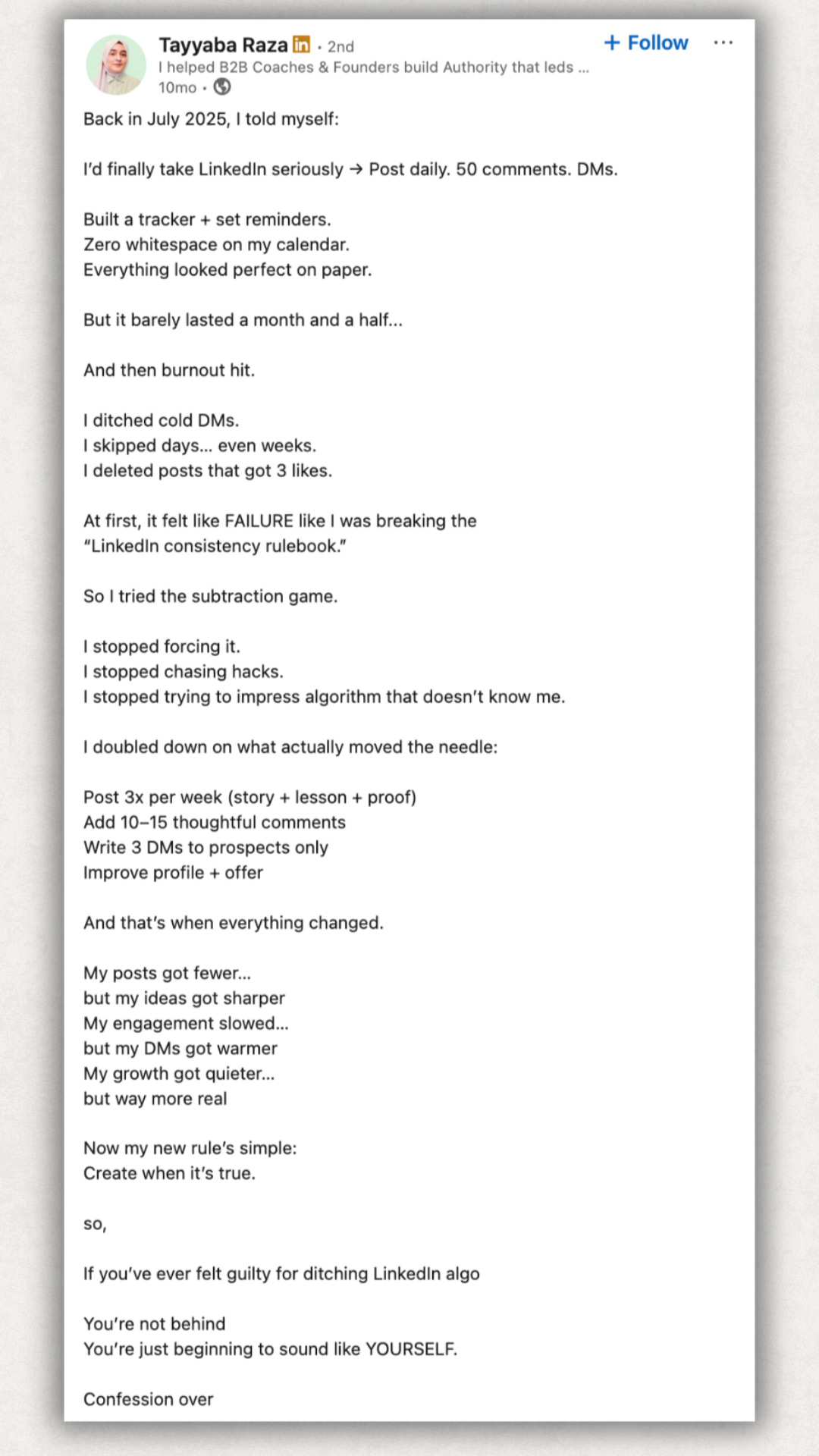
Tayyaba Raza wrote hers about a plan rather than a product:
"Back in July 2025, I told myself: I'd finally take LinkedIn seriously. Post daily. 50 comments. DMs. Built a tracker + set reminders. Everything looked perfect on paper. But it barely lasted a month and a half."
What she believed, what happened, what she does now, in that order, and the post never reaches for a moral.
The closest it gets is "Create when it's true," which is a rule she pulled out of the experience rather than a lesson she is teaching you.
2. The question you get asked most, answered properly
You have a question that comes up in every sales call, every interview, every client kickoff. Write the answer you actually give, not the polished one.
The value here is that you already know the answer cold, so this is a fifteen-minute post. The reason it lands is that a question you are asked repeatedly is by definition a question your audience has.
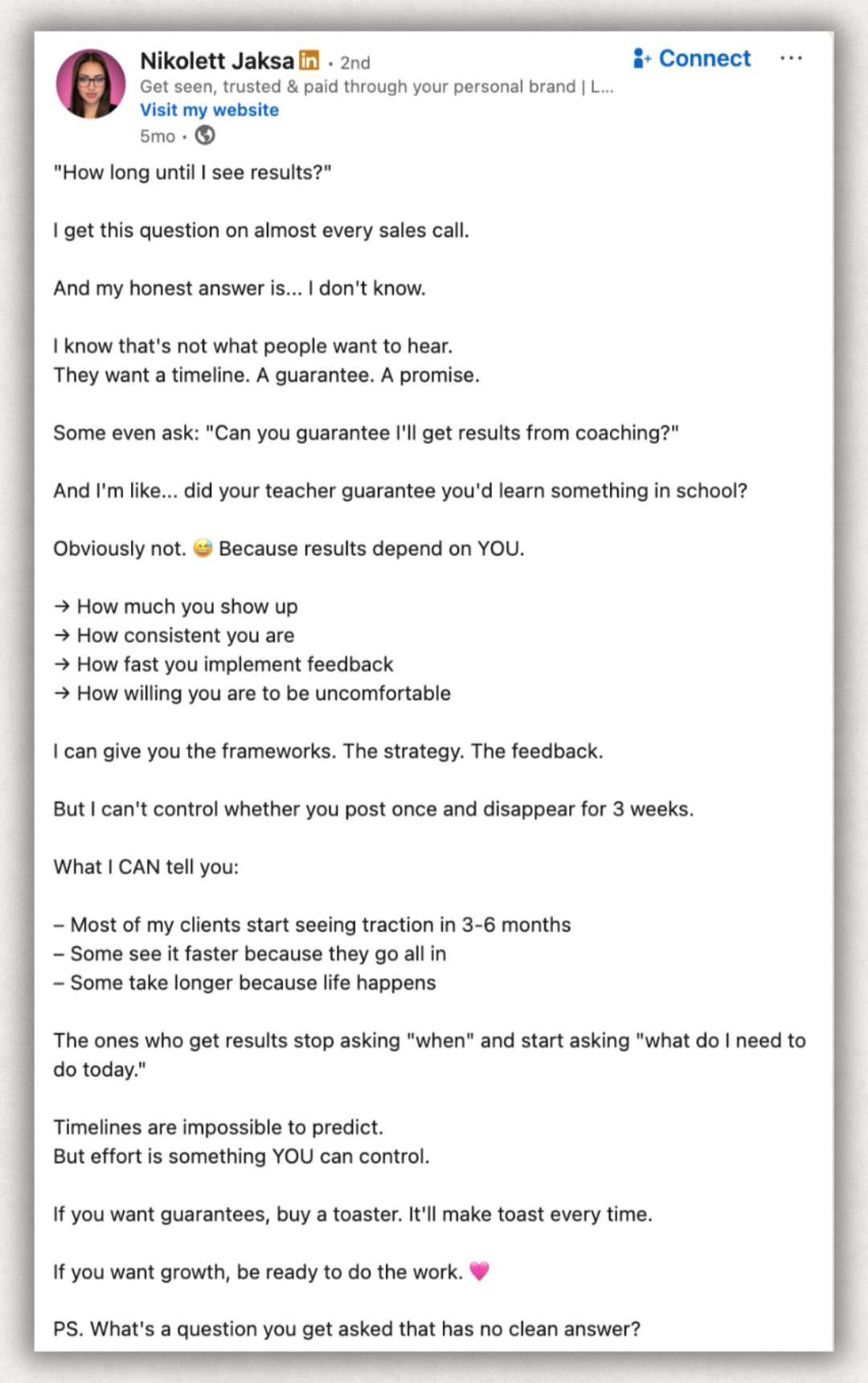
Nikolett Jaksa picked the question every coach dreads:
"How long until I see results? I get this question on almost every sales call. And my honest answer is... I don't know."
That is the answer people hear on the call, not the one on the sales page. She still gives a range further down, three to six months for most clients, but only after explaining why she cannot promise it, and that order is what makes the range believable.
3. Your process, broken into steps
Take something you do routinely and write down the actual sequence. Not the idealized version. The one with the step where you go back and redo the thing you did in step two.
How-to posts sit mid-table in our within-author data at 42.9%, which means the type is not doing the work. The specificity is.
A generic five-step framework performs like a generic five-step framework. A process with the awkward parts left in reads as real because it is.
This is the strongest candidate on the list for a document post, the only format above median on both reach and engagement.
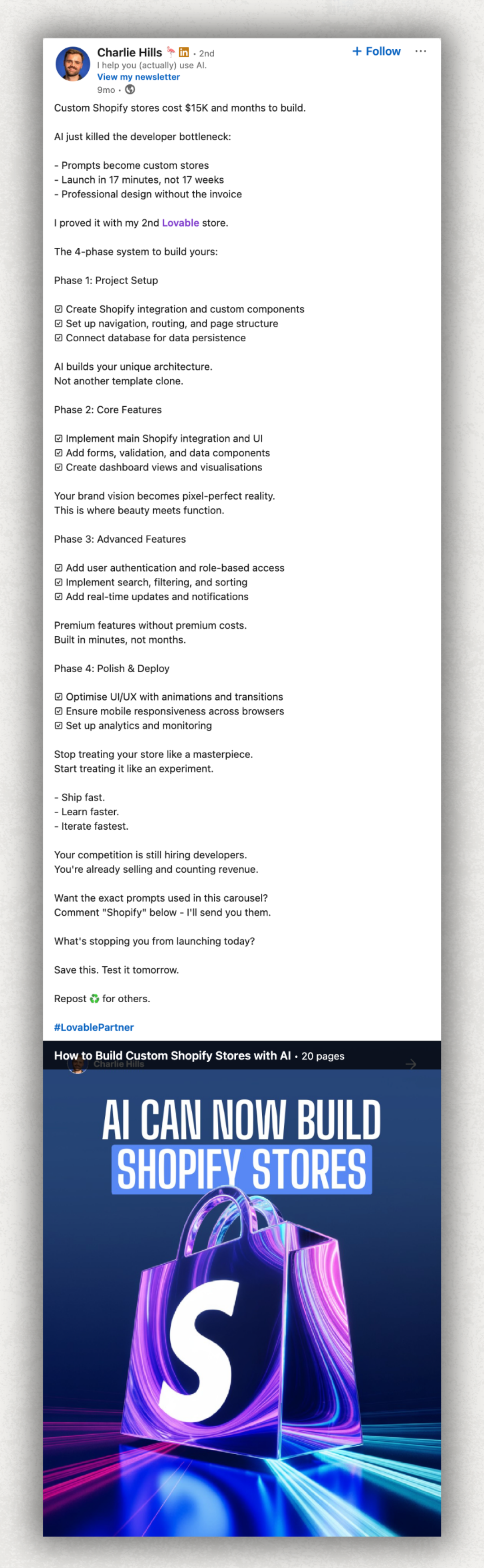
Charlie Hills put a four-phase build into a carousel:
"Custom Shopify stores cost $15K and months to build. AI just killed the developer bottleneck. I proved it with my 2nd Lovable store. The 4-phase system to build yours:"
Each phase is three checkbox lines, which is the carousel doing its job: one screen per phase, nothing to scroll past.
Notice "I proved it with my 2nd Lovable store." The process is his because he ran it twice, and the post says so before it teaches anything.
4. A number from your own work
One metric from your month, with the context that makes it mean something. Revenue, churn, reply rate, time-to-hire, a conversion number, a number that surprised you.
Numbers stop the scroll because they are checkable. They also carry a risk that most advice about them skips: a number without context invites the reader to supply their own, and their own is usually less flattering than yours. Give the denominator.
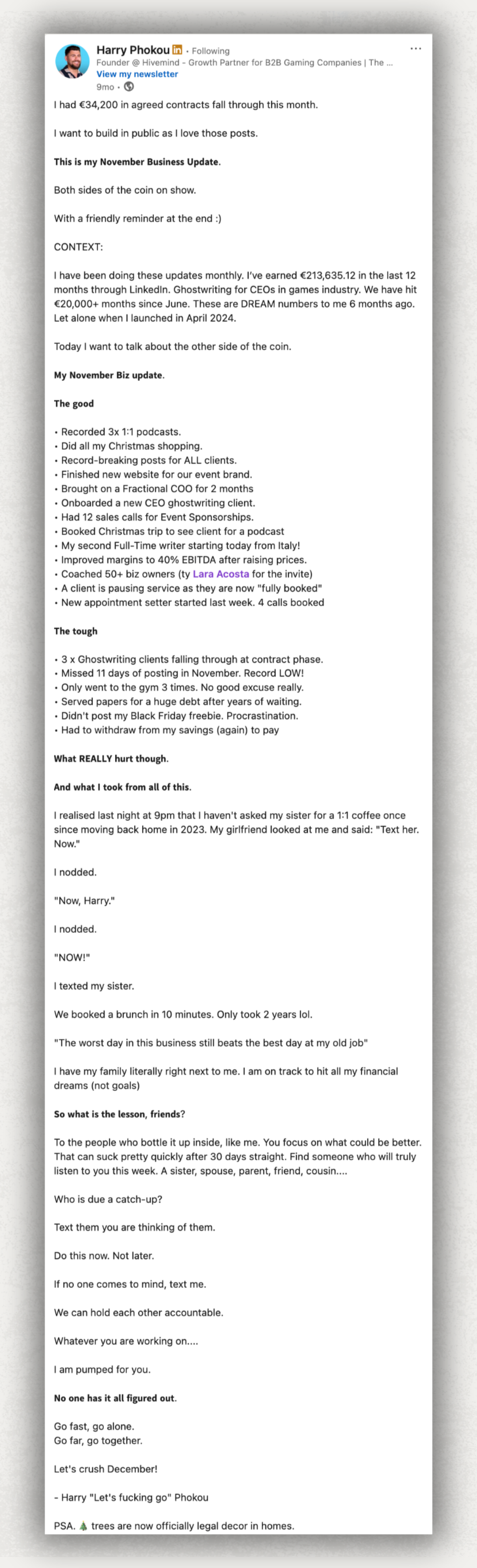
Harry Phokou leads with the loss:
"I had €34,200 in agreed contracts fall through this month."
A few lines later comes the denominator, €213,635.12 earned over the previous twelve months, with a good column and a tough column underneath. Read the number both ways.
Without the twelve-month figure next to it, €34,200 is a disaster. With it, it is a month.
5. The opinion you have been sitting on
You have a view about your industry that you have not posted because it would annoy someone.
Contrarian posts sit at 43.6% in the within-author test, so as a category they are unremarkable.
Their distinguishing feature is variance: they have the widest gap between a typical post and a top one of any type we measured.
That cuts both ways, and it is the honest reason to reach for this idea only when you actually hold the opinion. Manufactured contrarianism reads as manufactured.
Write the position first and the hedges second, then delete most of the hedges. If you need help with the opening line, our hook examples cover the patterns that survive the first three lines of the feed.
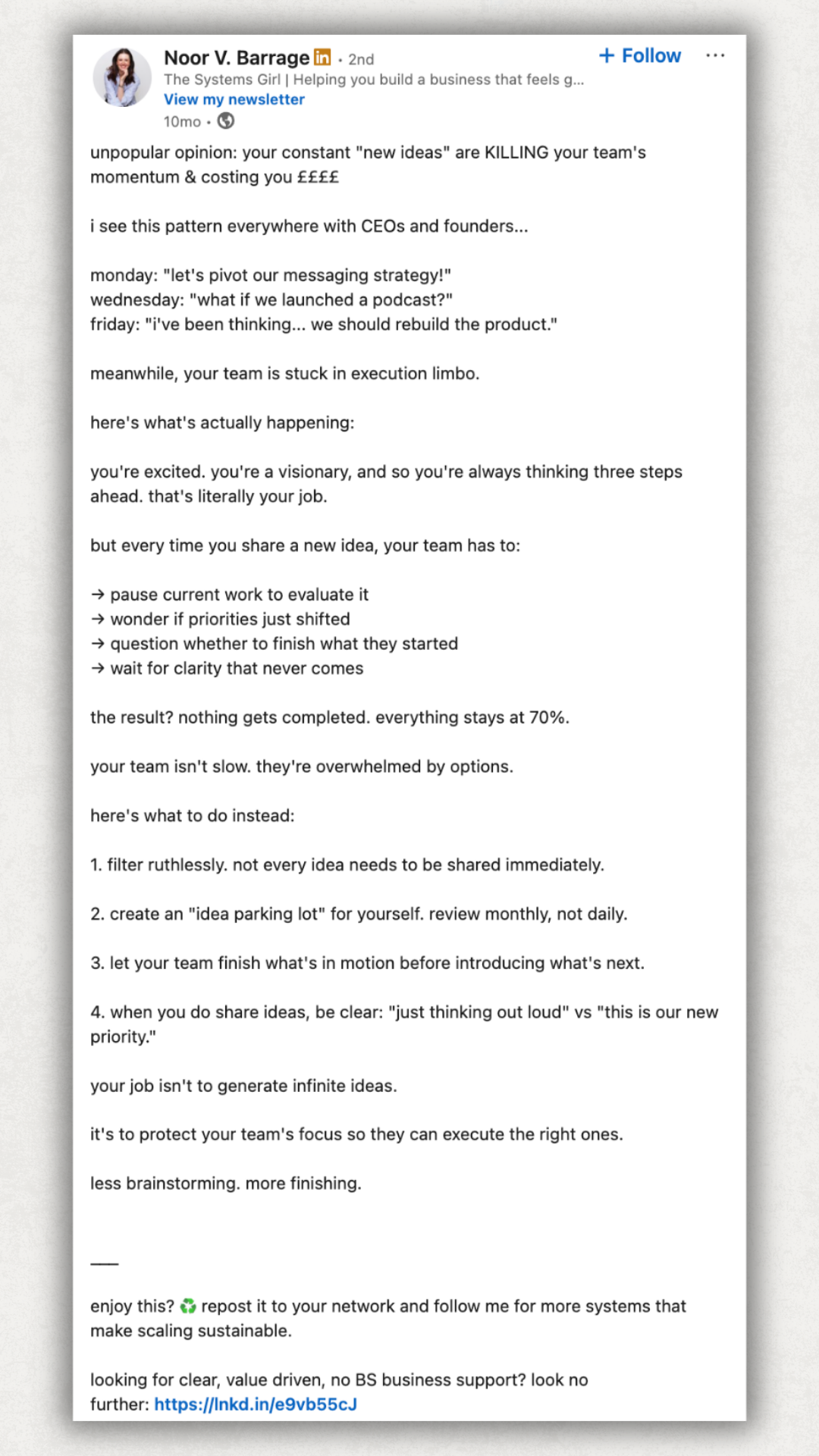
Noor V. Barrage skipped the build-up entirely:
"unpopular opinion: your constant 'new ideas' are KILLING your team's momentum & costing you ££££"
The opinion is aimed at the exact people who follow her, founders, which is the part most contrarian posts get wrong: they pick a fight with someone who is not in the room.
She then spends the rest of the post on what to do instead, so it reads as advice rather than a complaint.
6. A teardown of something you admire
Take a piece of work in your field, a campaign, a product decision, a piece of writing, and explain what makes it good. Name what you would steal.
This is the easiest idea on the list to publish on a day you have nothing of your own, and it avoids the reshare trap, because you are producing analysis rather than passing a post along.
Reshares return 0.29× median reach. Your own post about someone else's work returns whatever your own posts return.
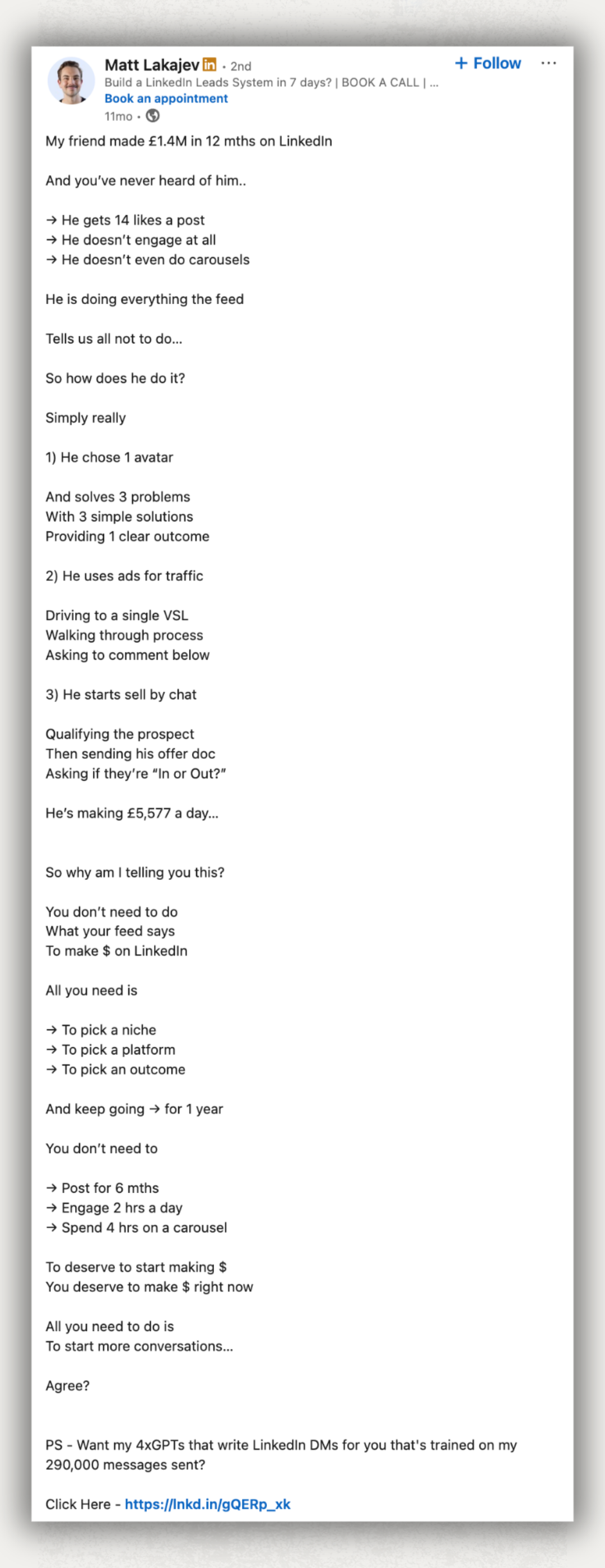
Matt Lakajev took apart a friend's business instead of his own:
"My friend made £1.4M in 12 mths on LinkedIn. And you've never heard of him. He gets 14 likes a post. He doesn't engage at all. He doesn't even do carousels."
Three numbered moves, one line each, then the part this idea depends on: what he would take from it, stated plainly as "you don't need to do what your feed says."
He is not resharing the friend. He is explaining him, and the analysis is Matt's own post rather than a pass-along.
7. What you changed your mind about
Same shape as the decision post, longer time horizon. What you believed three years ago, what you believe now, what moved you.
This one is worth a slot of its own because it is the only idea here that gets better the longer you have been working. Ten years in your field is ten years of positions you have quietly abandoned.
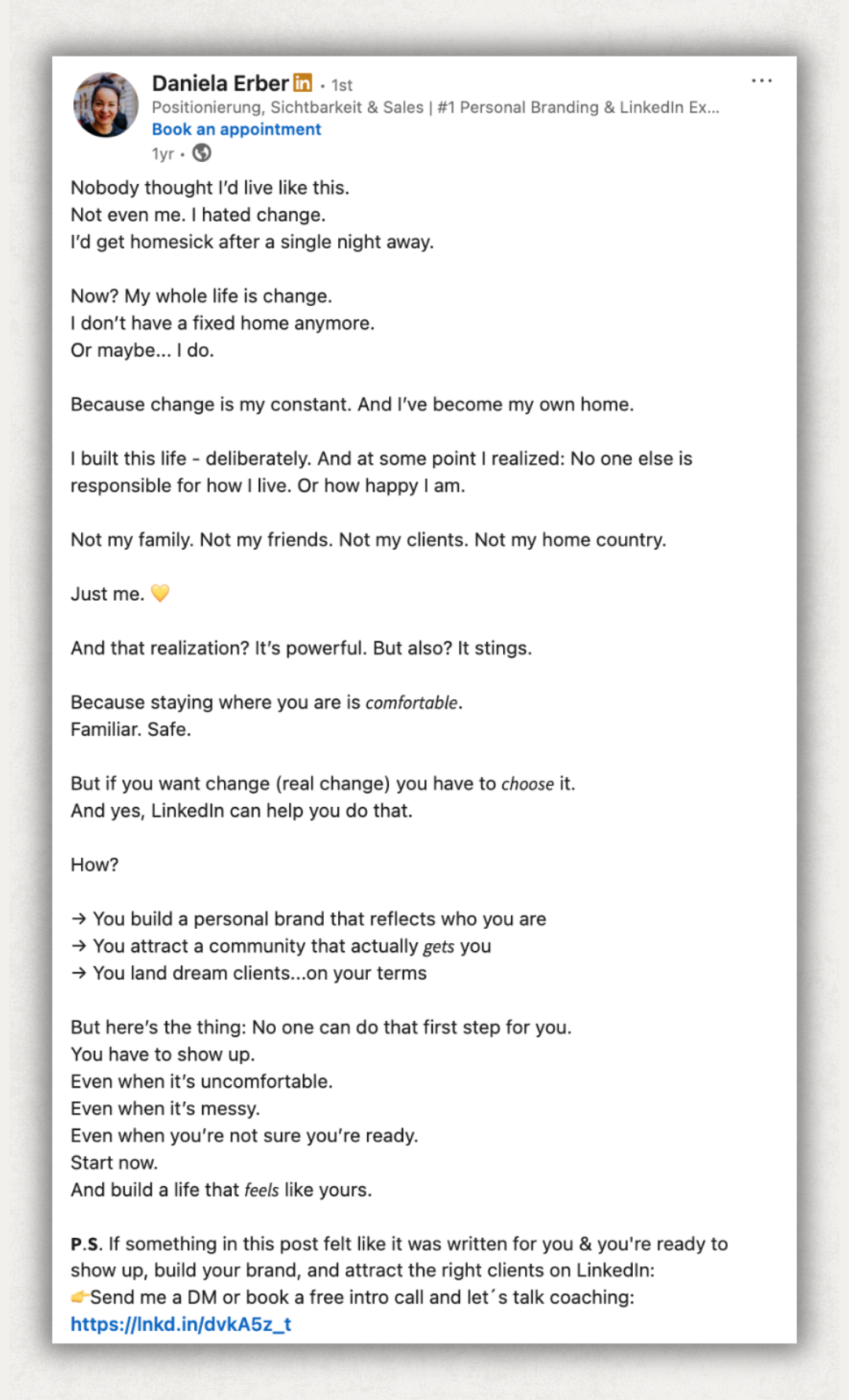
Daniela Erber covers years, not months:
"Nobody thought I'd live like this. Not even me. I hated change. I'd get homesick after a single night away. Now? My whole life is change."
The before and the after sit in the first four lines, so the reader has the whole arc before the explanation starts.
The second half moves toward an offer, which is the trade-off this idea carries: the further you travel from the change itself, the more the post reads as a pitch. Stop close to where the change of mind stops.
8. The thing you tell people privately
Every field has advice that circulates in DMs and does not get posted. Some of it is genuinely sensitive. Most of it is just unglamorous.
Post the unglamorous half.
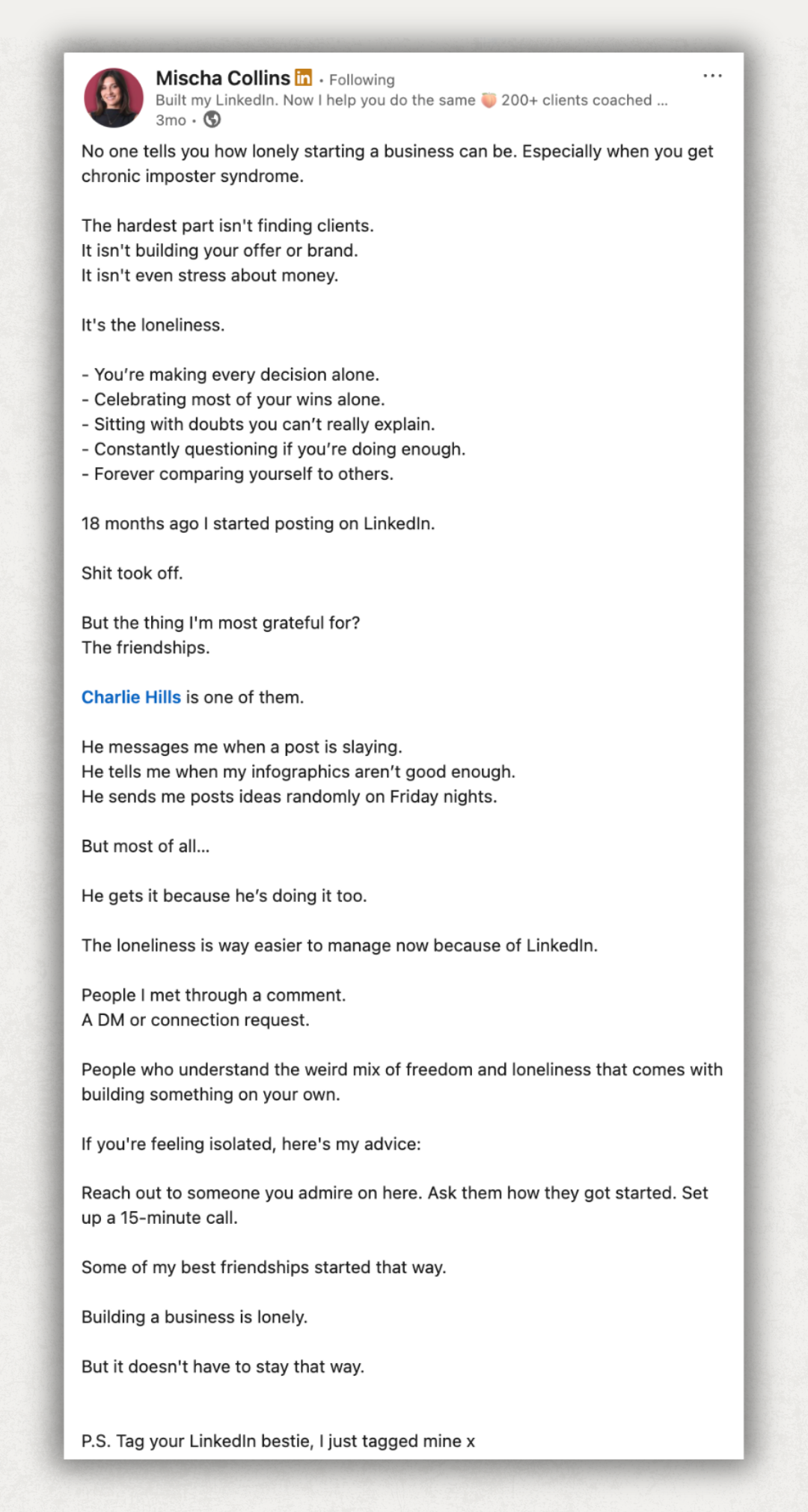
Mischa Collins opened with the line most people only say in a DM:
"No one tells you how lonely starting a business can be. Especially when you get chronic imposter syndrome."
Nothing in the post is a secret and nothing in it is glamorous: deciding alone, celebrating alone, comparing yourself to people you have never met.
Then one specific instruction, book a 15-minute call with someone you admire, which is the private-advice shape this idea is asking for.
9. A short answer to a question nobody asked you
Pick a narrow question in your field and answer it in under a hundred words. No hook, no story, no call to action.
Short posts are the format most people skip because they feel like they do not count. They count.
They are also the only idea on this list you can write while waiting for coffee, which matters more than it sounds: our posting frequency data shows consistency doing more work than any single post does.
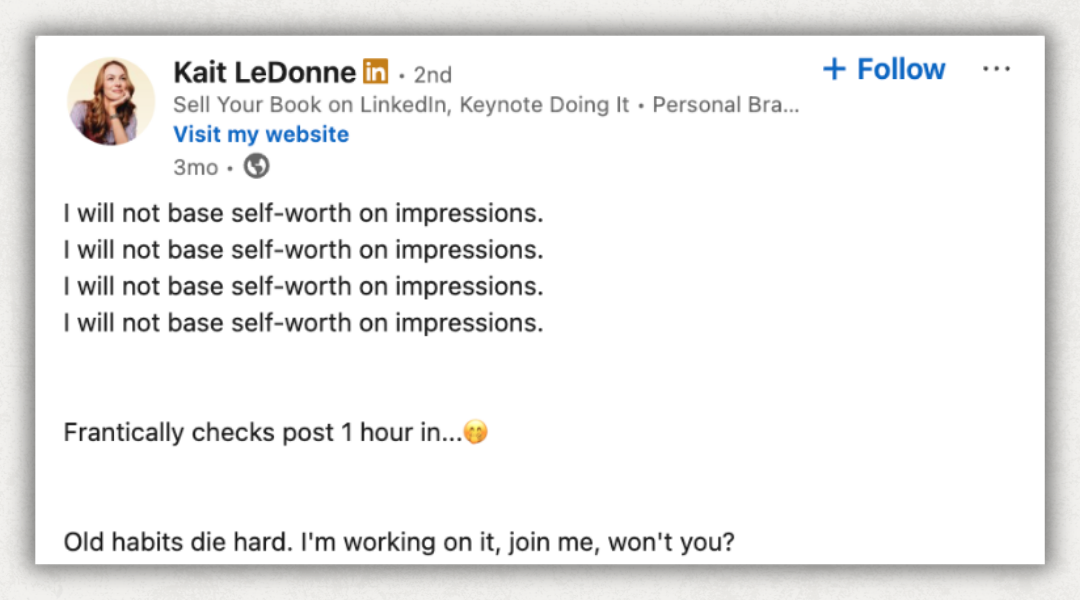
Kait LeDonne needed 46 words:
"I will not base self-worth on impressions. I will not base self-worth on impressions. I will not base self-worth on impressions. I will not base self-worth on impressions. Frantically checks post 1 hour in..."
No hook, no story, and the joke is the whole post. It works because everyone reading it has done the same thing an hour after publishing, which is the test from earlier: something a specific person would recognize as true.
3 ideas we used to recommend and no longer do
This page previously recommended all three. The data changed, and in one case the feature stopped existing.
Sharing industry news with your take
The old version of this article opened with it. Two numbers argue against it now.
Reshares return 0.29× median reach and 0.22× median engagement, the worst of any format we track.
And news commentary posted natively fell 12.5% in median reach between the second half of 2025 and the first half of 2026, the steepest year-over-year decline of any post type in our sample.
News commentary is not dead, and idea 6 above is the version of it that still works: analysis you wrote, published as your own post. What has stopped working is the reshare with a sentence on top.
Running a poll to get reach
Polls do exactly what they are advertised to do. They return 1.78× median reach, the highest multiplier of any format.
They also return 0.37× median engagement. Median engagement on a poll is 10 interactions against a median reach of 1,529 impressions. You reach a lot of people who tap a button and leave, and none of them are in your comments.
If you want the reach and you have a genuine question, run the poll. If you are running it because a growth guide told you polls perform well, you are buying a metric you cannot spend.
LinkedIn's own content guidance still lists polls among its suggestions, which is worth knowing when you read platform advice against platform data.
Giving Kudos
LinkedIn removed the feature. Kudos launched in 2019 as a way to publicly recognize a colleague from their profile, was covered as a recognition feature at the time, and quietly disappeared from profiles in early 2024 with no announcement.
The underlying idea still works. Write the post yourself, tag the person, and say what they specifically did. That was always the better version.
Turning one idea into a week of posts
Nine ideas is not nine posts. It is closer to a month, because most of these split.
Take idea 3, your process. The full sequence is a document post. Step two on its own, the one everybody gets wrong, is a short text post. The reason you built the process that way is a story post. Same raw material, three publishing days, and none of them read as repeats because the angle changes each time.
The constraint is not ideas. It is capture. Ideas arrive when you are doing the work and are gone by the time you sit down to write, so the useful habit is writing them down badly and immediately.
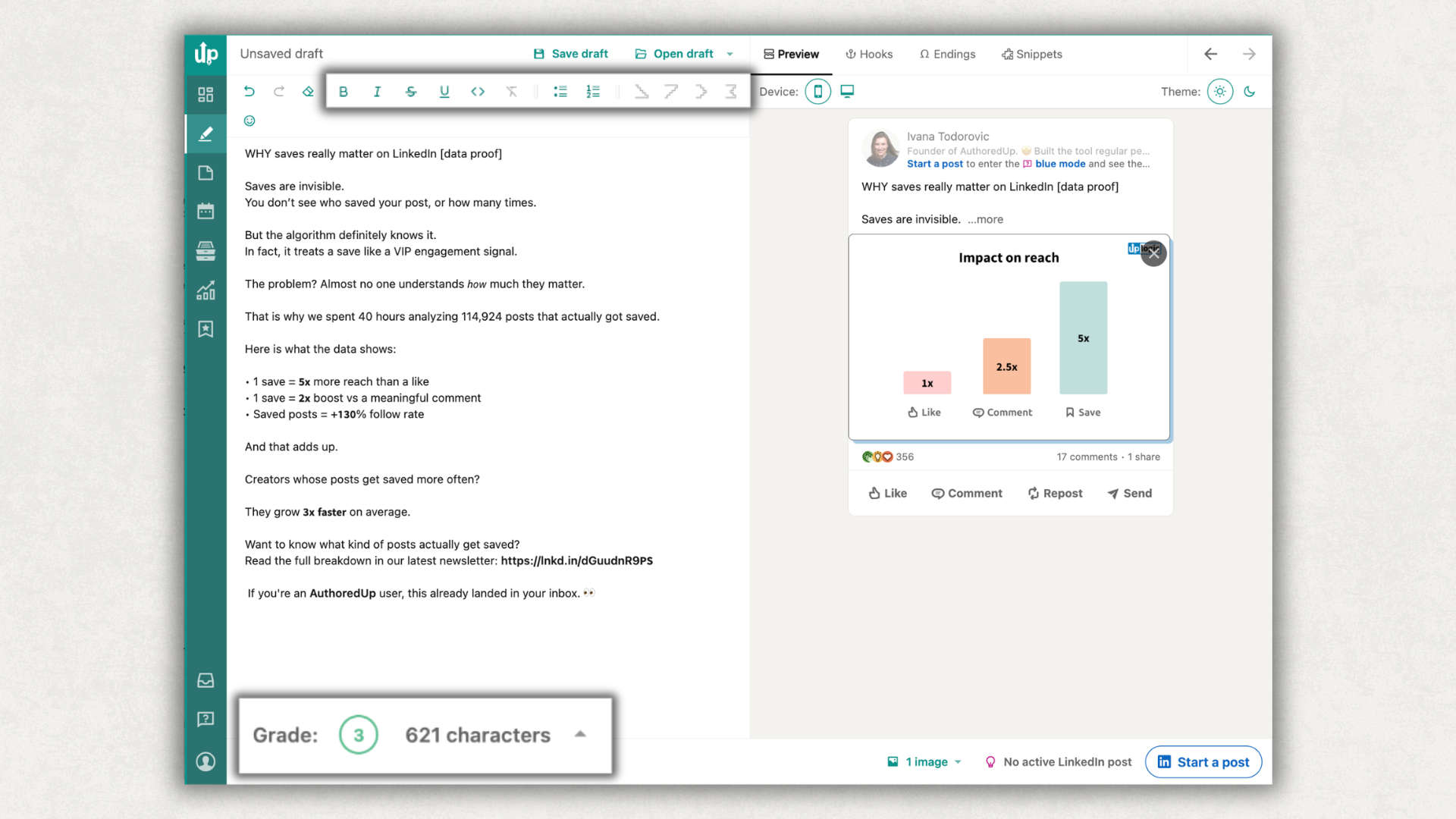
In AuthoredUp you can drop a half-formed line into Drafts the moment it occurs to you, come back when you have time to write, and schedule it once it is ready.
.png)
When you are ready to write, the editor handles the parts that make a post readable in the feed: bold and italics, line breaks, emojis, a readability score that tells you when a sentence has got away from you, and a preview of how the post will actually look on mobile before you publish it. There is also a library of 200-plus hooks and 150-plus CTAs if the opening or closing line is the part that stalls you.
If you want the week planned rather than improvised, the free weekly content mix planner turns a handful of ideas into a schedule with the formats already assigned, and you can format any of them in the free text formatter without installing anything.
Which idea to pick if you only have twenty minutes
Idea 2, the question you get asked most. You already know the answer, it needs no research, and it is guaranteed to be relevant to the people who follow you because they are the ones asking.
If you have an hour, idea 1. If you have a slow week and want something that will still be getting comments on Thursday, idea 3 as a document.
How much time do you have?
Do you have a story or an opinion ready to go?
Write this one
Jump to the idea →Pick a time, then whether you have material. The idea numbers match the list above.

Frequently asked questions
What is the 3/2/1 rule on LinkedIn?
A posting split some creators use: three posts that give something away, two that show your work, one that asks for something. It is a rule of thumb rather than a finding, and our data does not test it directly. What our data does support is the ratio's underlying instinct, since promotional posts are the only type where a clear majority of authors underperform their own average, at 39.0%.
What is the 5-5-5 rule for social media?
Five minutes engaging with other people's posts, five minutes responding to comments on yours, five minutes creating. It is a time-budgeting habit, not a LinkedIn feature, and it holds up better than most posting rules because the middle five minutes are the ones people skip. Van der Blom's 2026 research found that replying to comments within the first 30 minutes earns substantially more comments and views on the same post.
What should I say in a LinkedIn post?
Something only you can say. The nine ideas above are all built on the same test: if the post could have been written by someone who has never done your job, it will perform like a post written by someone who has never done your job. Start from a specific thing that happened to you.
What are the most popular LinkedIn posts?
By volume, images account for 57.16% of everything posted on personal profiles. By reach, polls pull the highest multiplier at 1.78× and document posts lead among formats that also hold engagement. By post type, personal stories are 26% of what gets published and the only type where most authors beat their own median. Our post statistics page has the full breakdown.
What is a good post for LinkedIn?
One that a specific person would recognize as true. Our within-author testing found that for seven of eight post types, the category made almost no difference to whether the post beat that author's average, which means the useful question is not which type to write but whether the particular thing you are saying is specific enough to be worth reading.
How often should I post on LinkedIn?
Often enough that you are choosing between ideas rather than scraping for one. The specific cadence depends on your audience and how much you can sustain, which we cover in how often to post on LinkedIn and posting on weekends.
.svg)
.png)

.svg)
.png)
.png)