

.svg)

.png)
Most lists of LinkedIn best practices are written from experience. This one is measured.
We have a dataset of more than 3 million LinkedIn posts with the full text and the engagement attached to each one, and every practice on this page is built on it.
Some of it is not what the usual advice says. Selling in a post does not cost you engagement. Carousels only start earning their reach once you pass roughly 5,000 followers. And video reaches fewer people than the median post at every follower size we measured, from 9% fewer at under 1,000 followers to 35% fewer at 20,000 to 50,000, according to AuthoredUp's analysis of 3M+ personal-profile posts.
Every number on this page comes from personal profiles in AuthoredUp's dataset, with the sample size and collection window stated next to it. Company pages are excluded throughout, because they behave differently and mixing them in flatters nothing. If you want the wider set of numbers behind this page, our LinkedIn post statistics collect them in one place.
The six practices at a glance
Each section below opens with the number and then covers what to do with it.
6 Effective LinkedIn Post Best Practices For Your Content Strategy
1. Transform Your Content into Income
Selling in a post does not cost you engagement. It earns you some.
Promotional posts, meaning posts that name an offer, a product, a service or a price, earn a 2.75% median engagement rate. Everything else earns 2.33%. That is an 18% gap in favor of the posts that sell, across 376,423 personal-profile posts from September 2025 to February 2026, filtered to posts with at least 100 impressions.
The other half of that finding is the volume. Only 4% of posts in the sample are promotional. Most accounts post about their expertise and rarely get to the ask, which is usually where the belief that content does not sell comes from. The ask is fine. It is just rare.
What your content strategy looks like still depends on what you want from it, and the two most common goals pull in different directions.
1.1. Attract Qualified Leads With Your LinkedIn Posts
If leads are the only objective, write the content that solves your target audience's problems, so that they see you as the person to call when they have one.
"How I" posts do this better than "How To" posts. A how-to can be googled. A how-I shows the work behind the result, and it is the one kind of post nobody else can write.
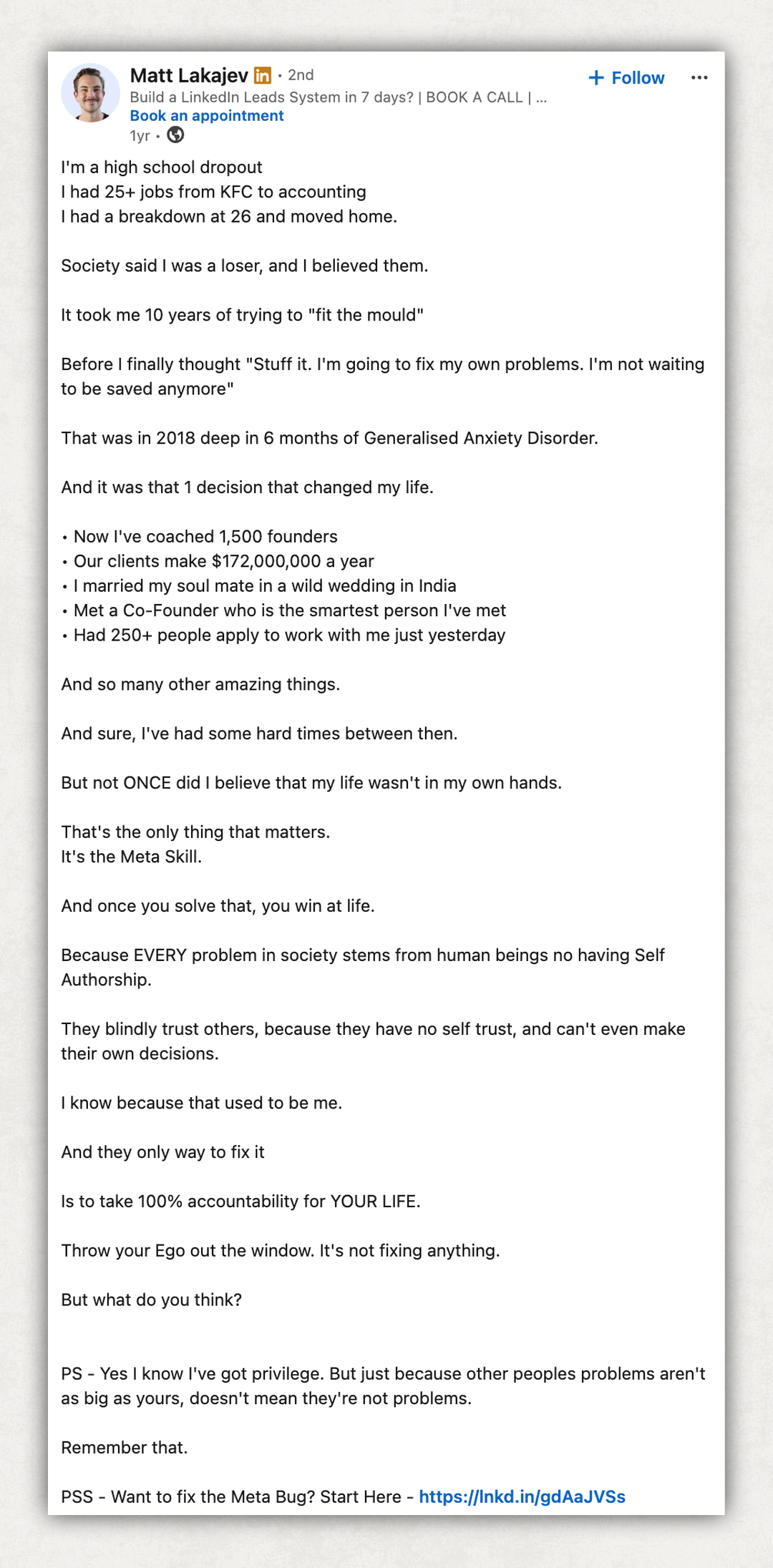
Matt Lakajev's post opens with "I'm a high school dropout" and spends almost all of its length on the decade before anything worked: more than 25 jobs, a move back home, and a decision in 2018 to stop waiting to be saved. Only after that does it get to the work he does now, coaching founders, and the offer itself is tucked into a postscript.
One detail from the dataset worth applying to every post in this section. Hooks get shorter as they get better. First lines under 40 characters earn a 2.61% median engagement rate. First lines over 200 characters earn 2.08%, and every bucket in between sits in order, across 323,111 posts from December 2025 to May 2026.
Shorter first lines earn more engagement
Median engagement rate by length of the first line, LinkedIn personal profiles
Source: AuthoredUp data — 323,111 posts from personal LinkedIn profiles with 100+ impressions, December 2025 to May 2026. Bars are scaled to the highest value.

If you keep running out of short, specific openers, the hook library in AuthoredUp holds over 200 of them that you can edit down to your own, and our LinkedIn hook examples show what the best of them look like in the wild.

1.2. Improve Your LinkedIn Following and Brand Awareness
If you want the whole account to grow rather than a lead this week, you need a content funnel. Wide posts draw the audience, narrower posts show your expertise to the part of it that matters, and the narrowest posts turn that into leads.
The top of the funnel is the content most people can relate to or learn from. Stories from your own experience belong here, told for the lesson rather than the applause, which is the difference between a story and a boast.
The middle of the funnel is where you narrow to your industry or niche: your take on a trending topic, a lesson that only makes sense to people who do your job, advice on a problem your niche shares.
The bottom of the funnel is the offer. Case studies and success stories work here, and the format that works is "I achieved [result] through [service] in [time frame], and this is how." The "how" is what separates an offer people read from an offer people scroll past.
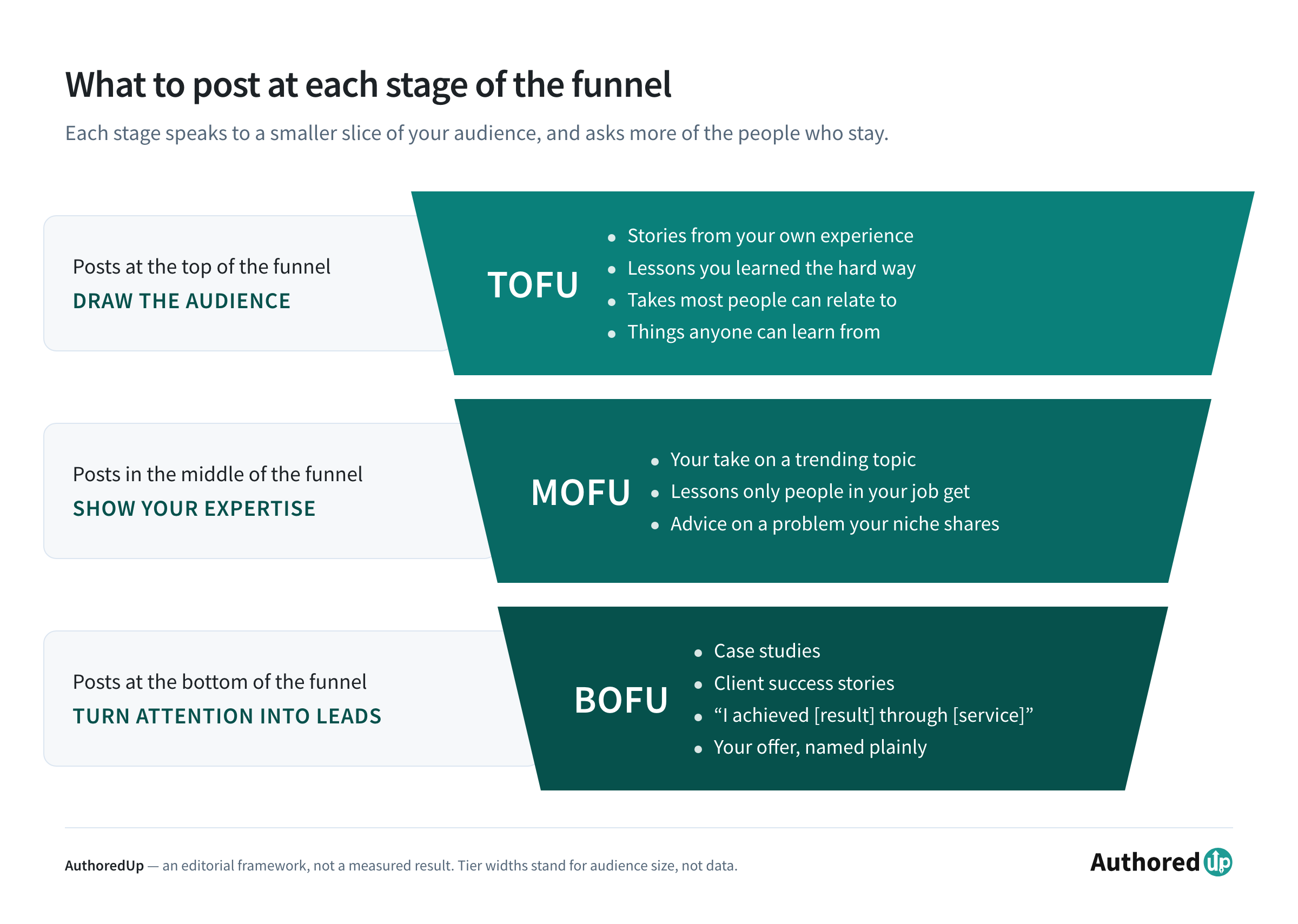
There is no fixed ratio between the three tiers that the data supports. What it does say is that promotional posts are 4% of everything published and outperform the other 96%, which means most accounts are running the bottom tier far leaner than they need to.
2. Write Personal Stories
Of the six practices, this is the one the dataset backs most clearly.
We classified the opening line of 309,614 posts by style, December 2025 to May 2026, posts with at least 100 impressions:
Story openers beat the average statement opener by 15% and the question opener by 20%. Only 7% of posts use one. The most common style, the plain statement, is also one of the weakest.
Personal stories still make some people uneasy on LinkedIn, on the grounds that they are not business content. The numbers say the audience disagrees. A story that is told for its lesson, that resonates, teaches something, and holds attention to the last line, is the highest-performing thing you can open with.
Story openers beat the average statement opener by 15% and the question opener by 20%. Only 7% of posts use one. The most common style, the plain statement, is also one of the weakest.
Personal stories still make some people uneasy on LinkedIn, on the grounds that they are not business content. The numbers say the audience disagrees. A story that is told for its lesson, that resonates, teaches something, and holds attention to the last line, is the highest-performing thing you can open with.
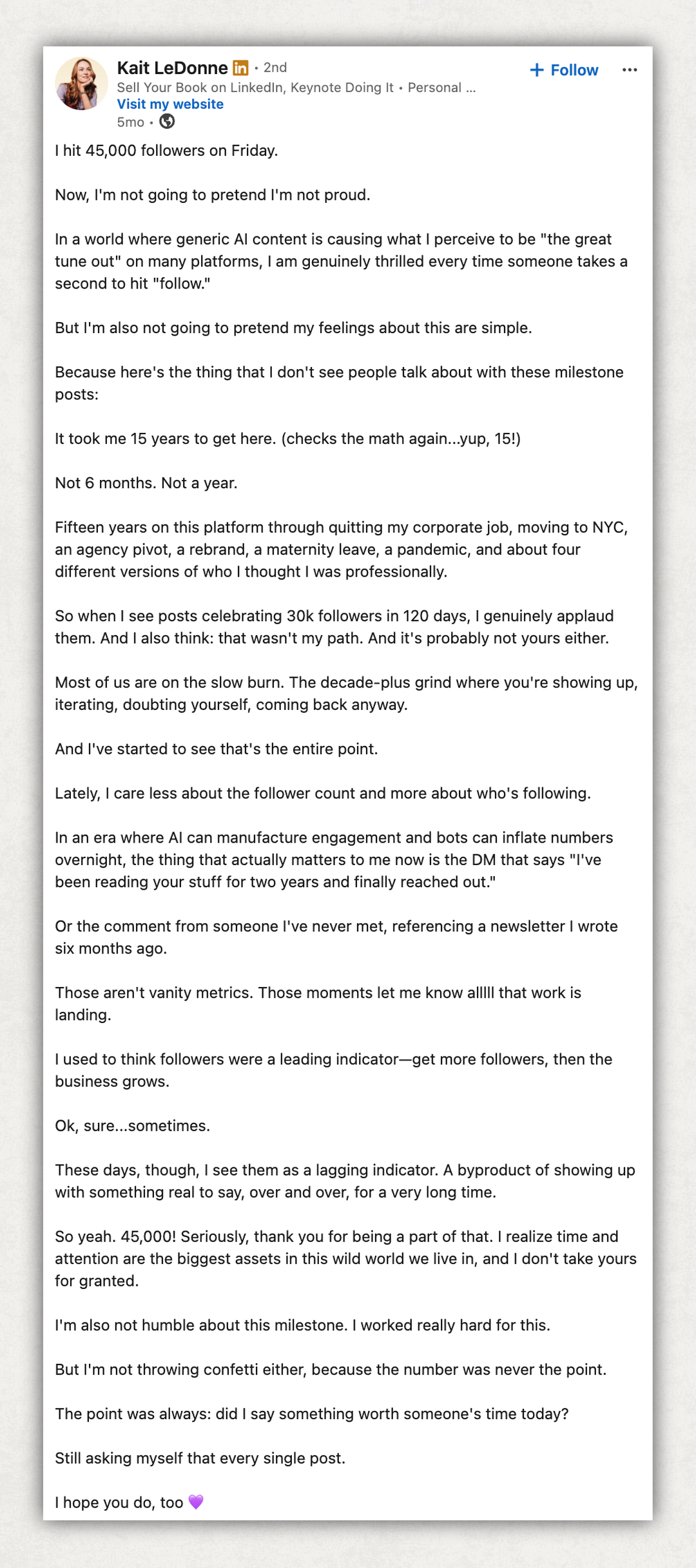
Kait LeDonne's post opens with "I hit 45,000 followers on Friday." and then declines to make it a victory lap. The story is the fifteen years the number took: a corporate job she quit, a move to New York, an agency pivot, a rebrand, a maternity leave. The lesson comes in her last lines: "the number was never the point. The point was always: did I say something worth someone's time today?"
Two smaller findings from the same cut. A closing question helps, but only just: posts that end on one earn 2.33% against 2.26% for posts that do not. And you do not need to fake a result to tell a story. "Results" hooks, the ones that lead with a number, sit fourth of five.
If you want the story to carry a number, use a real one. AuthoredUp's post comparison shows two of your own posts side by side, so the metric you quote is yours and the analytics do the bragging without you having to.
.png)
3. Create Carousels
Carousels are the standard advice for reach, and for roughly a third of the people reading this they are the right advice.
Here is median reach by format, measured against the median post in the same follower bracket, across 3M+ personal-profile posts from March 2025 to February 2026:
Read the document column top to bottom. Below 5,000 followers a carousel reaches fewer people than an ordinary image post. At 5,000 to 20,000 the two are level. Past 20,000 the carousel pulls away, and at 50,000+ it reaches half again as many people as the median post.
The explanation is probably distribution rather than the format itself. A carousel needs people to swipe, and swipes are what the algorithm reads as dwell time. A small account does not have enough early readers to generate that signal before the post stops being shown. A large one does. Our full breakdown of which formats perform on LinkedIn goes deeper on the same table.
The threshold is the whole practice. If you have more than 5,000 followers, a LinkedIn carousel is still the format that tells a story in order, shows a portfolio, breaks a complicated topic into slides and earns engagement from people who swipe. If you have fewer, post the same content as an image and a longer caption, and come back to carousels later.
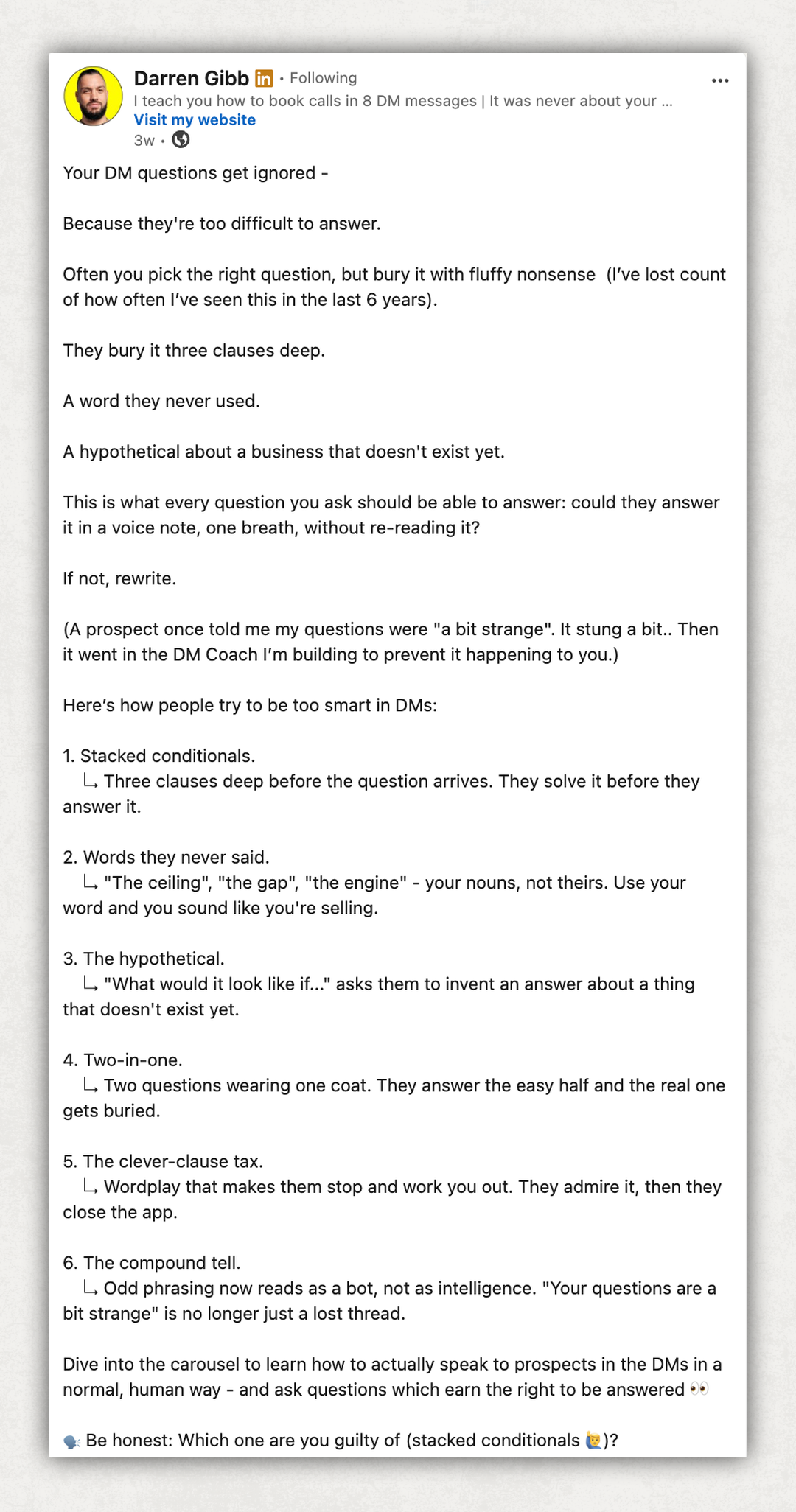
Darren Gibb's carousel opens with "Your DM questions get ignored -" and then gives away all six mistakes in the caption itself: stacked conditionals, words the prospect never used, the hypothetical, two questions wearing one coat. The slides expand each one, but a reader who never swipes still leaves with the list. His account sits at roughly 21,000 followers, inside the bracket where documents start to reach further than every other format, and the post has the shape that earns it.
A carousel does best when people save and reshare it early, so ask for the save or the repost in the caption.
4. Create Video Material
Video is the format to use with the most care. It reaches fewer people than the median post in every follower bracket, from 0.91x at under 1,000 followers down to 0.65x at 20,000 to 50,000. No other format is below the median in all five rows.
Within video posts, length works the opposite way from what most advice says:
Same 36,946 videos, same window. Short clips are the weakest kind of the weakest format, and the clips that do best are the ones long enough to say something.
So if you post video, post it because your audience wants to see you, and make it long enough to be worth the click. And write the caption as if the video were not there. Video posts with captions over 300 words earn 1.30x the engagement of the median video post, while captions under 100 words earn 0.78x, across 74,556 video posts from July 2025 to June 2026. The text is doing a lot of the work.
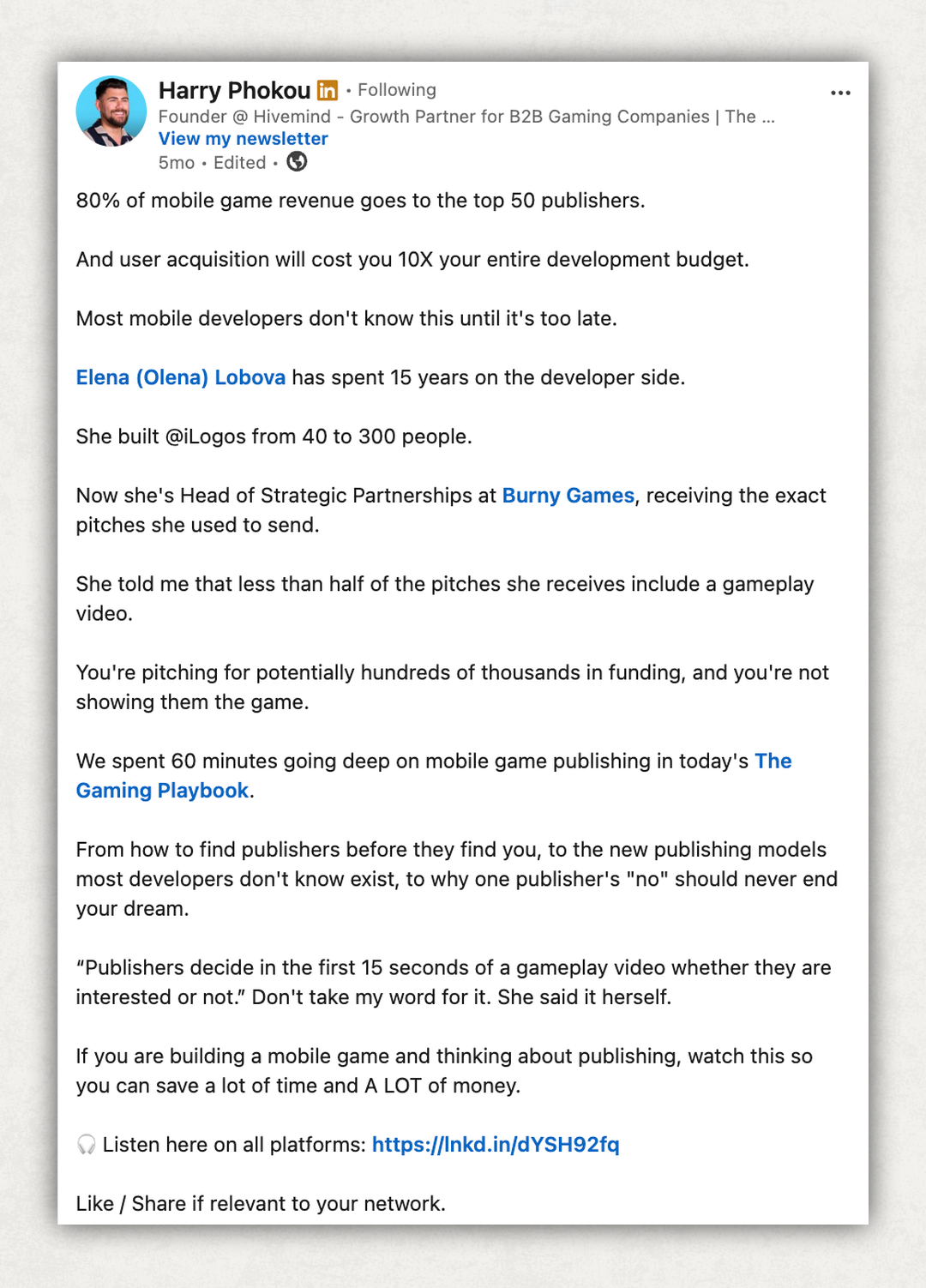
Harry Phokou's post opens with "80% of mobile game revenue goes to the top 50 publishers." and carries a video just over three minutes long, cut from his podcast. The caption does not lean on the clip. It says who the guest is, what she built, the one thing she told him that matters most ("less than half of the pitches she receives include a gameplay video"), and why that costs developers money. The video is the long version for people who want it. The caption is complete without it.
5. Use Testimonials
We do not have a testimonial-specific cut in the dataset, so this is the one practice on the page that is reasoned rather than measured. The nearest evidence points its way.
A testimonial is a promotional post by another name. It names your service, it names a result, and it asks the reader to picture themselves getting the same one. Promotional posts, as section 1 showed, earn an 18% higher median engagement rate than everything else and make up only 4% of what gets posted. That is a strong reason not to sit on the reviews you already have.
The way to use one is as a small story rather than a quote in a box. Say who the client was, what they came in with, and what changed, so the reader can answer for themselves whether the product is right for them, whether it will make a difference, and what they can expect. The "I achieved [result] through [service] in [time frame]" format from section 1 works just as well when the "I" is your customer.
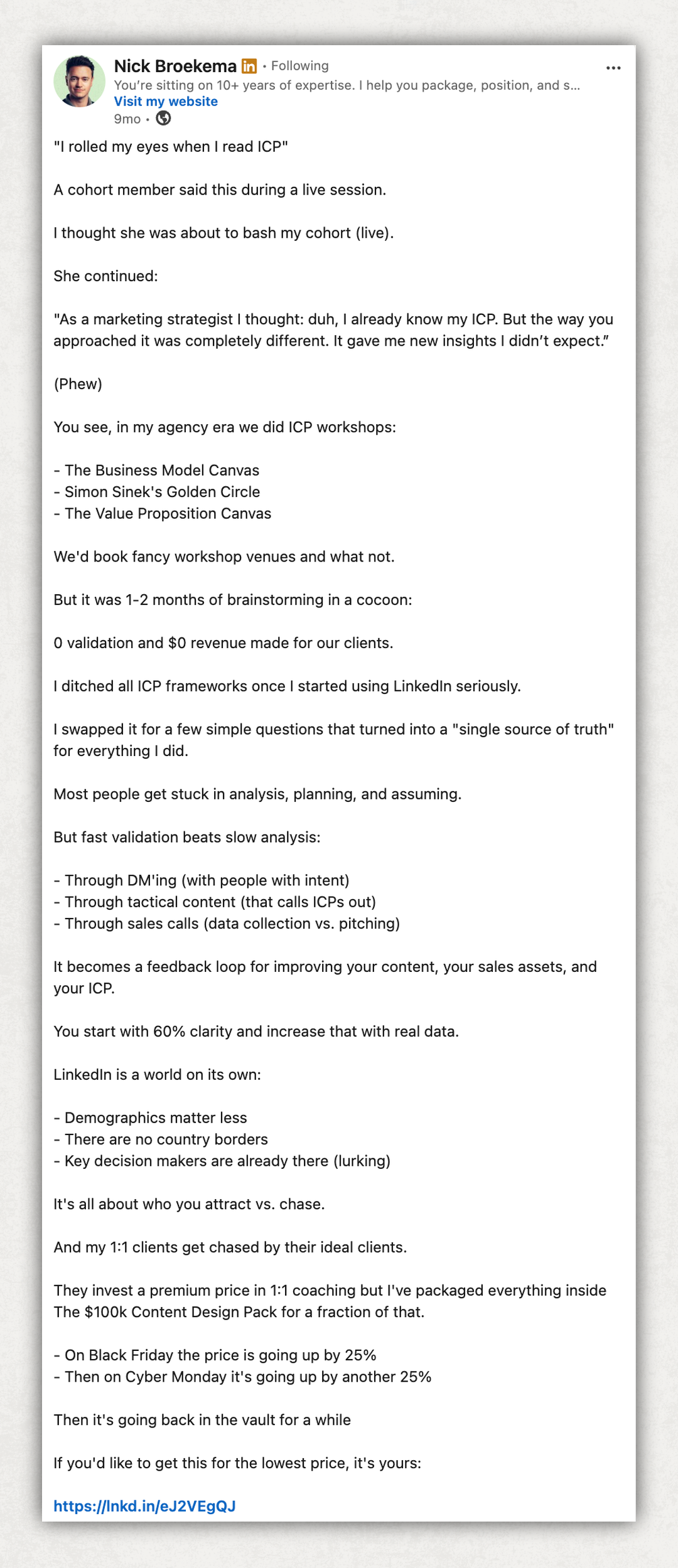
Nick Broekema's post opens on his client's words rather than his own: "I rolled my eyes when I read ICP." The rest keeps the testimonial in order. She was a marketing strategist in one of his cohorts, she arrived sure she already knew her ideal client, and she left with an approach she had not expected. The pitch for his Content Design Pack waits until all of that has been told.
6. Repurpose Old Posts
The worry behind this one is usually that LinkedIn punishes recycled or scheduled content. It does not.
Median engagement rate by format, scheduled through a tool against published by hand, across 300,994 personal-profile posts:
The largest gap in the table is 0.08 percentage points. Scheduled text posts do reach fewer people than manual ones (a median of 731 impressions against 882), which is the one place we would tell you to hit publish yourself, but there is no engagement penalty anywhere in the data for content that was planned rather than posted live.
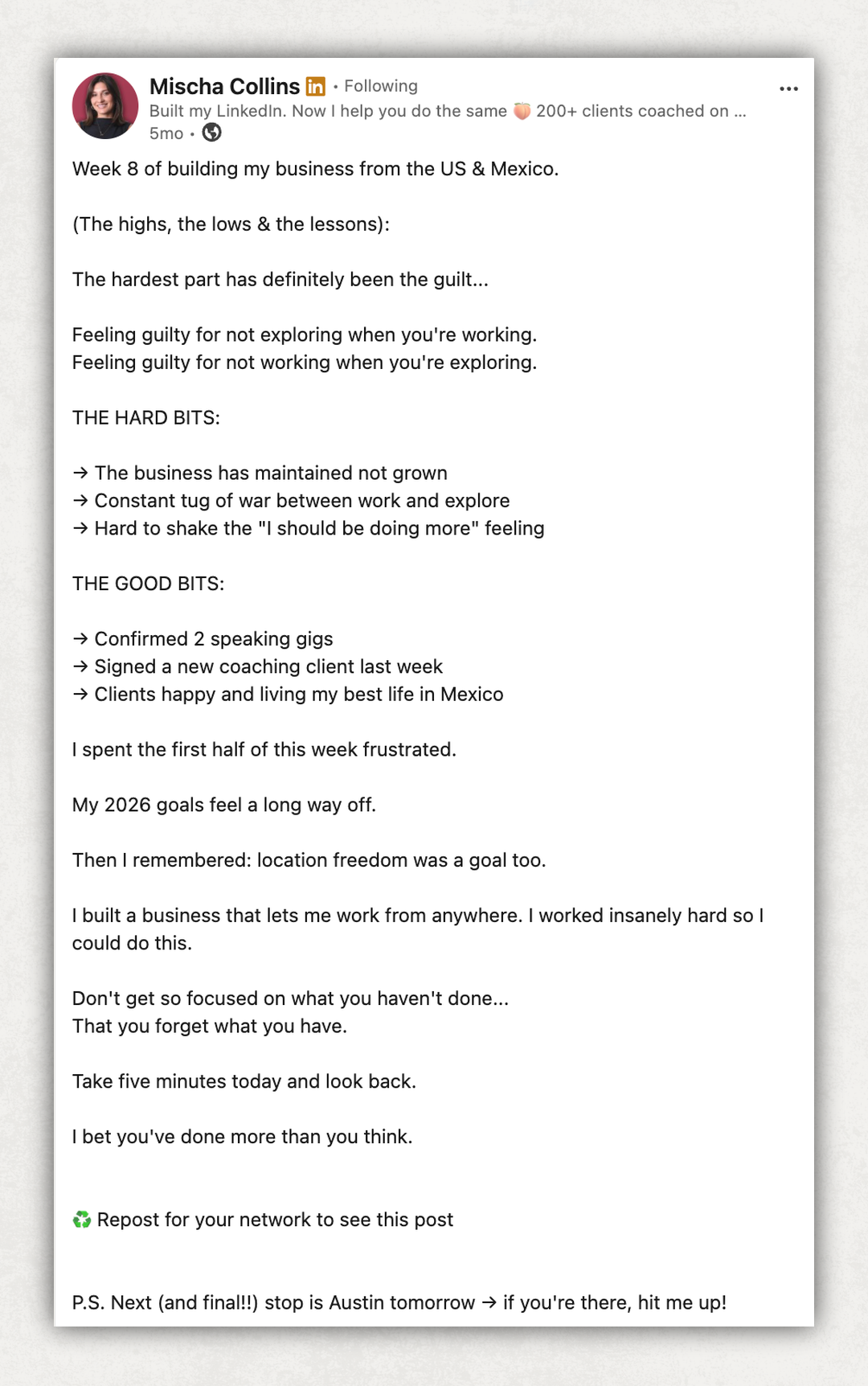
Mischa Collins' post opens with "Week 8 of building my business from the US & Mexico." and went out through a scheduler rather than by hand. The words that matter are "Week 8". The post is one installment of a series with a fixed shape, the hard bits, the good bits, the lesson, and that shape is the reused asset: built once, filled in each week, planned ahead so it publishes while she is somewhere between Mexico and Austin. That is repurposing in its most practical form, and nothing about scheduling it held it back.
Reuse freely, then. If you have been posting for a year, you have posts that did well and posts that should have done well. Most of the second kind failed at the first line, and the hook-length finding from section 1 tells you what to change: cut the opener under 40 characters and post it again. Inside AuthoredUp, the one-click reuse feature pulls the old post into the editor so the rewrite takes a minute instead of a search through your activity feed.
How to reuse a post that deserved better
The idea was fine. The first line was too long. That is the whole repair.
Find it
A post whose idea still holds up and whose numbers never did. A year of posting leaves plenty.
Count the first line
Only the opening line, up to the first break. Over 40 characters is where engagement starts dropping.
Cut it and post again
Keep the body as it is. Rewrite the opening short, then schedule it like any other post.
Over 60% of corporate influence programs fail because of one critical mistake:
Over 60% of influence programs fail.
Same idea, same post, one bucket up. Openings under 40 characters earn a 2.61% median engagement rate against 2.39% for the 41 to 80 band the original sat in.
Source: AuthoredUp data — 323,111 posts from personal LinkedIn profiles with 100+ impressions, December 2025 to May 2026. Shorter openings correlate with higher engagement; a rewrite is not a guaranteed result.
Repurposing also solves the cadence problem. Median engagement peaks at four to five posts a week (2.60%) and falls back at eight or more (2.33%), yet 68% of the 12,418 profiles we measured from December 2025 to May 2026 post once a week or less. LinkedIn's own creator guide suggests two to five posts a week; our data puts the sweet spot at the top of that range, and reusing what already worked is the cheapest way to get there. The full frequency breakdown is in our post on how often to post on LinkedIn.
Engagement rate peaks at four to five posts a week
Median engagement rate by posting frequency, personal LinkedIn profiles. Select a bar for the full breakdown.
Source: AuthoredUp data, 12,418 personal LinkedIn profiles, December 2025 to May 2026.
| Posts per week | Share of profiles | Median engagement rate | Median impressions |
|---|---|---|---|
| 1 | 68.47% | 2.40% | 700 |
| 2 to 3 | 22.31% | 2.50% | 831 |
| 4 to 5 | 6.48% | 2.60% | 924 |
| 6 to 7 | 1.87% | 2.41% | 1376 |
| 8 or more | 0.86% | 2.33% | 1420 |
Bonus: LinkedIn Post Quality Checklist
Run every post through this before you publish. The numbers come from 709,206 personal-profile posts, July 2025 to June 2026.
Content Focus
Read the first line on its own. Is it under 40 characters, and does it make the second line worth opening? That single cut is worth more than anything else on this list.
Then read the ending. A closing question helps slightly, so add one if a simple one exists, and skip it if you would be forcing it.
Then cut. Every sentence that does not add an example, a number or a step goes, which is a different thing from cutting the post short.
Metrics to Monitor
Length
Engagement rises with length on every format, and the 200 to 300 word range is where all four main formats cross their median. The common advice of 700 to 950 characters sits below the median until its top end (0.83x to 0.93x on image posts). Write past 100 words, and do not fear 300.
Reading time
Posts that take 60 to 120 seconds to read out-earn the 30 to 60 second bucket on every format, by 15% to 43% depending on the format and the bucket, and posts under 30 seconds are the weakest bucket everywhere. Under a minute is not a target.
Readability
Posts scoring under 4 earn the highest engagement on every format (1.27x to 1.44x the format median), scores of 4 to 7 sit at the median, and past 10 every format loses 30% or more of its engagement. Aim under 7, and under 4 when the topic allows. Our readability score explainer covers what moves the number.
Emoji
One is enough. Zero emoji earns 2.30% median engagement, one earns 2.47%, and everything from two to fifteen sits between 2.46% and 2.56%, across more than 840,000 posts. The gain is real, and it is entirely in the first one.
Mobile preview
Most of your readers are on a phone. Check the line breaks and the "see more" fold before you post. In AuthoredUp you see the mobile and desktop preview side by side, with the character count, reading time and readability score next to it.
Longer posts earn more engagement, on every format
Engagement against the median post of the same format. 1.00x is that format's own median.
| Under 100<100 | 100–200100–200 | 200–300200–300 | 300–400300–400 | 400+ words400+ | |
|---|---|---|---|---|---|
| Image | 0.73x | 0.90x | 1.10x | 1.20x | 1.40x |
| Text only | 0.79x | 0.93x | 1.14x | 1.29x | 1.57x |
| Video | 0.78x | 1.00x | 1.26x | 1.30x | 1.96x† |
| Document | 0.72x | 0.96x | 1.24x | 1.44x | 1.46x |
Source: AuthoredUp data — 702,562 posts from personal LinkedIn profiles, July 2025 to June 2026. Each multiplier is measured against the median post of that same format, so read along a row and not down a column. †Video over 400 words is the one bucket the source marks moderate rather than strong reliability (1,681 posts); treat 1.96x as directional.
Frequently asked questions about posting on LinkedIn
What is the 3-2-1 rule on LinkedIn?
The 3-2-1 rule is a weekly content mix: three posts that share industry insight or someone else's useful content, two posts about your own work or wins, and one post that directly promotes what you sell. It is a reasonable default for a new account, and it has one problem our data exposes: the promotional post is the one people drop first, and promotional posts earn an 18% higher median engagement rate than the rest. If you follow the rule, keep the one.
What is the most effective way to post on LinkedIn?
Open with a first line under 40 characters, tell a story rather than asking a question, write more than 100 words, attach an image if you have fewer than 5,000 followers and a carousel if you have more, and post four to five times a week. Each of those has a table on this page behind it. The full writing routine is in our guide to writing a LinkedIn post that gets results.
What type of LinkedIn post gets the most engagement?
For accounts under 5,000 followers, image posts, at 1.06x to 1.10x the median reach and 1.16x to 1.18x the median engagement of their bracket. For accounts over 20,000 followers, document posts (carousels), at up to 1.49x median reach. Video is the weakest format at every account size. Polls are the odd one out: strong on reach in the 5,000 to 20,000 bracket, weak on engagement everywhere.
What is the 5-5-5 rule for social media?
The 5-5-5 rule is an engagement routine rather than a posting rule. The most common version is to leave five thoughtful comments on other people's posts, reply to five comments on your own, and send five direct messages a day. It is not something our dataset can score, because it measures posts rather than comments, but it fits the frequency finding. Accounts that post four to five times a week and show up in the comments between posts are the ones the reach numbers favor.
What is not appropriate to post on LinkedIn?
Anything you would not say at work in front of a client: partisan politics, private grievances, content that exists to bait reactions, and anything that breaks LinkedIn's Professional Community Policies. Most "don't" lists then add a dozen softer rules, and when we checked those against 360,000 posts, three of them turned out to be myths. That check is in our post on what not to post on LinkedIn.
How many hashtags should you use on LinkedIn?
None, or at most one. LinkedIn removed hashtag following in late 2024, and in Richard van der Blom's Algorithm Insights research, which AuthoredUp contributes data to, posts without hashtags now outperform posts with them by 5 to 10%. Use a hashtag when it labels a series you run. Do not use one for reach.
Wrapping It Up
Most LinkedIn advice is written from what works for large accounts and handed to everyone. The six practices above hold across follower sizes, with the one threshold that matters stated where it applies: carousels earn their reach above 5,000 followers, and video is the format to use least and make longest.
The routine for writing a single post, line by line, is in our guide to tips for writing a LinkedIn post. Turning posting into a personal brand is a months-long version of the same six practices.
Where to start
If you want one change rather than six, cut your first line under 40 characters. It is the finding with the clearest curve behind it, it applies to every format, and it takes a minute.
If you want a second, write past 100 words and post four to five times a week. Between them those two cover most of the distance between the median post and the top rows of the tables above.
The writing is the part no tool does for you. Everything around it you can hand to AuthoredUp: the character count, reading time and readability score update while you type, formatting that survives the mobile fold, a preview that shows where the "see more" cut lands on desktop and on a phone, and a library of over 100 calls-to-action for the bottom-of-funnel posts where the ask has to be specific.
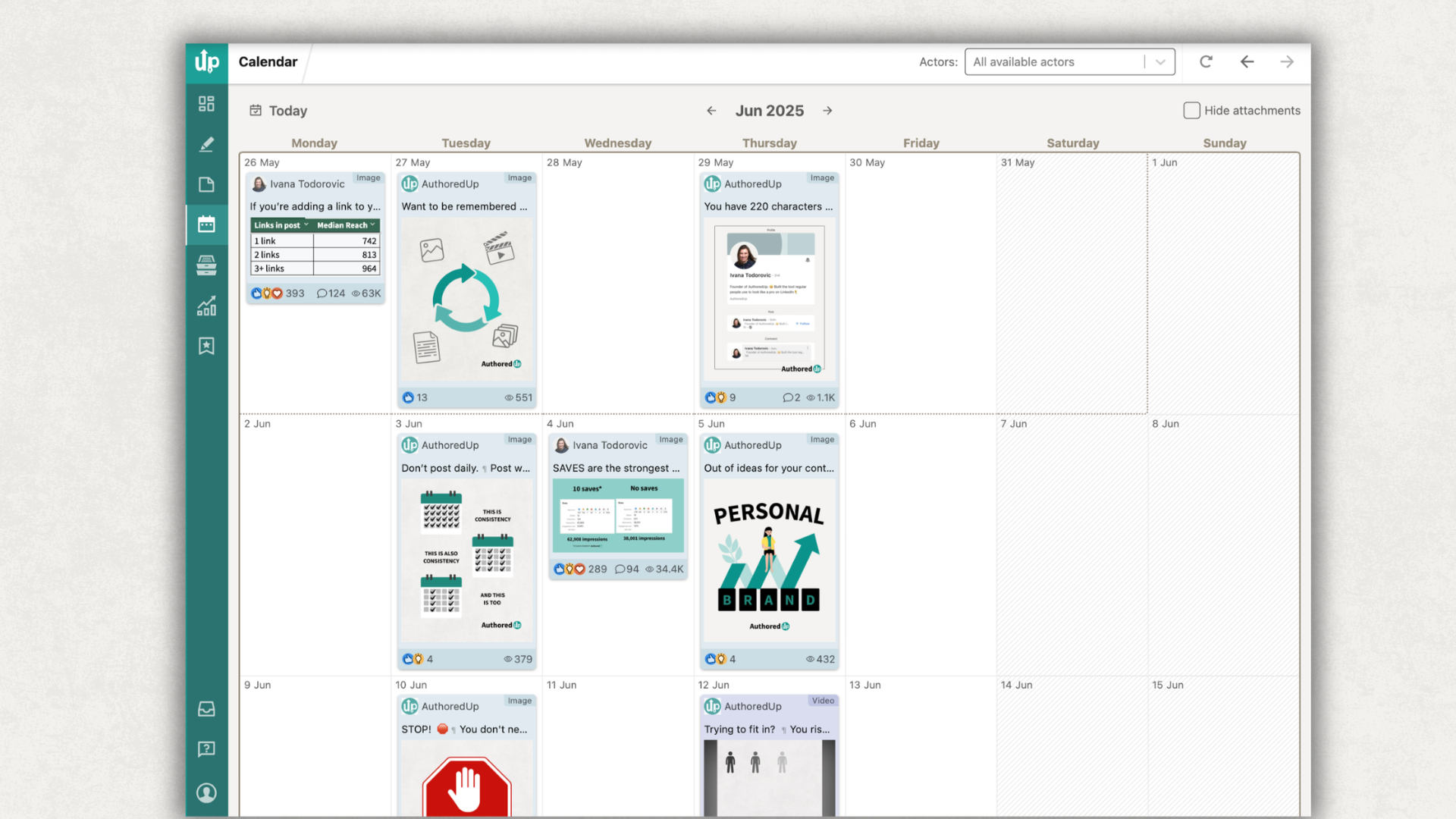
Scheduled posts land on the calendar automatically, and since scheduling costs you nothing in engagement, planning a week in one sitting is how most people get from one post a week to four.

Keep Learning
What to Post on LinkedIn - 13 LinkedIn Post Ideas
What Should You Not Post on LinkedIn? 12 Mistakes Checked Against 360K Posts
What Makes a Post Go Viral on LinkedIn and How You Can Make Yours Go Viral Too
.svg)
.png)

.svg)
.png)
.png)