

.svg)


Your Connection Count Is Not Your Reach
You can grow a LinkedIn network fast. Send fifty requests a day, accept everything that comes in, and the number climbs.
The number climbing is not the same as more people seeing your work.
We pulled 664,688 posts from 15,507 personal profiles, grouped them by how many connections the author had, and looked at what actually changed as those networks got bigger. Reach went up. It kept going up the whole way, from a median of 305 impressions per post to 2,127.
The share of the network that engaged went the other direction. It peaked early, at somewhere between 501 and 1,000 connections, and then fell for every band after that.
So more connections do buy you reach. What they stop buying, quite early, is engagement. Most advice on this topic treats those two things as the same thing, and the gap between them is where people waste years.
What a bigger network is actually worth
Here is the whole dataset in one table. Personal profiles only, August 2025 through July 2026, posts with more than 100 impressions.
Read the two columns against each other and you get the finding.
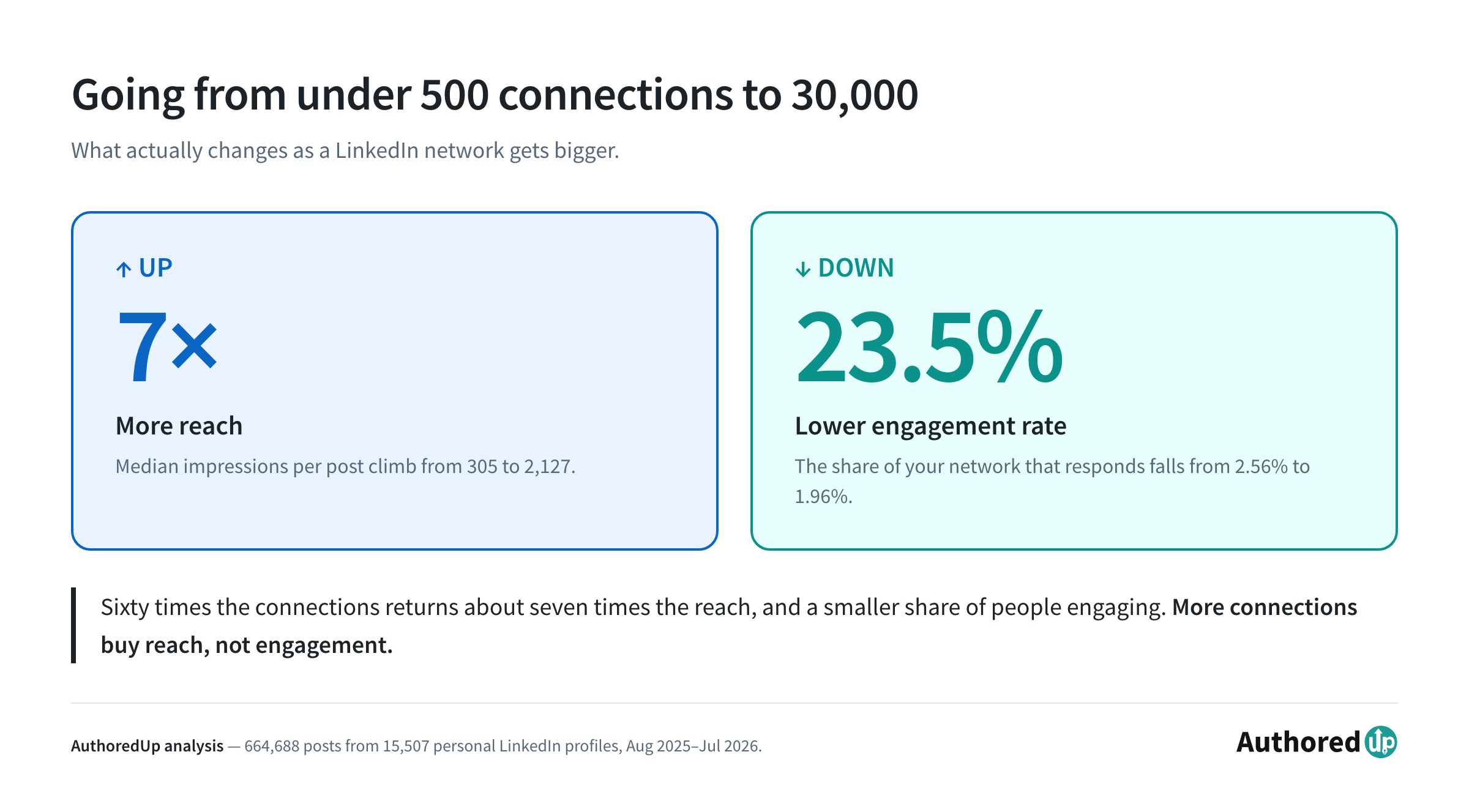
Going from 500 connections to 30,000 is roughly sixty times the network. It returns about seven times the reach. Every connection you add is worth less, in reach, than the one before it, and the drop-off is steep rather than gentle.
Meanwhile, the engagement rate falls 23.5% from its peak. At 501–1,000 connections, 2.56% of the people who saw your post did something about it. Above 20,000, that is down to 1.96%.
More connections buy reach, not engagement
664,688 posts from 15,507 personal LinkedIn profiles, grouped by the author’s connection count. Hover or tap any band.
AuthoredUp analysis of 664,688 posts from 15,507 personal profiles, Aug 2025–Jul 2026. Company pages and groups excluded; posts under 100 impressions excluded. Engagement rate axis starts at 1.8% to make the change legible.

What that means for you depends entirely on which number you need. If you want the largest possible audience, keep growing and accept that each addition does less work. If you want a network that responds when you post, you hit that quality somewhere under 1,000 connections, and it does not get better after.
The one stretch where both numbers improve
LinkedIn caps first-degree connections at 30,000, so that final band is the top of the range rather than an arbitrary cut-off. There is exactly one place in that table where reach and engagement rate rise together: the move from under 500 connections to the 501–1,000 band. Engagement rate goes from 2.41% to 2.56%. Median impressions go from 305 to 397.
After 1,000, the two come apart and never rejoin.
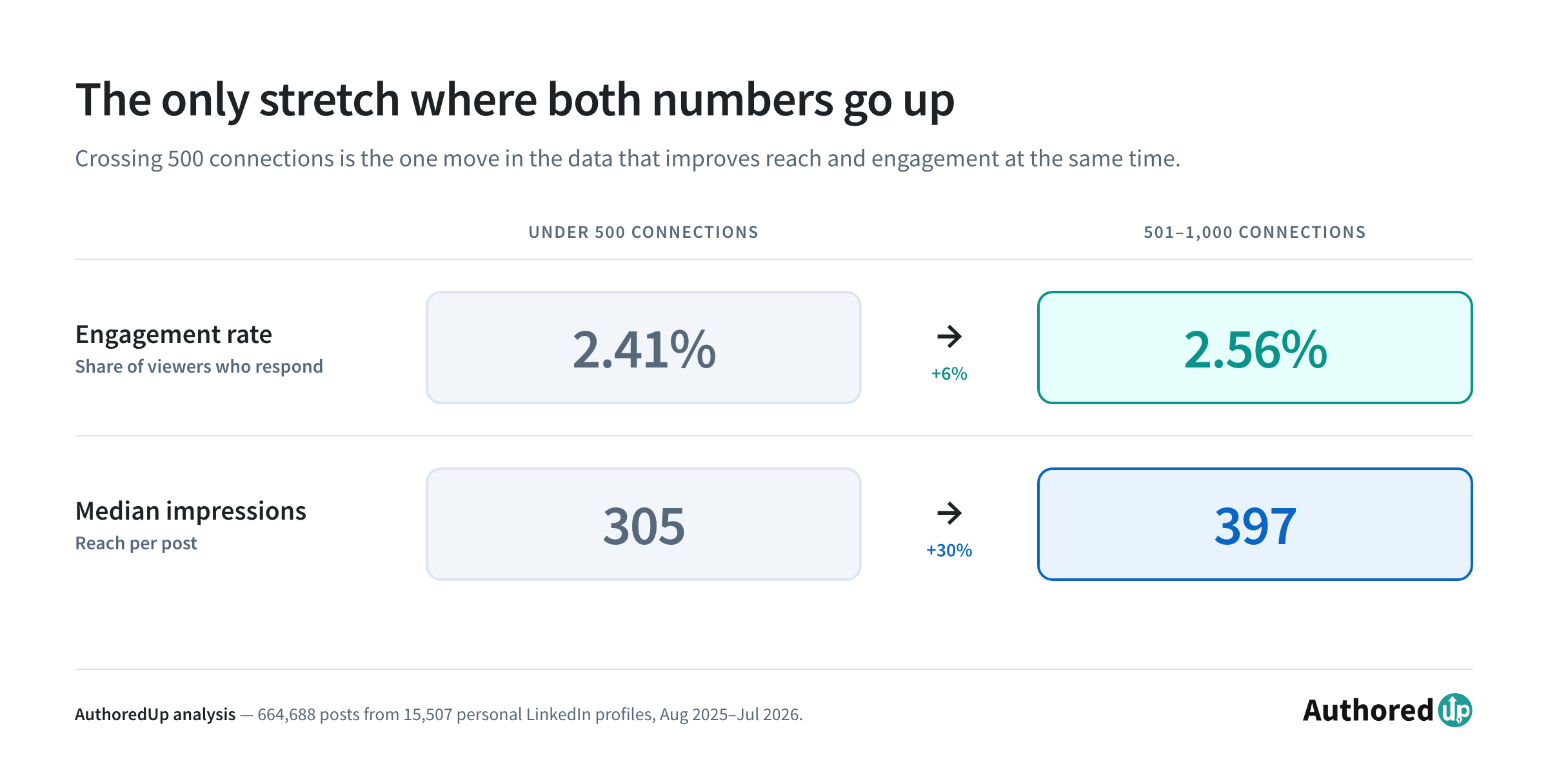
This answers a question people ask constantly, which is whether 500+ connections is a threshold worth caring about. On our data, yes, and it is the only one. Crossing 500 is associated with about 30% more reach per post and better engagement. Crossing 5,000 buys reach at the cost of engagement rate. Crossing 20,000 buys more reach at a steeper cost.
If you are under 500 today, growing your network is genuinely the highest-value thing you can do. If you are past 1,000, it has already stopped being your bottleneck.
The number to watch instead of the count
Connection count is easy to see, which is most of why people track it. It is also close to useless as a measure of whether your LinkedIn presence is working.
Engagement rate is the one to replace it with. It tells you what share of the people reached actually reacted, commented, or reposted, and unlike the connection count it responds to what you write.
The band medians above give you a benchmark to check yourself against. If you have 3,000 connections and your posts land at 2.5%, you are at the median for your size. At 4%, you are in the top quarter.
Work out your own with the free engagement rate calculator below. Enter the numbers from one post and compare the result against your band in the table above.
Calculate your engagement rate
The metrics worth tracking covers what else belongs alongside engagement rate.
One warning about comparing yourself to big accounts. The 20,001–30,000 band has a median engagement rate of 1.96%, which is below the 2.41% of people with fewer than 500 connections. When you look at a large account and feel behind, you are often looking at someone whose audience responds less than yours does. They have more reach, not better content.
Your network grows because people see you
The mechanism nearly every guide on this topic gets backwards: connections do not produce reach so much as reach produces connections. People connect with you after your post turns up in their feed, not before.
Which makes posting the actual growth lever. We looked at what different posting frequencies do, across the same dataset.
Four to five posts a week is the peak for engagement rate, and reach keeps climbing a little past that. Then at eight or more per week both fall away together. Engagement rate drops to 1.79% and reach falls to 586, which is below what people posting once a week get.
That last row is the same shape as the connection table. Past a certain point you are adding volume and losing the response, and the extra effort is working against you rather than just failing to help.
Four to five posts a week is the ceiling, not more
Median engagement rate and median impressions per post by posting frequency, personal LinkedIn profiles. Hover or tap any bar.
AuthoredUp internal data, personal LinkedIn profiles. Company pages and groups excluded. Engagement rate axis starts at 1.6% to make the differences legible; the impressions axis starts at zero. The 8+ per week bucket is under 1% of profiles, so treat it as directional.
The useful part of the table is the second column. Nearly 80% of profiles post once a week or less. If you are in that group you are nowhere near the ceiling, and moving to two or three posts a week costs very little while sitting inside the range where both numbers are still improving. How often to post on LinkedIn goes further into the cadence question.
Four things that actually work under 1,000 connections
The tactics below survived contact with the data above. They are ordered by what our numbers support, not by how commonly they are recommended.
1. Post two to three times a week before you do anything else. If you are in the 80% posting once a week, this is the biggest available move, and the frequency table shows both engagement rate and reach improving as you go.
2. Connect with people who engaged with your posts. They have already seen your work and responded to it, which makes the request make sense. LinkedIn lists several routes to connect beyond the profile button, and its own guidance on acceptance rates points the same way ours does. This is the direction that matters: post first, connect second.
3. Comment where your audience already is. Reach begets connections, and comments on other people's posts are reach you can get without waiting for the algorithm to pick you.
4. Write a headline that explains why connecting is worth it. Your headline is what someone reads when they decide whether to accept. Writing a LinkedIn headline covers the specifics.
.png)
Notice what is missing. Nothing here involves sending bulk requests to strangers.
What stopped working
Hashtag strategies
LinkedIn removed the ability to follow hashtags, which took away the mechanism that made them work for discovery.
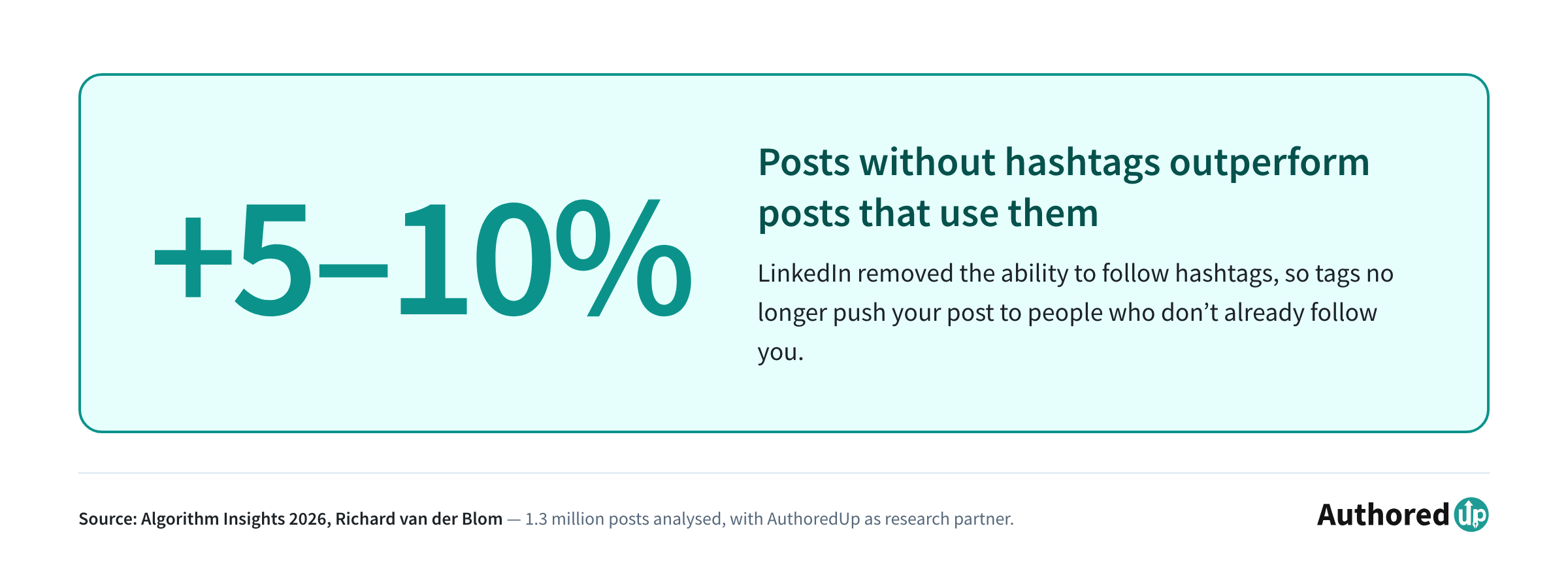
Posts without hashtags now tend to outperform posts with them by 5 to 10%, according to Algorithm Insights 2026, Richard van der Blom's study of 1.3 million posts that we act as research partner on.
Any guide still telling you to add thirty hashtags to reach new people is describing a version of LinkedIn that no longer exists.
Automation and connection bots
These are the most-recommended tools on this topic and we do not suggest them, which is a positioning choice as much as a practical one.
LinkedIn restricts automated activity, publishes invitation limits that bulk tools are built to push against, and account restrictions are a real outcome.
The data reason is separate and more interesting: since reach is what produces connections rather than the reverse, bulk-adding strangers grows the number without growing the thing the number was supposed to represent.
You end up with a larger network and a lower engagement rate, which is the wrong side of every trade in the first table.
Chasing 500+ as a status marker
The threshold is real in our data, but for reasons no one states. It matters because it is the last point at which reach and engagement improve together, not because of the badge.
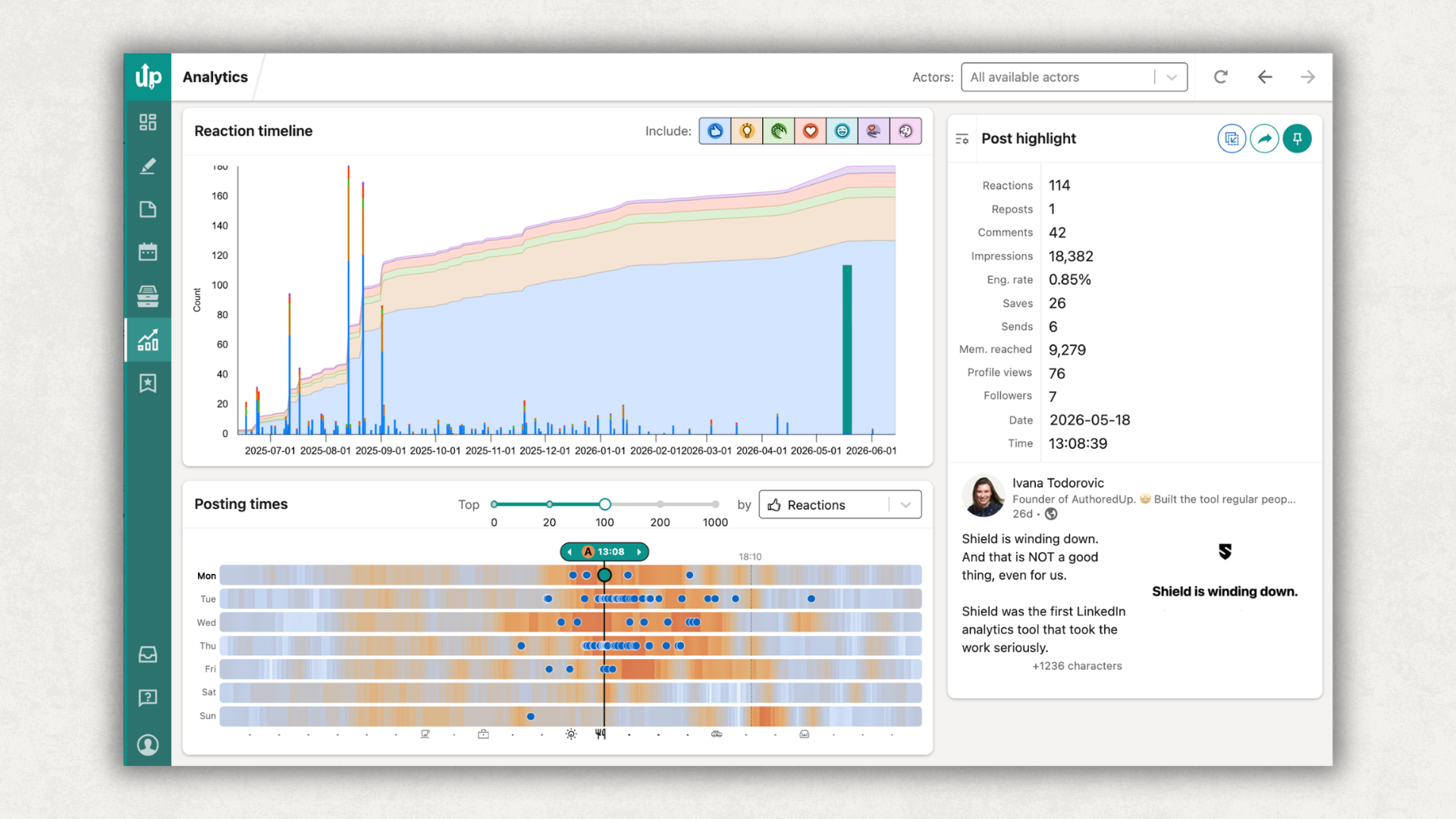
If you want to see which of your own posts drive profile visits and new connections, AuthoredUp's analytics show performance per post over time, so you can tell which pieces did the recruiting.
Understanding how the algorithm decides reach helps you read those numbers, and our post statistics breakdown has the wider benchmark set.
Growing a network is one part of a bigger picture. Building a LinkedIn content strategy puts the posting side together, and if follower count is the number you care about, growing your followers covers that separately.
Frequently asked questions
How can I get 500+ connections faster on LinkedIn?
Post more often and connect with the people who engage. Our data shows profiles posting two to three times a week get a median 741 impressions per post against 679 for weekly posters, and every one of those extra readers is a possible connection. Importing your existing contacts is the fastest legitimate one-off move. Bulk requests to strangers get the number up quickly and put your account at risk.
Is having 500+ connections on LinkedIn good?
Yes, and it is the one threshold our data supports. Moving from under 500 to the 501 to 1,000 band is the only point where median engagement rate and median reach improve together, going from 2.41% to 2.56%, and 305 to 397 impressions. Past 1,000 connections, reach keeps rising but engagement rate falls the rest of the way.
How to get a lot of LinkedIn connections fast?
Fast growth and useful growth are different goals. You can add thousands quickly by accepting everything, and our data shows what you get: profiles in the 20,001 to 30,000 band have a median engagement rate of 1.96%, below the 2.41% of profiles with under 500 connections. If you want reach, growing works. If you want an audience that responds, it does not.
What happens if you get 1,000 connections on LinkedIn?
Nothing changes on the platform, but our data shows it is roughly where the returns shift. Below 1,000, more connections improve both reach and engagement rate. Above it, median impressions keep climbing to 2,127 at the top band while engagement rate falls to 1.96%. You are still gaining reach, just not resonance.
What is the 4-1-1 rule on LinkedIn?
A sharing guideline: for every promotional post, share one update about someone else and four pieces of genuinely useful content. It is a convention rather than a platform rule, and there is no LinkedIn mechanism enforcing the ratio. The instinct behind it holds up, which is that a feed of pure self-promotion gives people little reason to stay connected.
.svg)
.png)

.svg)
.png)
.png)
