


.svg)


LinkedIn's standard post editor has no formatting toolbar. No bold button, no Ctrl+B, no rich text menu. You type plain text and that's what gets published.
Yet you see bold text in posts every day. Someone's using it. The trick is knowing how — and which method actually works for what you're trying to do.
There are three ways to bold text in LinkedIn posts. This guide covers all of them: where each one works, what to avoid, and how to handle bold on mobile.
You can bold your text right here, right now:
Why Bold Text Matters on LinkedIn
The average person scrolls through hundreds of posts per day. Most look identical: solid blocks of grey text with no visual breaks. Bold text gives your reader something to grab onto.
When you bold a key phrase, you create a visual anchor. Someone scanning quickly can pick out your main point without reading every word. A post that's easy to scan gets read. A post that gets read gets engagement.
Bold works best when used sparingly. One bolded phrase in a 200-word post draws the eye exactly where you want it. Bold every sentence and the effect disappears.
Beyond readability, formatting signals effort. A well-structured post with bold headings, bullet points, and clear sections tells your audience you took the time to make your content worth reading.
Method 1: Use LinkedIn's Native Bold Formatting
LinkedIn has been rolling out native rich text formatting in certain areas of the platform. Where it's available, this is the cleanest option: standard formatting, no workarounds.
Where native bold works
- LinkedIn articles. The article editor has a full formatting toolbar. Select text and click B, or use Ctrl+B (Windows) / Cmd+B (Mac).
- LinkedIn newsletter posts. Same editor as articles, with full formatting support.
Where native bold does not work (yet)
- Regular LinkedIn posts. The standard post composer has no formatting toolbar as of 2026. Keyboard shortcuts like Ctrl+B don't apply.
- LinkedIn comments. No native formatting support.
- Profile sections. The About section, headline, and experience descriptions don't support native bold.
If you're writing a LinkedIn article or newsletter, use the built-in bold button. It's accessible to screen readers, visible on all devices, and indexed by search engines. For regular posts (which is what most people need), use Method 2 or Method 3.

Method 2: Use a Unicode Text Formatter
This is the most common way to bold text in regular LinkedIn posts. It's free, it requires nothing to install, and it works in the standard post composer.
How it works
Unicode includes special character sets that visually resemble bold, italic, or underlined text. A text formatter swaps your plain letters for these Unicode equivalents. When you paste the result into LinkedIn, it displays as bold, even though LinkedIn's editor doesn't natively support it.
Step-by-step
- Go to AuthoredUp's LinkedIn Text Formatter.
- Type or paste the text you want to bold.
- Select the Bold style.
- Copy the formatted output.
- Paste it into your LinkedIn post composer.
The text appears bold in your post.

Limitations you should know
Unicode bold is a workaround, not native formatting. Real trade-offs:
- Screen readers can't interpret it properly. Unicode bold characters are classified as mathematical symbols. A screen reader may spell them out individually or skip them. If accessibility matters to your audience (on LinkedIn, it should), limit Unicode bold to short phrases, not full sentences.
- Search engines index it differently. Google treats Unicode bold characters as distinct from plain text. A bolded keyword may not help your post appear in LinkedIn search.
- Some devices render it incorrectly. Older phones and certain Android versions may show Unicode characters as empty boxes or question marks.
- Character count. Unicode bold characters can register as more than one character toward LinkedIn's post limit internally.
Despite these trade-offs, it's the most practical option for regular posts. Bold a headline, a key stat, or a call to action. Not the entire post.
The copy-paste round-trip is the main friction with the formatter. If you post more than once a week, Method 3 removes it: you format directly inside LinkedIn's composer, no tab switching.
Method 3: Use the AuthoredUp Chrome Extension
The AuthoredUp Chrome extension adds a formatting toolbar inside LinkedIn's post editor. You write, select, click Bold. Done. No separate tool, no copy-pasting.
Step-by-step
- Install the AuthoredUp extension for Chrome.
- Go to LinkedIn and click Start a post.
- The AuthoredUp toolbar appears above the post editor.
- Write your text, select the words you want to bold, and click B.
The extension also includes a readability score that tells you how easy your post is to read, a post preview so you can see the final result before publishing, and a snippet library for saving reusable text blocks.
The difference from Method 2 is workflow. Write, select, bold. All in one place. For people who post regularly, that adds up fast.
Install the free AuthoredUp Chrome extension. It's free, works on Chrome and Edge, and adds a toolbar directly in LinkedIn's composer.
How to Bold Text on LinkedIn Mobile
Mobile is trickier. No Chrome extension, no formatting toolbar in the LinkedIn app.
Your best option on mobile: use a Unicode text formatter in your phone's browser.
Step-by-step (iOS and Android)
- Open your phone's browser (Safari, Chrome, etc.).
- Go to AuthoredUp's LinkedIn Text Formatter (it works on mobile).
- Type or paste the text you want to bold.
- Select the Bold style and copy the output.
- Switch to the LinkedIn app, open the post composer, and paste.
The bold text appears the same way it does on desktop.
Tips for mobile formatting
- Write on desktop when possible. If your post needs more than a word or two of bold text, formatting on desktop with the AuthoredUp extension or text formatter is faster. Publish from there, or save as draft.
- Test in the app before publishing. Unicode characters occasionally render slightly differently on mobile. Preview your post in the composer.
- Keep mobile bold short. Copying and pasting between apps is error-prone. A headline, a name, a key number — that's enough.
Where Bold Text Works on LinkedIn
Bold doesn't work everywhere on the platform. Here's the map.
LinkedIn posts
Unicode bold (Method 2) and the AuthoredUp extension (Method 3) both work. Native bold (Method 1) does not work in the standard post composer.
LinkedIn profile sections
You can use Unicode bold in your About section, Headline, and Experience descriptions. Useful for making section headers stand out or emphasizing key skills.
To bold text in your profile: go to AuthoredUp's LinkedIn Text Formatter, type the text you want to bold (e.g., "What I Do"), copy the output, and paste it into the relevant profile section.
Keep it minimal. A bolded section header in your About section looks clean. A fully bolded About section looks like spam.
One note for job seekers: some Applicant Tracking Systems may not parse Unicode characters correctly. If recruiters are likely to copy your profile text into an ATS, keep Experience and headline in plain text. Reserve Unicode bold for your About section where visual impact matters more than ATS compatibility.
LinkedIn articles and newsletters
Use native bold (Method 1). The article editor has a proper formatting toolbar. There's no reason to use Unicode here — native bold is cleaner, accessible, and fully supported.
LinkedIn comments
Unicode bold works in comments. Use it sparingly — one bolded phrase to draw attention to your main point. A fully bolded comment is hard to read.
Bold Text Do's and Don'ts
Do's
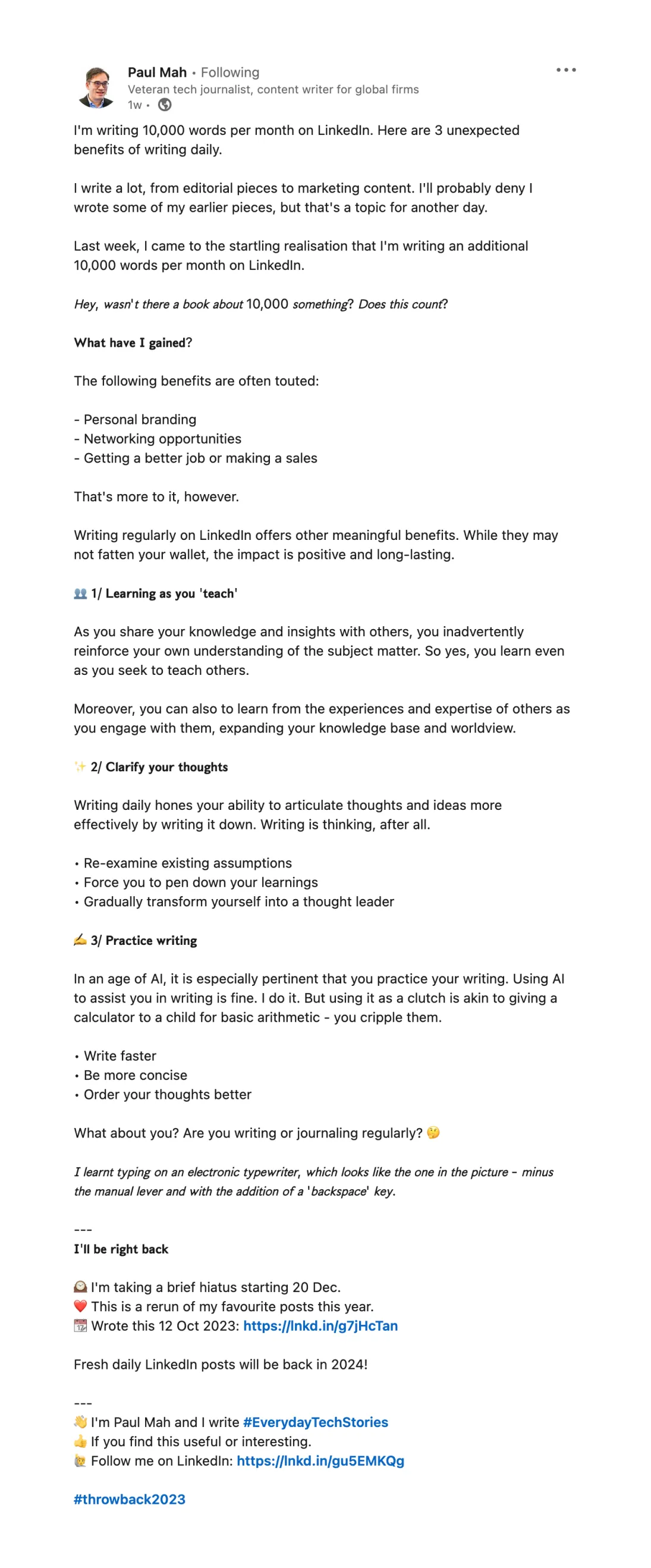
Bold your opening hook. The first line of a LinkedIn post is the most visible. Bolding a key phrase in your hook draws the eye and increases the chance someone clicks "see more." A strong hook combined with bold formatting is one of the most effective ways to stop the scroll.
Bold statistics and data points. Numbers already draw attention. Bold them and they become impossible to miss. "Our team reduced churn by 38% in one quarter." The number jumps off the screen.
Bold names and key terms. If you're mentioning a person, company, or concept that's central to your post, bolding it makes it scannable. Readers can quickly find the "who" and "what" without reading every sentence.
Bold your call to action. If your post asks the reader to do something (comment, share, visit a link), bold that ask. It signals "this is the part that matters."
Don'ts
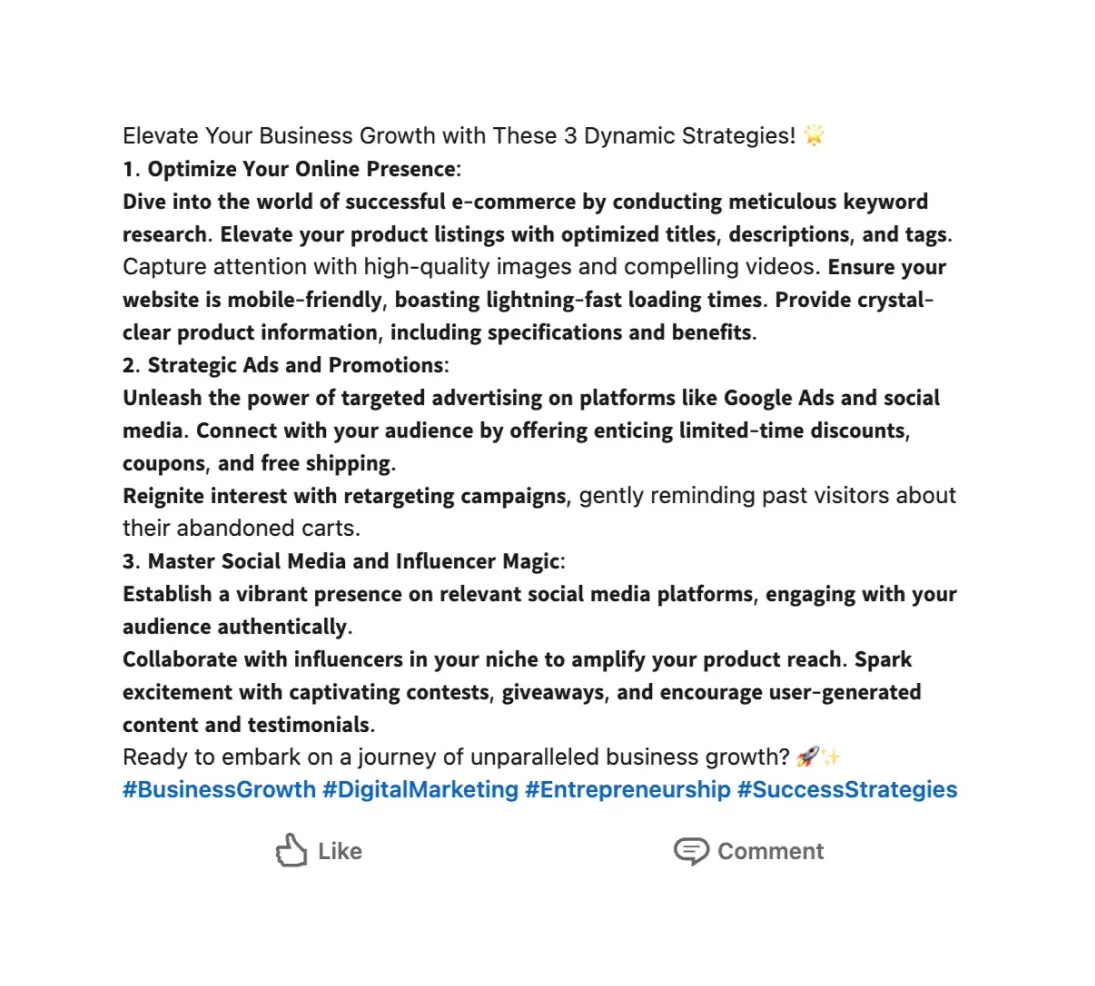
Don't bold entire paragraphs. If everything is bold, nothing is bold. The point of formatting is contrast. A wall of bold text is harder to read than plain text.
Don't use bold as decoration. Bold has a purpose: emphasis. Random bolding throughout a post confuses readers instead of guiding them.
Don't ignore how it looks on mobile. About 60% of LinkedIn users browse on their phones. Always preview your post in the LinkedIn app before publishing. What looks good on a monitor might look cluttered on a phone screen.
Don't mix too many formatting styles. Bold and bullet points work well together. Bold and italic and underline and emojis and all caps, that's visual chaos. Pick one or two techniques and stick with them.
Don't bold for SEO. Bold text in LinkedIn posts doesn't affect LinkedIn's search algorithm the way it might on a webpage. Bold because it helps your reader, not because you think it helps the algorithm.
Accessibility and Limitations of Unicode Bold
If you're using Unicode bold (Method 2 or the mobile method), understand what's happening under the hood.
Screen readers
Unicode bold characters are technically "Mathematical Bold" characters from the Unicode specification. To a screen reader like JAWS, NVDA, or VoiceOver, they're symbols, not regular letters. Some screen readers attempt to read them normally. Others spell them out character by character: "mathematical bold capital H, mathematical bold lowercase e..." or skip them entirely.
If your audience includes people who use assistive technology (on LinkedIn, it likely does), don't bold long sections of text with Unicode. A bolded headline or a single emphasized phrase is fine. Bolding three consecutive sentences makes your post inaccessible to some readers.
Device compatibility
Most modern devices (iOS 14+, Android 10+, recent desktop browsers) render Unicode bold correctly. Older devices, some email clients, and certain third-party apps may display bold characters as empty boxes, question marks, or garbled text.
Search and discoverability
LinkedIn's internal search treats Unicode bold characters as different from their plain-text equivalents. If someone searches for "marketing strategy," a post where those words are Unicode-bolded might not appear in results the same way a plain-text post would. Keep keywords in plain text; bold the surrounding context.
For a broader look at how formatting shapes your LinkedIn presence, see the LinkedIn text formatting guide.
Still need to bold your text? The free formatter takes 10 seconds. No sign-up required.
FAQ: Bold Text in LinkedIn Posts
Why isn't there an option to make text bold directly on LinkedIn?
LinkedIn's standard post composer was designed for simplicity. Unlike the article editor (which has a full formatting toolbar), the post composer is intentionally minimal. LinkedIn has been gradually adding formatting features, but as of 2026, native bold isn't available in regular posts. The workaround is using Unicode text or a browser extension like AuthoredUp .
How do I bold text in a LinkedIn post on mobile?
Use a Unicode text formatter in your phone's browser. Go to the AuthoredUp LinkedIn Text Formatter, type your text, select Bold, and copy the output. Then switch to the LinkedIn app and paste the formatted text into the post composer. There's no native bold option in the LinkedIn mobile app.
How does Unicode work with LinkedIn for text formatting?
Unicode is a universal character encoding standard that includes special character sets (like "Mathematical Bold") which look like bold versions of regular letters. A text formatter swaps your normal characters for these bold Unicode equivalents. LinkedIn displays them as bold because it renders Unicode characters, even though its editor doesn't support native bold formatting. You can read more about LinkedIn's formatting options in the LinkedIn Help Center.
Are there specific tools for formatting LinkedIn text?
Yes. AuthoredUp's LinkedIn Text Formatter is a free web-based tool that converts text to bold, italic, and other styles. The AuthoredUp Chrome extension adds a formatting toolbar directly inside LinkedIn's post editor. Other options include YayText and various Unicode converters, though they're not built specifically for LinkedIn.
Can you bold text in LinkedIn comments?
Yes. Unicode bold works in LinkedIn comments the same way it works in posts. Use a text formatter to convert your text, then paste the result into the comment field. Keep it short: bold a key phrase or a question, not the entire comment.
Does bold text affect LinkedIn algorithm or reach?
There's no evidence that bold text directly influences LinkedIn's algorithm. LinkedIn's ranking signals focus on engagement (likes, comments, shares, dwell time), relevance, and recency. Not text formatting. Bold text can indirectly help by making your post more scannable, which increases the chance people stop scrolling and interact.
Is bold Unicode text accessible to screen readers?
Not fully. Screen readers may interpret Unicode bold characters as mathematical symbols rather than regular text. Some handle it reasonably; others spell out each character individually or skip the text. If accessibility matters to your audience, limit Unicode bold to short phrases and keep the body of your post in plain text. LinkedIn articles support native bold, which is fully accessible.
Can you bold text in LinkedIn articles?
Yes. This is the one place where native bold works perfectly. LinkedIn's article editor has a formatting toolbar with a bold button. Select your text and click B, or use Ctrl+B (Windows) / Cmd+B (Mac). No Unicode workarounds needed here; use native formatting for the best result.
.svg)
.png)

.svg)
.png)
.png)