.svg)


.svg)

.png)
You started writing a LinkedIn post, got pulled into a meeting, and closed the tab. Now you're back and the draft is... somewhere. LinkedIn saves it, but finding it again feels like a small treasure hunt.
LinkedIn drafts are saved automatically per device when you exit a post in progress. They aren't synced across devices, and you can only keep one active draft per platform (one on desktop, one on mobile) at a time. Open the post composer on the same device where you saved it, and your draft auto-populates.
That's the short version. The rest of this guide covers what that means in practice, where each draft actually lives, how to save new ones cleanly, what to do when a draft disappears, and how to work around LinkedIn's single-draft limit when you're trying to manage more than one in-progress post at a time.
Post drafts and article drafts are stored in two different places. Post drafts live in your device's local app cache (one per device, never synced). Article drafts are stored on LinkedIn's servers and accessible from any device at linkedin.com/article/manage/drafts. Most "where did my draft go?" confusion is people looking for one in the storage location of the other.
LinkedIn keeps exactly one post draft per device. Saving a new draft overwrites the previous one with no warning, no version history, and no recovery. This is the most common reason a draft "disappears" — you saved another one.
This guide reflects how LinkedIn handles drafts as of 2026 across desktop, mobile app, and the mobile browser experience.
Where Are Drafts on LinkedIn? (Quick Answer)
On desktop: Click Start a post. If you have a saved draft, LinkedIn shows a "Resume your draft" prompt inside the composer. Click it and your draft loads.
On mobile (iOS/Android): Open the LinkedIn app → tap the + button → tap Post. If you have a saved draft, it loads automatically in the editor.
LinkedIn doesn't have a dedicated drafts management page for standard posts. Article-specific drafts (the long-form articles, not feed posts) are an exception. You can access those at linkedin.com/article/manage/drafts.
A critical limitation worth knowing up front: syncing between devices is unreliable. Some users see delays of several minutes; others find that drafts saved on desktop never appear on mobile and vice versa. Treat your drafts as device-local.
How to Find Drafts on LinkedIn Desktop
Step 1 - Open the post composer
Go to your LinkedIn feed and click Start a post at the top. The composer window opens.
.png)
Step 2 - Resume your draft
If you have a saved draft, LinkedIn shows a "Resume your draft" prompt at the top of the composer. Click it to reload your previous work.
.png)
If you don't see that prompt, your draft has either expired, been overwritten by a newer save, or it's stored on a different device. There's no separate "drafts" tab in LinkedIn's main navigation. The prompt inside the composer is the only access path on desktop.
How to Find Drafts on LinkedIn Mobile App
The mobile experience works differently from desktop.
Step 1 - Open the post composer
Open the LinkedIn app and tap the + button at the bottom of your screen, then tap Post.
.png)
Step 2 - Your draft loads automatically
If you previously saved a draft on mobile, it appears in the editor as soon as you open it. No prompt to click, no menu to find.
The native app behaves differently from the browser version (which shows the "Resume your draft" prompt instead of auto-loading).
What about the mobile browser?
The mobile browser version of LinkedIn mirrors the desktop experience: it shows the "Resume your draft" prompt at the top of the composer. The native iOS/Android app is what auto-loads the draft into the editor immediately.
How to Save a Draft on LinkedIn
Saving on desktop
- Click Start a post on your homepage.
- Write your content in the editor.
- Click the X button in the top-right corner of the composer.
- A popup asks: "Save this post as a draft?"
- Click Save as draft.
.png)
That's it. Your text is stored. Next time you open the composer, you'll see a "Resume your draft" prompt to load it back.
Saving on the mobile app
- Tap + → Post to open the composer.
- Write your content.
- Tap the X or back arrow to close the editor.
- The app asks if you want to Save for later.
- Confirm, and your draft is preserved.
.png)
When you reopen the composer on the same device, the draft loads automatically.
What doesn't get saved
A few specific things to know before you rely on drafts:
- Autosave is inconsistent. Don't assume your work is being saved as you type. Closing the composer with the X button and confirming is the only reliable save action.
- Media attachments can't be edited within drafts. If you added an image, video, or document, you can't replace it inside the draft. You have to delete the media and re-upload.
- Audience and commenting settings may reset. When you reopen a draft, double-check who can see it and whether comments are allowed.
- Articles support multiple drafts. The single-draft limit only applies to standard feed posts. LinkedIn articles (long-form) can have several drafts at once, accessed via linkedin.com/article/manage/drafts.
LinkedIn's Single Draft Limit (And How to Work Around It)
LinkedIn only lets you save one draft at a time per device. A new draft overwrites the previous one without warning, and there's no version history. If you're working on more than one post in parallel (say a hiring post, a thought-leadership post, and a quick announcement), LinkedIn's native system isn't designed for you.
Option 1: Use a notes app. Google Docs, Apple Notes, or Notion work for composition outside LinkedIn. The downside: no LinkedIn formatting preview, no scheduling, no analytics tied to the post, and a manual copy-paste step every time you publish.
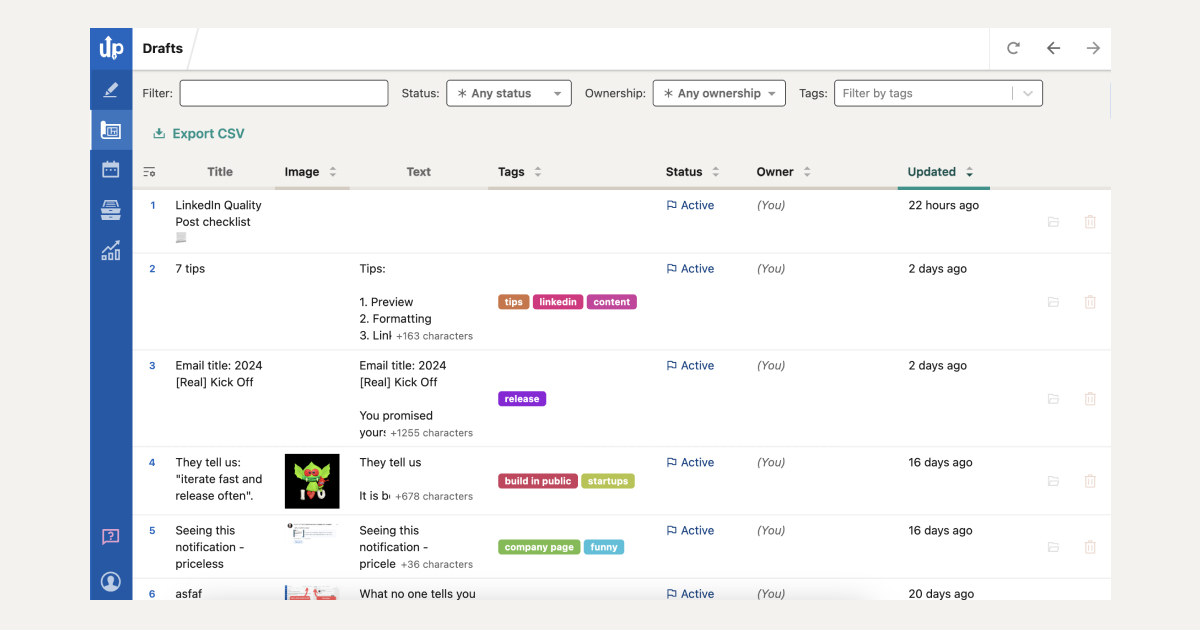
Option 2: Use a dedicated drafts tool. AuthoredUp's drafts panel gives you unlimited drafts with tags, search, and one-click publishing or scheduling straight to LinkedIn. You can keep ten posts in progress and switch between them without losing your work. The same panel feeds the content calendar so you can plan a week or month at once.
For a broader take on planning multiple posts, see how to build a LinkedIn content calendar.
Do LinkedIn Drafts Expire?
LinkedIn hasn't published a clear answer. User reports vary: some people see drafts disappear after roughly 7 days, others have drafts preserved for weeks.
What we know from observed behavior: drafts can vanish for several reasons that don't involve a fixed expiration timer.
- A new save overwrites the old draft. The single-draft limit means there's no version history; only the most recent save survives.
- App updates sometimes wipe local storage. Mobile drafts in particular are vulnerable when the LinkedIn app updates itself.
- Clearing cache or browser data on desktop removes drafts that were stored client-side.
- Logging out of LinkedIn has been reported to clear drafts on some accounts.
- LinkedIn platform updates (UI changes, server-side migrations) occasionally reset drafts across all users.
If you can't afford to lose the post you're working on, save it outside LinkedIn first. The draft slot is convenient for short-cycle composition (you'll finish and publish in one session); it isn't reliable storage for posts you're cultivating over a week.
Tips for Managing LinkedIn Drafts
A few practices that come up repeatedly from creators who post consistently:
- Batch your composition. Write three or four posts in one sitting rather than trying to compose-and-publish in the same five-minute window. Quality goes up; the single-draft limit becomes less of a problem because you're not switching tools mid-flow.
- Keep an ideas document. A scratch file (Notion, a notes app, a plain text doc) for raw concepts means you never sit down to a blank composer. Develop the idea into a draft only when it's ready.
- Don't over-edit in the draft phase. The two- or three-revision rule is usually enough. Continuous tweaking on the same draft tends to produce worse posts, not better ones.
- Back up before any composer change. If you're about to edit a draft you spent time on, copy the text into a notes app first. The composer is fragile.
Why did my LinkedIn draft disappear?
Several specific causes account for most "where did my draft go?" reports:
- You saved a new draft on the same device. LinkedIn allows one active draft per device, so the new save overwrote the old one.
- You opened the composer on a different device. Drafts don't sync between desktop and mobile reliably. The draft you saved on your laptop won't appear on your phone, and vice versa.
- You cleared your browser data, logged out, or used incognito mode. Desktop drafts are stored client-side; clearing site data removes them.
- The LinkedIn app updated. Mobile drafts can be wiped during an app update, particularly on iOS where local storage handling is stricter.
- LinkedIn pushed a UI or backend update. Less common, but platform-side changes have wiped drafts across all users in the past.
If you've lost a draft and the original text isn't recoverable, this is the case for keeping a parallel notes file or a tool like AuthoredUp's drafts panel that maintains its own copy independent of LinkedIn's storage.
FAQ: LinkedIn Drafts
Where are my drafts on LinkedIn?
Standard post drafts appear via the "Resume your draft" prompt at the top of the composer on desktop, or load automatically when you open the post composer on the mobile app. There's no separate drafts page for regular posts. LinkedIn articles (long-form) have their own drafts page at linkedin.com/article/manage/drafts.
Does LinkedIn save draft posts automatically?
Not reliably. Autosave is inconsistent across sessions. The only reliable save is clicking the X (or back arrow on mobile) and confirming Save as draft when LinkedIn prompts you.
Can you save multiple drafts on LinkedIn?
For standard feed posts, no; only one draft at a time per device. LinkedIn articles do support multiple drafts. If you need unlimited drafts for feed posts, you'll need an external tool.
Do LinkedIn drafts sync between desktop and mobile?
No, not reliably. Treat each device's drafts as separate. If you start a post on desktop and want to finish on mobile, copy the text out manually before switching.
How do I edit a draft on LinkedIn?
Open the post composer on the same device where you saved the draft. On desktop, click Resume your draft when the prompt appears. On mobile, the draft loads automatically. Make your changes, then publish, or close again to save the updated version.
How do I delete a draft on LinkedIn?
Open the draft, delete all the content, then close the composer and select Discard instead of Save. There's no explicit "delete draft" button.
Do LinkedIn drafts expire?
LinkedIn hasn't published an official expiration timeline. Observed behavior puts the practical lifespan at anywhere from a few days to several weeks, depending on app updates, cache state, and whether you save a new draft (which overwrites the old one). If you can't afford to lose it, save it outside LinkedIn too.
Can you schedule a draft post on LinkedIn?
LinkedIn's native scheduling requires creating a new post. You can't convert an existing draft into a scheduled post directly. Third-party tools like AuthoredUp let you go from draft to scheduled post in one panel.
.svg)
.png)
.svg)
.png)
.png)
