


.svg)

.png)
Open any "best LinkedIn hooks" list and you get the same advice: ask a question. Pose something your reader can't resist answering, and the comments will roll in.
We checked that advice against our data. It doesn't hold up.
We analyzed 309,614 posts from personal LinkedIn profiles between December 2025 and May 2026, sorted by the style of their opening line. Question hooks finished dead last of five styles. The two openers that beat everything else were the ones that pull the reader into a narrative: storytelling and contrarian takes.
So this isn't another list of 50 templates to copy. It's a ranking of which kinds of openers actually earn engagement, the real numbers behind them, and the examples that match what the data rewards. Where the popular advice is wrong, we'll show you exactly how wrong.
What 310K posts say about which hooks work
We classified each post by the style of its first line and pulled the engagement rate for each group. Here's the ranking.
Three things jump out.
First, story openers win. At a 2.60% median engagement rate, a hook that drops you into the middle of a scene ("I got fired on a Tuesday. By Friday I had three offers.") beats every other style. It's the one opener that makes the reader need to know what happens next.
Second, contrarian hooks come second (2.31%), just ahead of plain statements (2.27%). Both work by making a claim the reader has an opinion about, which is the opposite of asking permission to be read.
Third, and this is the part that should change how you write: question hooks come dead last (2.16%), below even the tired "results" hook. The single most-recommended opener on LinkedIn is the weakest one in the data.
A quick definition, since the styles matter: a story hook drops you into a moment ("Three years ago I couldn't get 10 likes."). A contrarian hook pushes against something the reader believes ("Posting daily is hurting your reach."). A statement hook leads with a flat, specific claim ("Most LinkedIn advice is written by people who don't post."). A results hook leads with an outcome or number ("3 deals closed this week from one post."). A question hook opens by asking ("Want more engagement on LinkedIn?").
This is the cleanest cut of the data we have: only posts with more than 100 impressions (so nothing is skewed by tiny-reach posts) and engagement rates under 10% (so a handful of viral outliers don't drag the averages). Across 309,614 posts, the pattern is stable.
Across 309,614 personal LinkedIn posts (Dec 2025–May 2026), posts opening with a story earned a median 2.60% engagement rate, while question hooks, the most-recommended opener, came last at 2.16%.
Why "just ask a question" is weak hook advice
The advice to open with a question is everywhere, so it's worth understanding why it underperforms.
A question asks the reader to do work before they've decided to care. "Want to grow on LinkedIn?" is easy to skip because the honest answer is "sure, but not enough to stop scrolling for you." The question hands the reader an exit.
A contrarian or statement hook does the opposite. It makes a claim, and a claim creates a gap. Psychologist George Loewenstein called this the information gap: curiosity spikes when there's a space between what you know and what you want to know. "Posting daily is hurting your reach" opens a gap you feel compelled to close. You keep reading to find out why, or to argue.
This is also why the first line carries so much weight. Most people scan before they read, and the eye lands on the opening words first. The Nielsen Norman Group has documented this scanning behavior for years. On LinkedIn, only the first line or two show above the "…see more" fold. The hook isn't a nice-to-have. It's the entire pitch for the click.
Richard van der Blom's Algorithm Insights research points the same direction: a strong opening line measurably lifts how far readers get into a post. Our data adds another layer, which opening lines, ranked by what they actually earn.
If you want the bigger picture on what performs, our breakdown of what 3M+ posts show about top content covers formats, length, and saves alongside hooks.
The "end with a question" myth
While we were classifying openers, we checked the other half of the advice too: end with a question to drive comments. It's the most-repeated engagement tip on the platform.
It barely registers.
Posts that end with a question do edge out those that don't, but by 0.07 of a percentage point. That's a roughly 3% lift, not the comment floodgate the advice promises. Across 309,614 posts, a closing question is a nudge at best.
What actually pulls comments is a post worth responding to and a reply from you in the first hour, not a "What do you think?" bolted onto the last line. We go deeper on this in our guide to increasing engagement on LinkedIn.
LinkedIn hook examples that match what the data rewards
Now the examples, organized by the styles that performed best, strongest first. Most are real LinkedIn posts, shown with their opening line and what they earned. One note before you read them: the percentages above are medians across hundreds of thousands of posts. The featured posts below are standout individual examples of each style done well, which is why even the "weaker" styles pull big numbers here. The lesson isn't "any question hook goes viral." It's what each of these does to earn the read.
Story hooks (the top performer)
These drop the reader into the middle of a scene before they know where it's going. The unfinished story is the pull: you keep reading to find out how it ends. It's the highest-performing opener in the data, and the hardest for an AI to fake, because it needs a real moment.
Mischa Collins opened with:
"2024: Shock dismissal from my job. 2026: Official speaker at Cannes Lions. I remember the day I lost my job so clearly. It was a Friday."
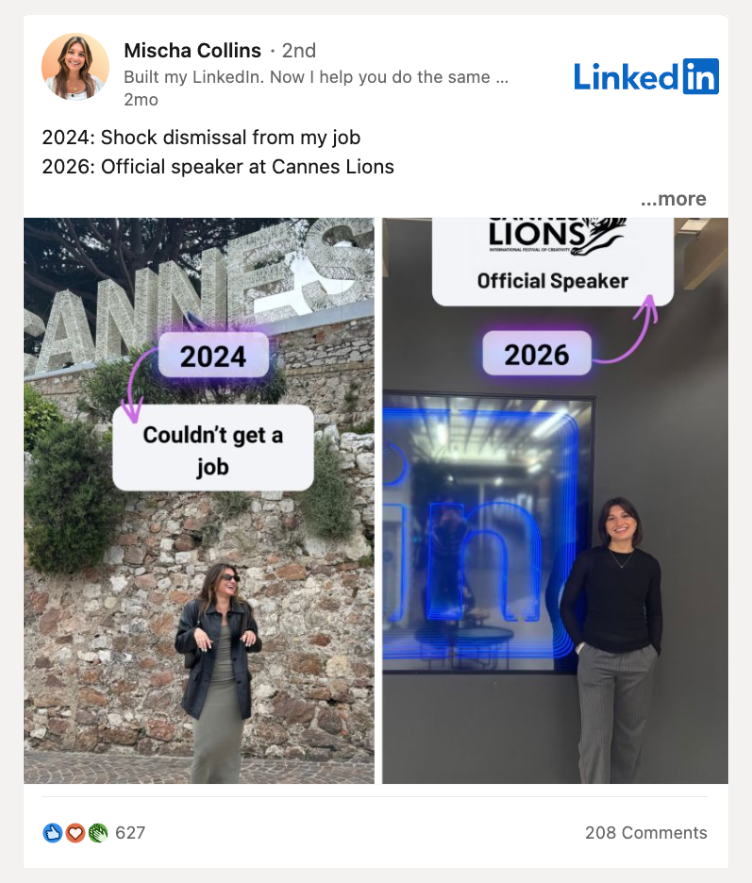
627 reactions, 208 comments. The two-line before-and-after does the heavy lifting: it names a dramatic reversal and makes you want the story that connects the two dates. Then "It was a Friday" drops you into the scene, so you expand the post to live it with him.
Illustrative patterns you can adapt:
- "I got fired on a Tuesday. By Friday I had three offers."
- "Three years ago I couldn't get 10 likes. Last month a post hit 2 million views."
- "A recruiter ghosted me after the final round. So I posted the rejection email."
- "My biggest client fired us over one sentence in an email."
The move: open mid-action, withhold the resolution, and make the reader expand the post to get it.
That the most human style wins is not an accident. In a time when anyone can generate a post in seconds, the one thing AI still can't manufacture is a real moment you lived through. An authentic experience, a point of view you actually hold, an anecdote with your name on it: that's what readers now scan for, because it's the clearest signal that a person, not a model, is on the other end. The story hook wins because it leads with exactly that, and it's a good reason to keep your own voice in the draft even when you use AI to help shape it.
Contrarian hooks (a strong runner-up)
These open by challenging a common belief. Use them when you genuinely disagree with the consensus. Forced contrarianism reads as bait.
Charlie Hills opened with:
"Stop asking AI to write LinkedIn posts. Do this instead:"
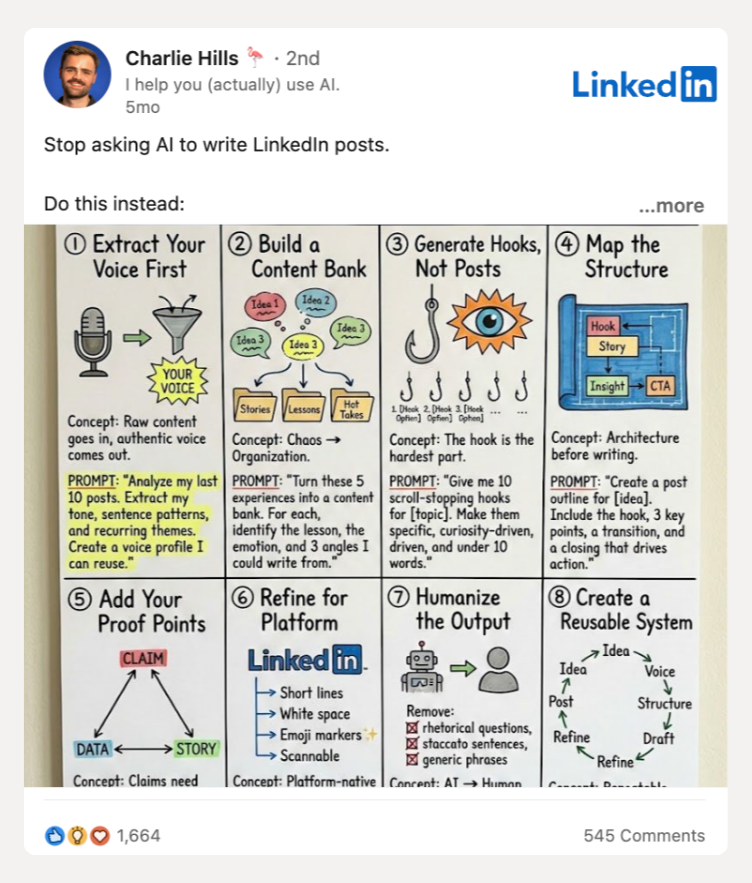
That post drew 1,664 reactions and 545 comments. It works because it tells a huge, growing group of people to stop doing the exact thing they're doing, then promises a replacement on the next line. The gap ("then what do I do?") is impossible to leave open.
Patterns you can adapt:
- "Posting every day is the fastest way to kill your reach."
- "Your engagement isn't low because of the algorithm. It's low because your first line is boring."
- "Most 'personal branding' advice will make you sound like everyone else."
Statement hooks (the reliable workhorse)
A flat, specific claim. No windup. These carry the most volume on LinkedIn for a reason.
Jessie van Breugel led with:
"Claude beats ChatGPT for getting leads on LinkedIn."
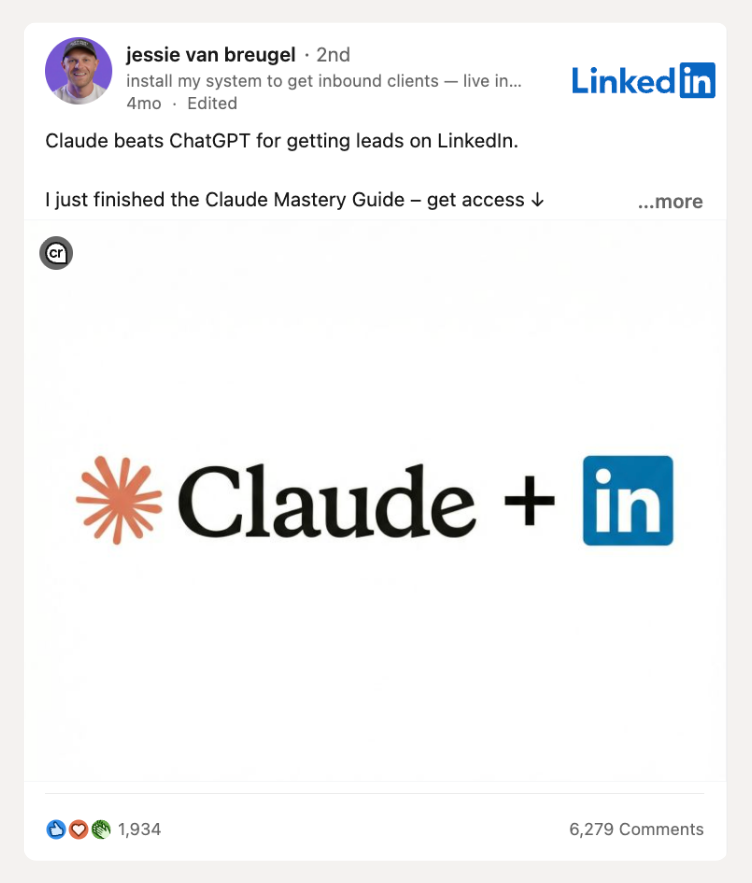
That post earned 1,934 reactions and over 6,000 comments. There's no question, no setup, no "have you ever wondered." It states a position people have an opinion about and lets the disagreement (and the curiosity) do the work.
Patterns you can adapt:
- "I rewrote my LinkedIn bio 11 times last year. The 11th one finally worked."
- "The best post I ever wrote took four minutes."
- "Nobody read my posts for 8 months. Then I changed one thing."
Results hooks (handle with care)
Numbers can work, but the format is so overused that readers discount it. If you lead with a result, make the why behind it the real hook.
Nick Broekema opened with:
"My impressions over the past 7 days went up by 122.9%. Profile views: +99.4%. And the reason why is stupidly simple: I posted more :)"
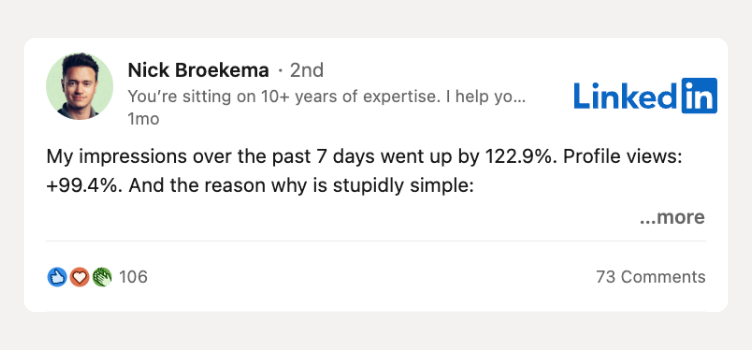
104 reactions, 73 comments. The numbers grab the eye, but the line that earns the read is "the reason why is stupidly simple." It promises a payoff that sounds almost too obvious to be true, so you keep reading to check. A bare "+122.9% impressions" with no twist would have been scrolled past.
- Tired: "How I gained 10,000 followers in 30 days."
- Better: "I gained 10,000 followers in 30 days and it tanked my inbound leads. Here's why."
Question hooks (make it specific or skip it)
The most-recommended opener is the weakest in the data, so earn the question. A specific, stakes-loaded question works far better than a generic one.
Matt Lakajev opened with:
"The worst LinkedIn trend right now? I'll go first: AI comments."
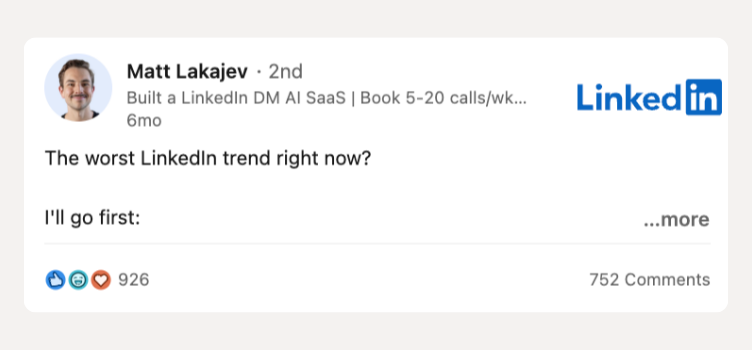
926 reactions, 752 comments. Notice this isn't a lazy yes/no question. It poses a question with a stake, answers it immediately with a strong opinion, and dares you to agree or fight. That's the difference between a question that pulls and one that gives the reader an exit. Most question hooks aren't written this way, which is why the style lands at the bottom of the ranking.
- Weak: "Want more engagement on LinkedIn?"
- Stronger: "Why do your best posts get 12 likes and your worst ones go viral?"
The pattern: a generic yes/no question hands the reader an exit. A question that names a real tension keeps them in.
How long should a LinkedIn hook be?
Only the first line or two clear the "…see more" fold, so length is a real constraint, not a style choice. Shorter is better, and the data is close to a straight line.
Every step longer costs you engagement. Hooks of 40 characters or fewer earn a 2.61% median, 25% higher than hooks over 200 characters (2.08%). "0–40 characters" is short: "I got fired on a Tuesday." is 25. The best-performing openers make one complete, intriguing claim and stop.
The working rule: keep the hook to a single short line. If the reader has to expand the post to understand your opening sentence, the hook hasn't done its job. Preview where your line breaks before you publish with our free LinkedIn Post Preview Generator, so you can see exactly what shows above the fold.
How you format the post matters here too, because a wall of text buries even a great hook.
How to write and test your own hooks
Picking the right style is step one. The real lift comes from testing your hooks against your own audience, because what works for a contrarian B2B founder won't match a careful corporate brand.
A workflow that works:
- Draft three openers per post, in different styles. One story, one contrarian, one statement. Writing the same idea three ways forces you off your default, and it steers you toward the styles the data rewards.
- Pull from a proven starting point. The AuthoredUp editor includes a library of 200+ hook openers you can adapt inside LinkedIn, so you're not staring at a blank line. If you'd rather have a first draft written in your own voice, Coauthor (our AI assistant, currently in beta) learns from your past posts and drafts openers that sound like you, not like generic AI.
- Preview before you post. Check that your strongest line sits above the fold.
- Compare what actually happened. This is the part most people skip. Using AuthoredUp's post comparison, you can put two posts side by side and see which hook drove more engagement against your real baseline — not a generic benchmark. After a month, you'll know which style your audience rewards.
The data in this article is the average across 309K posts. Your audience is a sample of one. Use the ranking to pick where to start, then let your own numbers settle the argument.
For more inspiration on what breaks through, see our roundup of viral LinkedIn post examples and the mechanics behind going viral on LinkedIn.


FAQ
What is a good LinkedIn hook?
A good hook is a first line that opens a gap the reader feels compelled to close. In our analysis of 309,614 posts, story openers earned the highest median engagement rate at 2.60%, followed by contrarian hooks at 2.31%. Question hooks came last at 2.16%. The best hook is specific, makes a complete claim in one short line (under 40 characters performs best), and fits above the "…see more" fold.
What is an example of a catchy hook?
"Posting every day is the fastest way to kill your reach." It works because it's contrarian, challenging something most people accept, which creates curiosity and, often, the urge to reply. Catchy doesn't mean clever; it means it opens a gap.
What is a good hook line?
One specific, surprising statement that can't be skimmed past. Avoid generic questions ("Want to grow on LinkedIn?"). In our data, question hooks underperformed statements and contrarian openers. A strong hook line names a real tension: "Nobody read my posts for 8 months. Then I changed one thing."
What is the 4-1-1 rule on LinkedIn?
The 4-1-1 rule is a content-mix guideline: for every 6 posts, share 4 pieces of useful content from others, 1 soft promotion, and 1 hard promotion. It's about what you post over time, not how you hook a single post. It pairs with hooks, since even a promotional post needs an opening line that earns the read.
What is the 5-3-2 rule on LinkedIn?
The 5-3-2 rule is another posting-mix formula: of every 10 posts, 5 are curated from others, 3 are your original content, and 2 are personal or human. Like the 4-1-1 rule, it governs your content balance, not your hook. Whatever the mix, the first line still decides whether the post gets read.
.svg)
.png)

.svg)
.png)
.png)