


.svg)

.png)
Your company page posts are reaching a fraction of the people your employees could reach. That's not speculation.
We analyzed close to 900,000 LinkedIn posts from July 2025 to June 2026 and found that personal profile posts get about one and a half times the impressions of company page posts (1,006 vs 659 median). When employees mention or tag their company in those posts, impressions jump another 40%, to a median of 1,405.
| Metric | Company page posts | Employee (personal profile) posts | Employee posts mentioning company |
|---|---|---|---|
| Median impressions | 659 | 1,006 | 1,405 |
| Median reactions | 15 | 20 | 30 |
| Median comments | 0 | 4 | 4 |
Source: AuthoredUp analysis of 897,963 LinkedIn posts (original posts with more than 100 impressions), July 2025 – June 2026. Company page and personal profile figures from the September 2026 refresh; the mention split from a matching pull on the same filters.
The math is straightforward. A team of 20 employees posting once a week reaches more people than the company page posting daily. Employee advocacy is how B2B companies actually get seen on LinkedIn. LinkedIn's own data confirms it: employee networks have 10x more connections than a company's follower base.
Getting 20 (or 200) employees to post consistently? That's where tools come in.
We tested and compared 9 employee advocacy tools, from enterprise platforms with gamification and compliance dashboards to lightweight content creation tools that get employees writing in minutes.
What Is an Employee Advocacy Platform?
An employee advocacy platform is software that helps companies encourage and coordinate employees sharing content on social media, primarily LinkedIn.
Most platforms fall into one of two categories:
Distribution-first tools give employees pre-approved content to share. Think of a content library where marketing uploads posts and employees click "share." Sociabble, GaggleAMP, and DSMN8 work this way.
Creation-first tools help employees write their own content. Instead of sharing identical company messages (which LinkedIn's algorithm penalizes for repeated content), employees create original posts in their own voice. AuthoredUp takes this approach.
The difference matters because LinkedIn actively deprioritizes repeated content. When 15 employees share the same link with the same caption, the algorithm treats it as spam. When 15 employees write original posts about their experience with the product, each post gets full distribution.
Here's what effective employee advocacy on LinkedIn looks like in practice: a product engineer writes about a technical challenge they solved, mentions the company, and shares a genuine insight from their work. That post gets 1,405 median impressions, compared to 659 for the same story posted from the company page. The content is authentic, the reach is higher, and the audience trusts it more because it comes from a real person.
Need inspiration? Check out these LinkedIn company post examples that show what works.
9 Best Employee Advocacy Tools Compared
Here's how the top platforms stack up across the features that matter most:
| Tool | Content creation | Scheduling | Analytics | Gamification | LinkedIn-specific | Multi-platform | Starting price |
|---|---|---|---|---|---|---|---|
| AuthoredUp | ✅ Rich editor, hooks, CTA templates | ✅ | ✅ Deep (years of history) | ❌ | ✅ Purpose-built | ❌ LinkedIn only | $19.95/mo per profile |
| Sociabble | ⚠️ Content library only | ✅ | ✅ | ✅ Advanced | ❌ | ✅ | Custom pricing |
| EveryoneSocial | ⚠️ Content hub | ✅ | ✅ | ✅ | ❌ | ✅ | Custom pricing |
| GaggleAMP | ⚠️ Activity prompts | ✅ | ✅ | ✅ Advanced | ❌ | ✅ | ~$8,800/yr |
| Hootsuite Amplify | ⚠️ Content curation | ✅ | ✅ | ⚠️ Basic | ❌ | ✅ | Add-on to Hootsuite |
| PostBeyond (Influitive) | ⚠️ Content library | ✅ | ✅ | ✅ | ❌ | ✅ | Custom pricing |
| DSMN8 | ⚠️ AI suggestions | ✅ | ✅ | ✅ | ❌ | ✅ | ~$850/mo |
| Clearview Social | ❌ Share only | ✅ | ✅ Basic | ⚠️ Leaderboards | ❌ | ✅ | Custom pricing |
| Ambassify | ⚠️ Campaign templates | ✅ | ✅ | ✅ Community | ❌ | ✅ | Custom pricing |
✅ = Full feature | ⚠️ = Limited/basic | ❌ = Not available
Notice a pattern? Almost every platform focuses on distributing pre-made content. Only AuthoredUp is built around helping employees create original content, which is what LinkedIn's algorithm actually rewards.
A word about LinkedIn's Terms of Service: some advocacy platforms include automated engagement features (auto-liking, auto-commenting, scheduled mass-sharing of identical content). LinkedIn explicitly prohibits automation that mimics human activity. If your employees' LinkedIn accounts matter to them, automation risk is worth considering.
AuthoredUp
AuthoredUp approaches employee advocacy differently than enterprise advocacy platforms. Instead of giving employees content to reshare, it gives them tools to create their own posts. Fast.
.png)
Key features:
- Rich text editor with bold, italic, bullets, and emoji directly in LinkedIn's interface (Chrome extension)
- 200+ hook templates and 150+ CTA templates to start writing immediately
- Post preview before publishing so employees see exactly how their post will look (also available as a free tool)
- Deep analytics going back years (via LinkedIn archive import), including post comparisons and engagement rate breakdowns
- Visual content calendar to plan and schedule posts across profiles and pages
- Unlimited company pages included free with every account
- Co-Author (coming soon): AI writing that learns each employee's actual voice from their post history
.png)
Pricing: Starts at $19.95/month per LinkedIn profile. 14-day free trial. Company pages are free and unlimited.

Best for: Teams where employees primarily use LinkedIn and you want them creating original content, not resharing links. Ideal for B2B companies, consulting firms, and tech companies with employees who want to build their personal brands while representing the company.
Honest limitation: AuthoredUp is LinkedIn-only. If you need advocacy across Twitter, Facebook, and Instagram, you'll need a multi-platform tool. If you need enterprise compliance dashboards or gamification leaderboards, the dedicated advocacy platforms (Sociabble, GaggleAMP) are built for that. But for LinkedIn content quality and depth of analytics, nothing else comes close at this price point.
Sociabble
Enterprise-grade advocacy platform with deep gamification. Employees earn points for sharing content, compete on leaderboards, and can redeem rewards. Content is curated centrally by marketing teams.
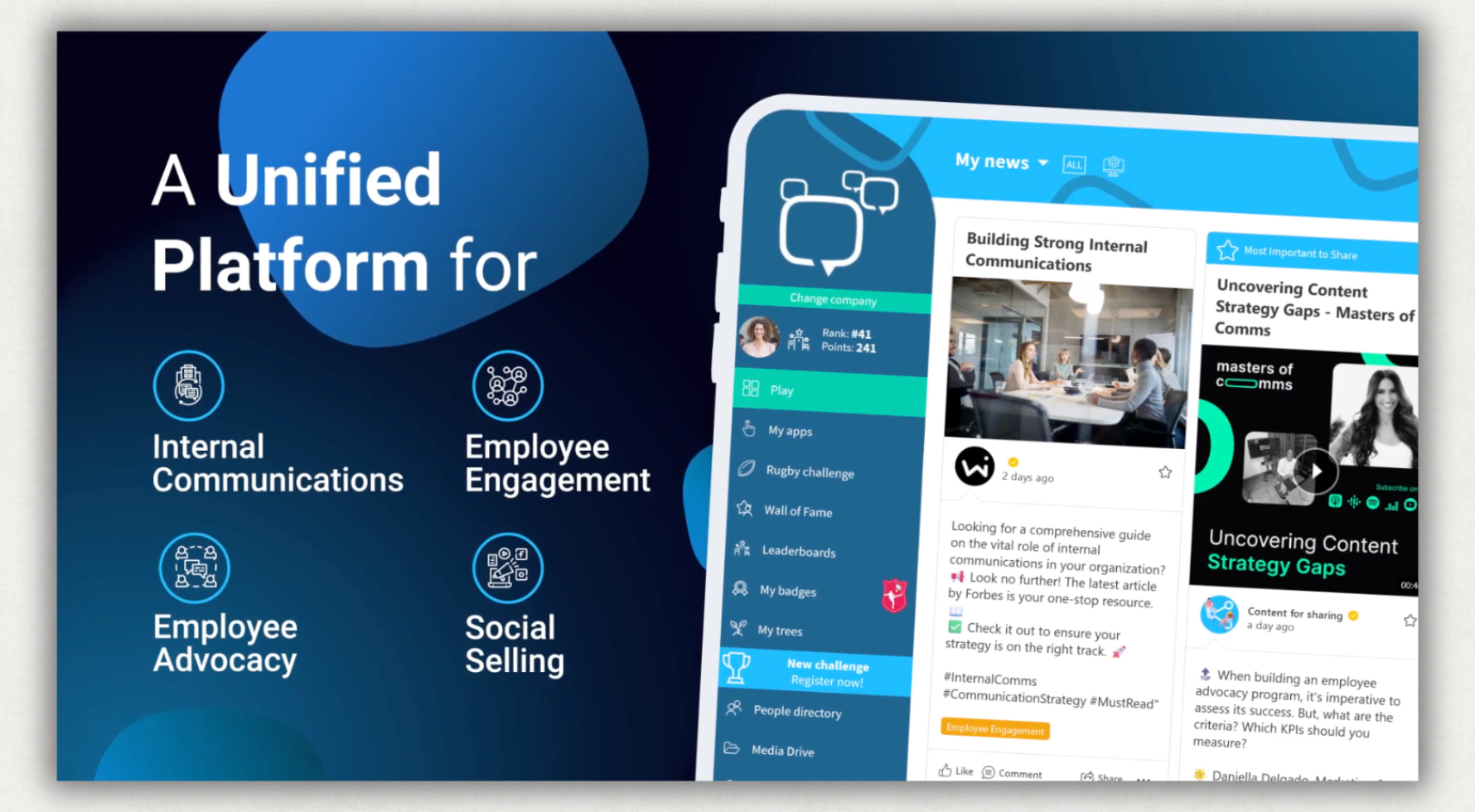
Key features:
- Multi-channel content distribution (LinkedIn, Twitter, Facebook, Instagram)
- Advanced gamification with points, badges, and reward redemption
- Content translation for global teams
- Compliance and governance controls
- ROI measurement dashboards
Pricing: Custom enterprise pricing. Typically $5,000+/year depending on team size. See Sociabble pricing.
Best for: Large enterprises (500+ employees) running formal advocacy programs across multiple social platforms with compliance requirements.
EveryoneSocial
Content hub model where marketing uploads approved content and employees browse and share what resonates with them. Strong mobile app for on-the-go sharing.
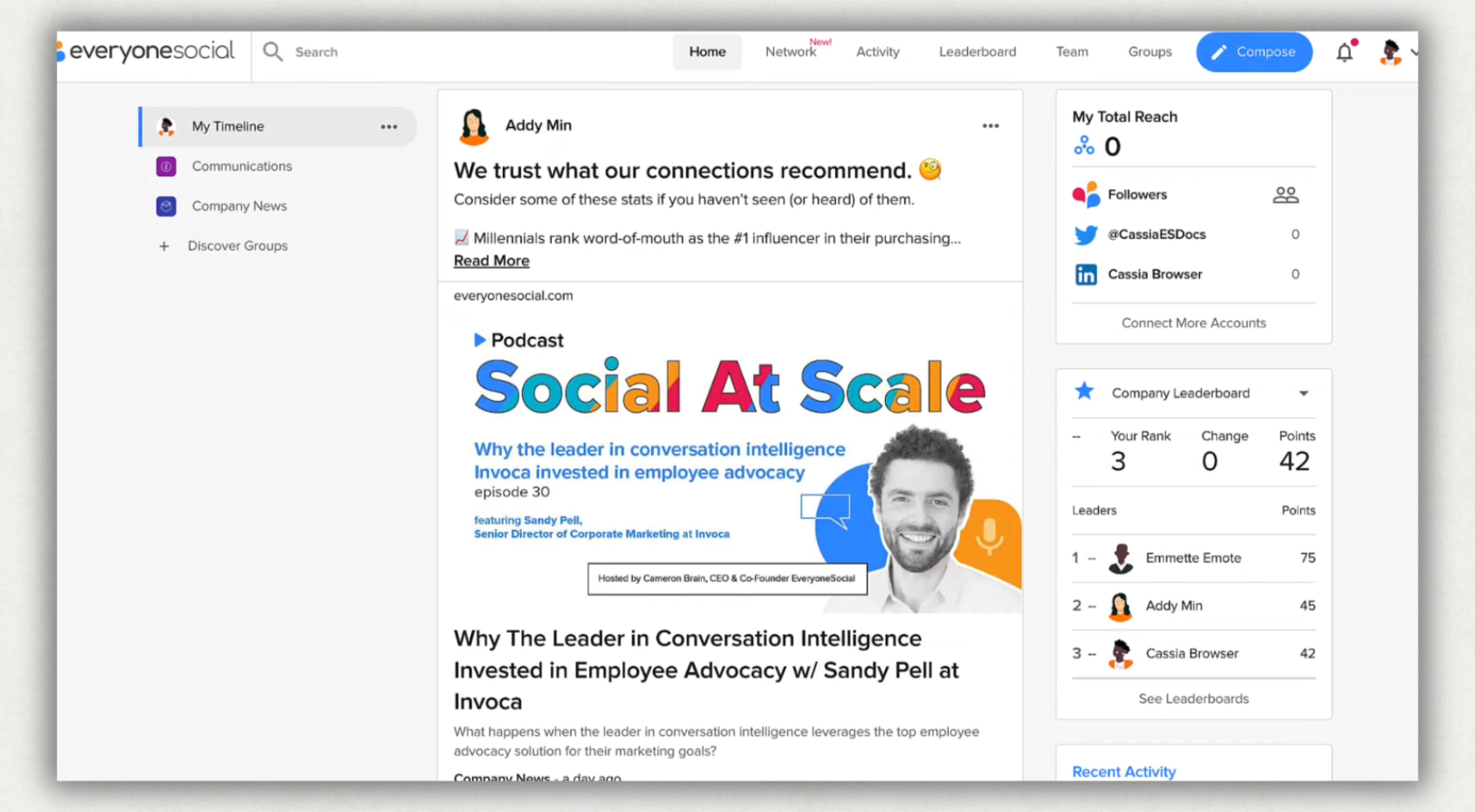
Key features:
- Content hub with topic channels
- Mobile app for easy sharing
- Integration with Slack and Microsoft Teams
- Newsletter feature for internal content distribution
- Analytics tracking reach and engagement by employee
Pricing: Custom pricing. Mid-market positioning. See EveryoneSocial.
Best for: Mid-size companies wanting a simple, app-based approach to getting employees sharing content without heavy training.
GaggleAMP
Activity-based advocacy. Managers create specific "activities" (share this post, comment on that article, like this update) and assign them to team members. Employees complete activities for points.
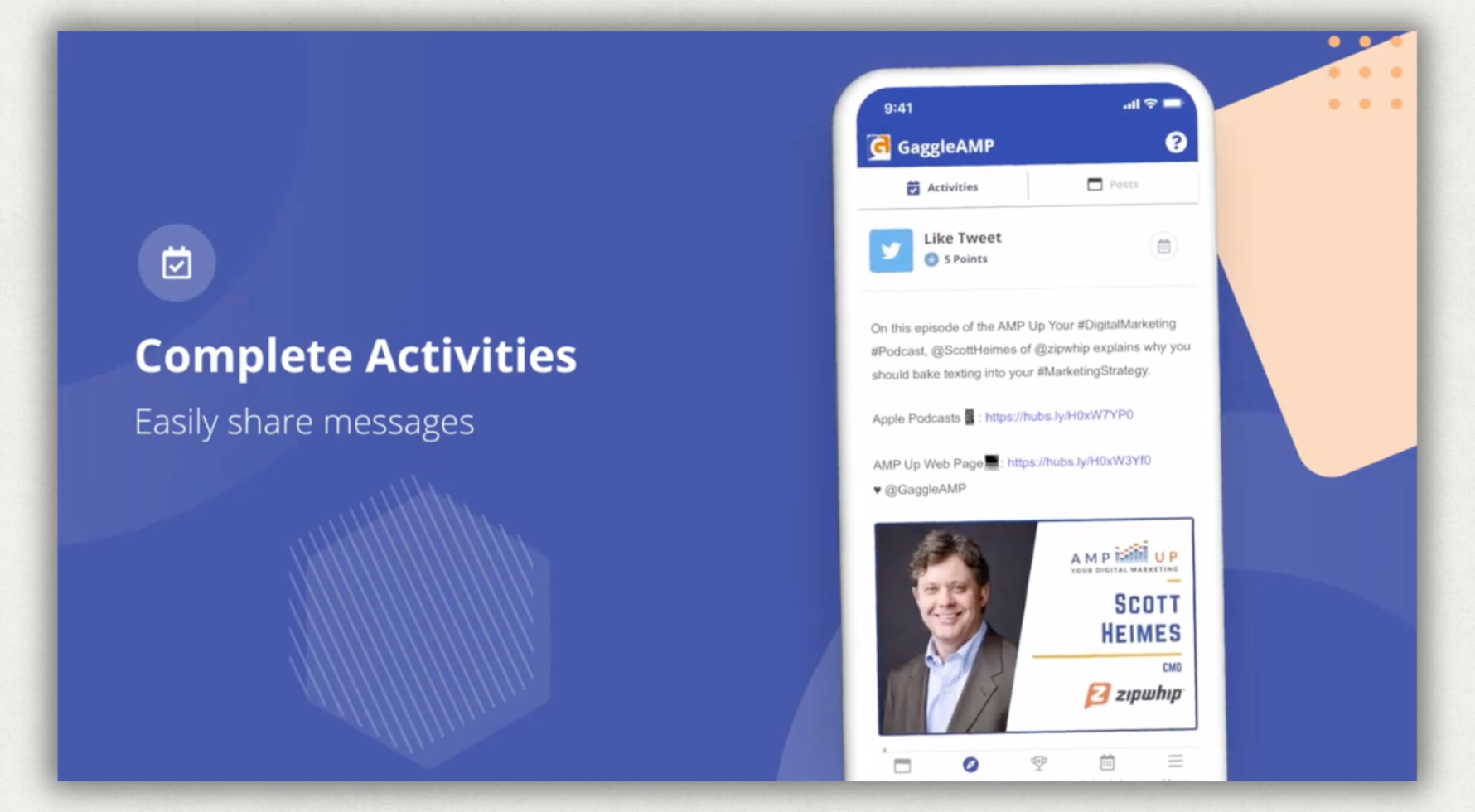
Key features:
- Activity manager for assigning specific advocacy tasks
- Gamified leaderboards and point systems
- Supports 50+ activity types across platforms
- ROI attribution and analytics
- AI-powered content suggestions
Pricing: Approximately $8,800/year. Enterprise tiers higher. See GaggleAMP.
Best for: Companies that want direct control over exactly what employees share and when. Works well for product launches and campaigns with specific messaging.
Hootsuite Amplify
Advocacy add-on for existing Hootsuite customers. Employees get a curated content feed and share to their personal accounts with one click.

Key features:
- Integrates with existing Hootsuite workflows
- Curated content streams for employees
- One-click sharing to personal LinkedIn, Twitter
- Basic engagement tracking
- Pre-written captions employees can customize
Pricing: Available as add-on to Hootsuite Business or Enterprise plans (starting around $249/month for the base Hootsuite plan). See Hootsuite Amplify.
Best for: Companies already using Hootsuite for social media management who want to add employee advocacy without learning a separate platform.
PostBeyond (now part of Influitive)
Content curation and distribution platform. Marketing teams create a library of approved content; employees choose what to share. Recently merged with Influitive's customer advocacy platform.
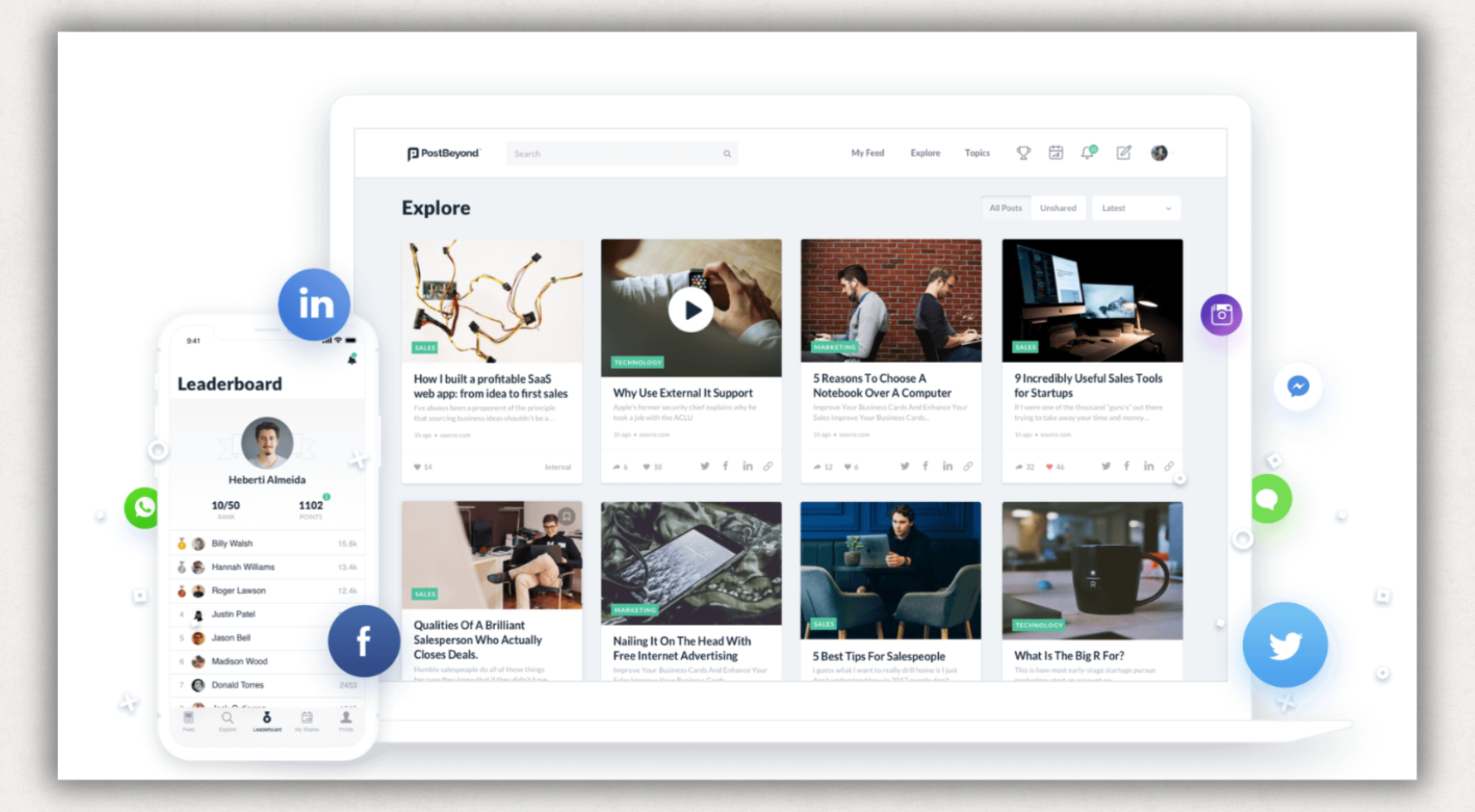
Key features:
- Content library with categories and tags
- Compliance controls and approval workflows
- Analytics on content performance and employee participation
- Integration with Salesforce and other CRMs
- Mobile app
Pricing: Custom pricing. Enterprise-focused. See PostBeyond.
Best for: Regulated industries (financial services, healthcare) where content approval workflows and compliance controls are non-negotiable.
DSMN8
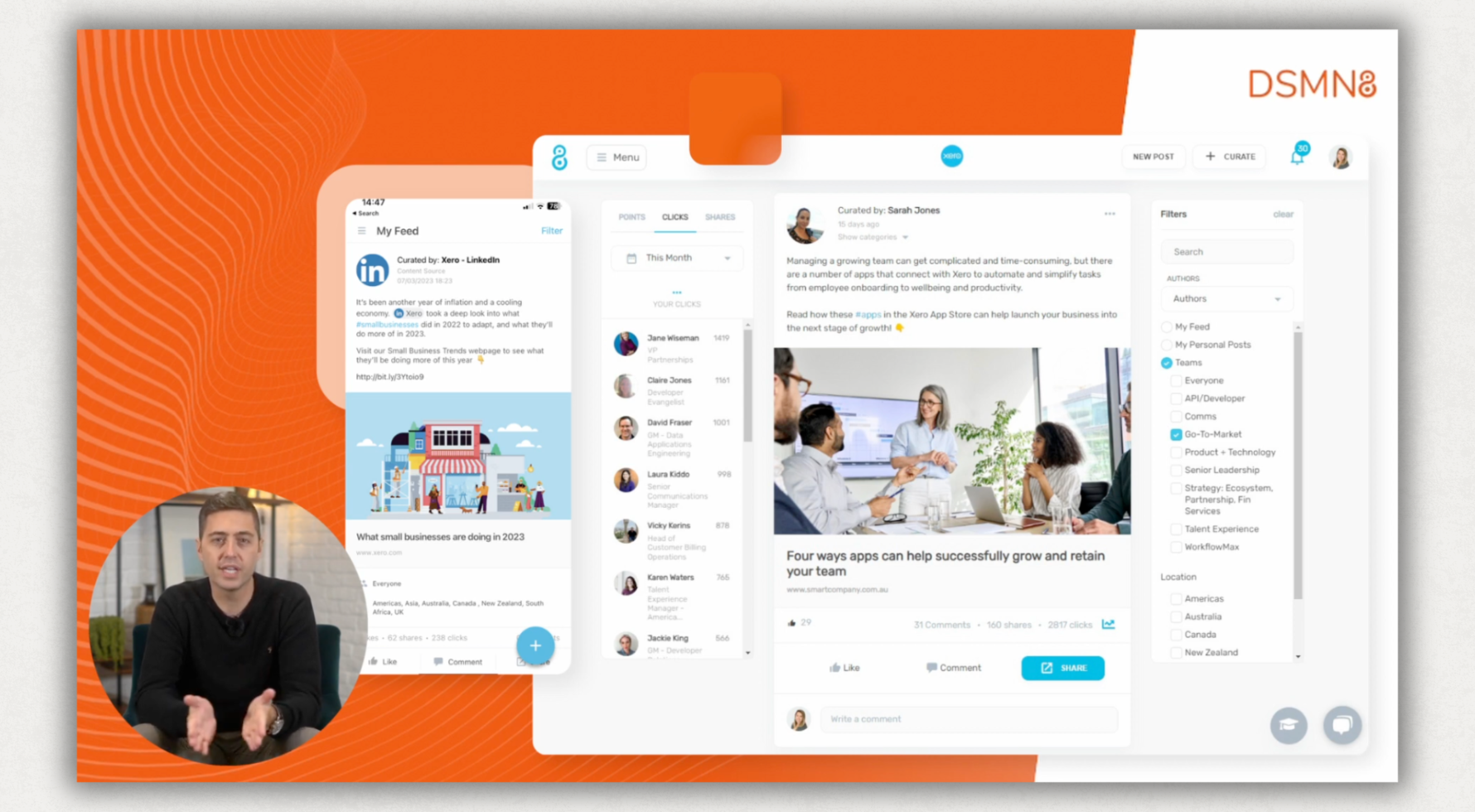
AI-powered content suggestions. The platform analyzes trending topics and suggests content for employees to share, along with pre-written captions.
Key features:
- AI content suggestions based on industry trends
- One-click sharing with pre-written captions
- Gamification and leaderboards
- Organic reach tracking
- Employee newsletter feature
Pricing: Approximately $850/month. Enterprise plans available. See DSMN8.
Best for: Companies that want AI to handle content curation. Works well when you have limited marketing resources to manually find and package advocacy content.
Ambassify
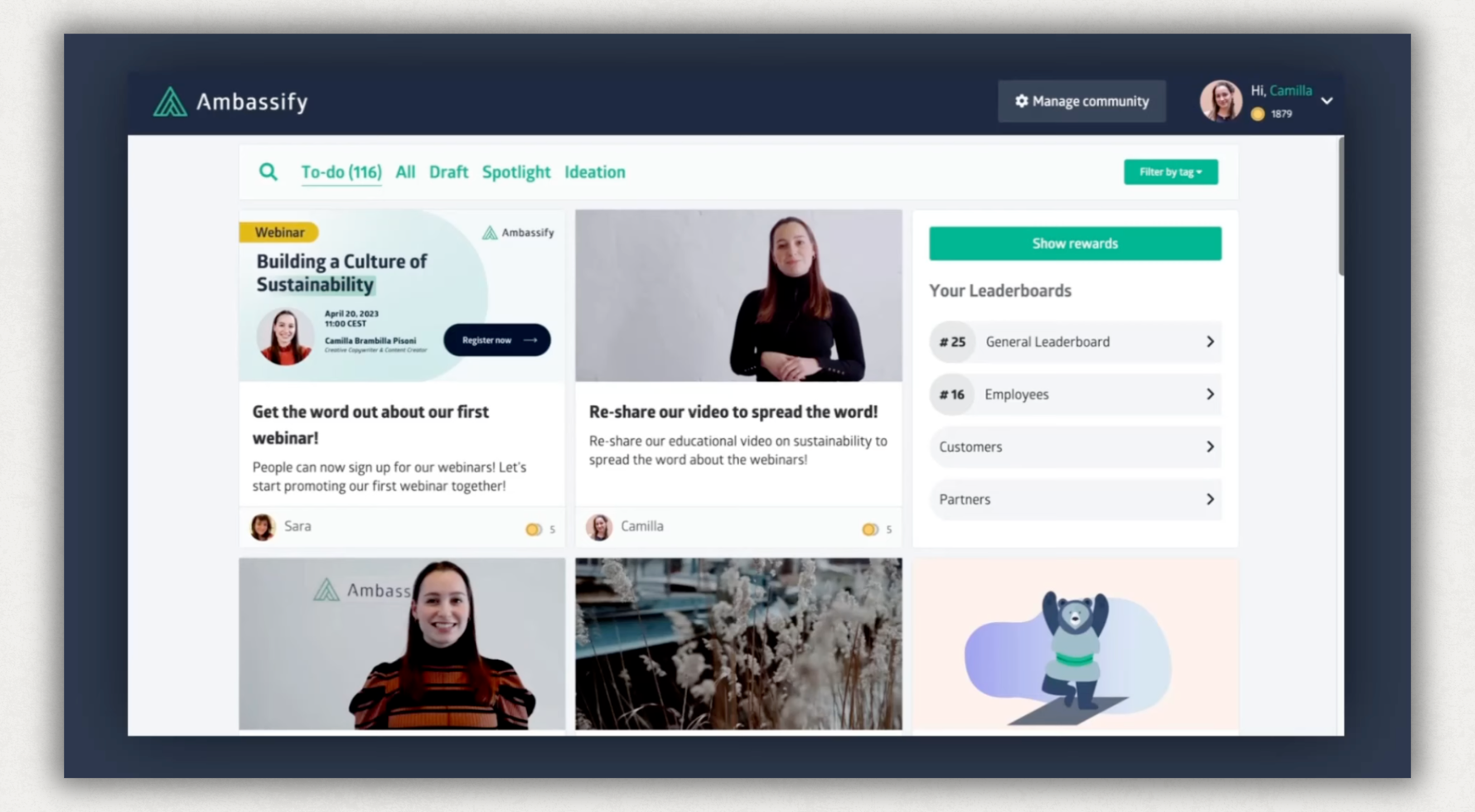
Community-driven advocacy where employees participate in campaigns and challenges. Focuses on building an internal community around brand advocacy.
Key features:
- Campaign-based advocacy (challenges, polls, quizzes)
- Community features for internal engagement
- Content creation templates for employees
- Multi-channel distribution
- A/B testing on advocacy campaigns
Pricing: Custom pricing based on community size. See Ambassify.
Best for: Companies that want advocacy to feel like a community initiative rather than a top-down marketing program. Works well for culture-driven organizations.
Clearview Social
The simplest option on this list. Employees receive email digests with content to share. Click a link, pick a platform, post. No app to install, minimal training needed.
Key features:
- Email-based content sharing (no app required)
- PeakTime scheduling (AI picks optimal posting time)
- Leaderboards and basic gamification
- LinkedIn, Twitter, Facebook support
- Compliance queue for content approval
Pricing: Custom pricing. Generally affordable for small teams. See Clearview Social.
Best for: Companies that want the absolute lowest friction for employees. If your team won't install an app or log into another platform, email-based sharing removes that barrier entirely.
Which Employee Advocacy Tool Is Best for Your Team?
There's no single "best" tool. It depends on what problem you're solving.
| Your situation | Best fit | Why |
|---|---|---|
| Employees mainly use LinkedIn, you want original content | AuthoredUp | Only tool built for content creation on LinkedIn, not just distribution |
| Enterprise, 500+ employees, multi-platform, compliance needs | Sociabble or PostBeyond | Full governance, multi-language, approval workflows |
| You want gamification to drive employee participation | GaggleAMP | Most advanced activity-based gamification |
| Already using Hootsuite | Hootsuite Amplify | Seamless add-on, no new platform to learn |
| AI content curation, limited marketing team | DSMN8 | AI handles content discovery and suggestions |
| Lowest possible friction, employees won't install apps | Clearview Social | Email-based, zero training needed |
| Community-driven culture, want internal engagement | Ambassify | Campaign and community features |
Two questions to ask before choosing:
1. Do you want employees sharing pre-made content, or creating their own?If sharing: most tools on this list work. If creating: AuthoredUp is the clear choice, because it's the only platform with a full-featured content editor, hook library, and analytics specifically for LinkedIn.
2. Is LinkedIn your primary channel?If employees mainly post on LinkedIn (and for B2B companies, it almost always is), a LinkedIn-specific tool gives you better text formatting, deeper analytics, and features designed for how LinkedIn actually works. Multi-platform tools spread across five networks but go shallow on each.
If you're building a content strategy for employee advocacy, start with the channel that drives results. For most B2B companies, that's LinkedIn.
Free Employee Advocacy Tools
You don't need a budget to start. Several tools offer genuine free options.
AuthoredUp free tools (available to anyone, no account needed):
- LinkedIn Text Formatter: bold, italic, and Unicode formatting for LinkedIn posts
- LinkedIn Post Preview Generator: see how your post looks before publishing
- Text Staircase Generator: create visual text effects that stand out in the feed
- LinkedIn Headline Writer: craft a headline that gets clicks
- Best Time to Post: data-backed posting time recommendations
- LinkedIn Engagement Rate Calculator: calculate engagement rate for your posts using the impression-based formula
- LinkedIn Industry Finder: find the right LinkedIn industry for your profile
- LinkedIn Hiring Post Audit: score your LinkedIn hiring post before you publish it
- LinkedIn Weekly Content Mix Planner: plan a week of LinkedIn posts that actually work
These won't replace a full advocacy platform, but they solve the most common employee complaint: "I don't know how to make my LinkedIn posts look good." Give your team access to the free formatter and preview tools, and post quality goes up immediately.
Free trials worth testing:
- AuthoredUp: 14-day free trial, full feature access
- Hootsuite: 30-day free trial (Amplify requires Business plan)
- Most enterprise platforms (Sociabble, GaggleAMP, EveryoneSocial) offer demos and pilot programs
The honest truth about free advocacy: Free tools get you started with formatting and basic posting. But if you want analytics, scheduling, and the ability to track what's working across your team, you'll need a paid plan. The good news: AuthoredUp starts at $19.95/month per profile, significantly less than enterprise advocacy platforms that run $5,000+ per year.
Looking to get more visibility from your employee posts? Here are tips to master LinkedIn employee advocacy with specific tactics that work.
How to Measure Employee Advocacy ROI
Tracking advocacy isn't just counting shares. These are the metrics that actually tell you whether it's working.
Reach amplification
How much further does employee content travel compared to company page posts? Our data shows employee posts (personal profiles) hit a median of 1,006 impressions vs 659 for company pages. When employees mention the company, that jumps to 1,405. Track this ratio over time.
HubSpot's research backs this up: content shared by employees gets 8x more engagement than content shared through brand channels.
Set the page baseline first. Our company page benchmark gives you the median engagement rate for company-page posts at your reach level, which is the number employee posts have to beat.
Engagement quality
Reactions and comments, not just impressions. Employee posts generate a median of 20 reactions and 4 comments, and 30 reactions when the post mentions the company. Company pages get 15 reactions and zero comments at the median. Comments signal genuine conversation. Zero comments means people scroll past. Track your LinkedIn metrics to spot these patterns.
Content format effectiveness
Not all company page content works equally. On company pages specifically, image posts perform best (2.89% median engagement rate), followed by video (2.84%) and carousels (2.48%). Text-only company page posts struggle at 0.83%. If your advocacy program shares mostly text links from the company page, the numbers won't look good.
| Company page format | Median engagement rate | Median impressions | Post count |
|---|---|---|---|
| Image | 2.89% | 518 | 71,650 |
| Video | 2.84% | 489 | 16,769 |
| Carousel / Document | 2.48% | 504 | 9,317 |
| Text | 0.83% | 214 | 3,382 |
| Poll | 0.60% | 362 | 802 |
Source: AuthoredUp analysis of 101,920 company page posts, September 2025 – February 2026.
Click-through and lead attribution
If employees include links in their posts, track click-throughs with UTM parameters. Most advocacy platforms provide this. For deeper analysis, use AuthoredUp's analytics to compare which content formats and hooks drive the most engagement, then replicate what works across your team.
Participation rate
What percentage of invited employees actually post? Industry benchmarks hover around 20-30% for enterprise programs. If participation drops, the problem usually isn't the tool. It's that employees don't know what to post. Content creation tools outperform distribution tools here because a template and a hook library removes the blank-page problem entirely.
Using AuthoredUp's analytics dashboard, you can track individual employee post performance, compare which hooks drove more engagement, and identify your top-performing advocates.
FAQ
What is the best employee advocacy tool?
It depends on your primary goal. For LinkedIn content creation and analytics, AuthoredUp offers the deepest feature set at the lowest price point. For enterprise-scale programs with gamification across multiple platforms, Sociabble and GaggleAMP lead the market. For simplicity, Clearview Social's email-based approach requires zero employee training.
What are employee advocacy platforms?
Employee advocacy platforms are software tools that help companies coordinate and encourage employees sharing content on social media. They range from content distribution systems (where marketing provides pre-approved posts for employees to share) to content creation tools (where employees write original posts with help from templates, formatting tools, and analytics).
What is an example of employee advocacy?
A product manager at a SaaS company writes a LinkedIn post about a customer problem their team just solved. They mention their company, share a genuine insight from the process, and tag relevant colleagues. That post reaches 1,405 impressions (the median for posts mentioning a company, from 137,171 such posts in AuthoredUp data covering July 2025 to June 2026), more than twice what the same story would reach from the company page.
How to measure employee advocacy?
Track four metrics: reach amplification (employee post impressions vs company page impressions), engagement quality (reactions and comments per post), content format effectiveness (which formats drive the most engagement), and participation rate (what percentage of employees actually post). Use UTM parameters on shared links to attribute leads and conversions back to advocacy content.
Is employee advocacy worth it for small teams?
Yes, and arguably more so than for large enterprises. A 10-person team where 6 people post weekly generates more LinkedIn reach than most company pages posting daily. The cost is lower too: AuthoredUp at $19.95/profile/month vs enterprise platforms at $5,000+/year. The impact per person is higher because each employee reaches their own unique network.
Do employee advocacy tools violate LinkedIn's Terms of Service?
Some do. LinkedIn's ToS prohibit automated actions that mimic human behavior: auto-liking, auto-commenting, bot-driven engagement, and mass-sharing of identical content. Tools that focus on content creation and scheduling (like AuthoredUp) operate within LinkedIn's rules. Tools that include auto-engagement features or identical mass-sharing push into gray areas. If employees value their LinkedIn accounts, this risk matters.

.svg)
.png)

.svg)
.png)
.png)
