


.svg)


Most LinkedIn posts end with nothing. No question. No invitation. No reason for someone to do anything except keep scrolling.
That's the problem. You spend 30 minutes writing a post, it gets shown to hundreds of people, and then silence. Not because the content was bad, but because you never told anyone what to do next.
A CTA (call to action) is the line at the end of your post -sometimes in the middle, sometimes woven into the hook, that gives your reader a next step. Comment, share, click, connect, save. Without one, even a great post dies quietly.
Below are 15 CTAs you can copy and adapt today, organized by what you're trying to achieve. Plus: where to place them, what to avoid, and which types actually drive more engagement.
A note on scope: This guide covers CTAs in organic LinkedIn posts -the ones you write and publish from your profile. If you're looking for LinkedIn Ads CTA button options (the dropdown when creating sponsored content), LinkedIn's ads guide covers that separately.
15 LinkedIn Post CTA Examples (Organized by Goal)
CTAs That Drive Comments
These work when you want engagement -comments, reactions, conversation. Comments signal to LinkedIn's algorithm that your post is worth showing to more people, so engagement CTAs directly increase reach.
1. The open question
What's been your experience with this? I'd love to hear how others are handling it.
Works after a personal take or an observation about your industry. Open questions get longer replies than yes/no questions.
2. The "agree or disagree"
Agree or disagree: [your take]. Tell me why in the comments.
Polarizing (in a good way). Works best when your take is specific and slightly provocative, not generic.
3. The fill-in-the-blank
The best career advice I ever received was ____. Drop yours below.
Low friction. People can respond in 5 seconds. Works well for personal topics, career reflections, and "lessons learned" posts.
4. The "what would you do?"
If you were in this situation, what would you do differently? Curious to see how others would approach it.
Turns the reader into a participant. Works after you describe a specific challenge or decision.
5. The tag prompt
Tag someone who's been doing great work in [field/topic] lately. They deserve some visibility.
Extends your reach to second-degree connections. Use sparingly. Tagging prompts can feel forced if overused.
CTAs That Drive Leads
These work when you want people to take an action outside of LinkedIn -visit a page, download something, sign up.
6. The resource offer
I put together a [free template/checklist/guide] for this. Link in the comments if you want it.
Put the link in the first comment, not the post body. Posts with external links in the body get less reach. The algorithm deprioritizes them because they send people off-platform.
7. The newsletter plug
I write about [topic] every [frequency]. If that's useful, the subscribe button is on my profile.
Works when you have an active LinkedIn newsletter. Doesn't hurt reach because there's no external link.
8. The DM invite
If you want the full breakdown, send me a DM. Happy to share it directly.
Creates a 1-to-1 conversation. Good for consultants, coaches, and anyone who converts through direct relationships. Don't overuse it. It can come across as a lead trap if every post ends this way.
CTAs That Grow Your Network
These work when you want new connections -people who follow you, visit your profile, or send a connection request.
9. The "let's connect"
If you're working in [industry/role], let's connect. I post about [topic] regularly and I'd like to learn from people in the space.
Specific beats generic. "Let's connect" alone is weak. "Let's connect if you're a product manager in B2B SaaS" gives people a reason to say yes.
10. The follow prompt
I'm writing a [series/project] about [topic] over the next few weeks. Follow along if you want to catch the rest.
Works when you're doing something ongoing: a content series, a challenge, a public learning experiment. Gives people a reason to follow now rather than later.
11. The profile tease
I keep my best [resources/templates/frameworks] in my Featured section. Take a look if any of this was useful.
Drives profile visits without an external link. Works well if you actually have useful content in your Featured section.
CTAs That Drive Shares and Saves
These work when you want distribution -people reposting your content or bookmarking it for later.
12. The "save this" prompt
Bookmark this if you want to reference it later. LinkedIn lets you save posts -click the three dots in the top right.
Works for how-to posts, checklists, and reference material. Many people don't know the save feature exists, so telling them how to use it actually helps.
13. The repost nudge
If this would be useful for your network, hit repost. Sharing good information is always welcome.
Direct and honest. Don't dress it up as something more than it is. "Repost if you agree" is engagement bait. "Repost if useful for your network" is a genuine ask.
14. The "share with someone specific"
Know someone who's going through [situation described in post]? Send this to them. It might help.
More personal than a generic repost request. Works when the post addresses a specific problem (job searching, career switch, starting a business).
The Wildcard CTA
15. The anti-CTA
No ask today. Just something I've been thinking about. Take it or leave it.
Counterintuitive, but it works. When every post in someone's feed ends with "comment below!" or "agree or disagree?", a post that doesn't ask for anything feels like a breath of fresh air. People engage precisely because you didn't demand it.
Use this occasionally, once every 8-10 posts. The contrast makes your other CTAs more effective.

Where to Place Your CTA
The placement of your CTA affects whether people actually see it.
LinkedIn truncates posts after roughly 210 characters (about 3 lines of text) with a "…see more" link. If your post is long and your CTA is at the very bottom, most people will never reach it. They'd have to tap "see more" and scroll to the end.
Three placement options:
End of post (most common)
Works when the post is short (under 200 words) or when the CTA naturally follows the conclusion. If your post is longer, assume most people won't see the last line.
P.S. line
Adding "P.S." before your CTA separates it visually from the body and draws the eye. It signals "this is the important bit." Works well for resource offers and newsletter plugs.
In the hook (first 2 lines)
For maximum visibility, front-load the CTA: "I'm looking for product managers who've dealt with [problem]. If that's you, read on and tell me what you did." This ensures the CTA is visible even for people who don't click "see more."
When you're planning your post structure, use AuthoredUp's post preview tool to see exactly where the "see more" cutoff hits. If your CTA gets buried, you'll know before you publish.
CTAs That Backfire
Not all CTAs are equal. Some actively hurt your post.
"Like if you agree"
LinkedIn has explicitly flagged this as engagement bait. The algorithm recognizes it and may reduce your post's reach. Don't ask for likes -earn them with the content itself.
External links in the post body
A CTA like "Click here to read more: [link]" sends people off LinkedIn. The platform deprioritizes posts with outbound links because they reduce time on site. If you need to share a link, put it in the first comment and mention that in your CTA: "Link in the comments."
Multiple CTAs competing with each other
"Comment below AND subscribe to my newsletter AND check out my website AND repost this." Pick one. When you give people four options, most choose none.
Vague CTAs
"Let me know what you think" is barely a CTA. Compared to what? About which part? Specificity drives action: "What's the one metric you track most closely? Comment with your answer."

The humble brag disguised as a question
"Just closed a $2M deal -anyone else having their best quarter ever?" That's not a CTA. It's a flex with a question mark. Your audience can tell the difference, and they'll scroll past.
How to Write a CTA That Doesn't Feel Forced
The line between a good CTA and a pushy one is thin. Here's what separates them:
Match the CTA to the post's energy
A vulnerable post about a career setback shouldn't end with "Sign up for my newsletter!" A data-driven post about industry trends shouldn't end with "What's your favorite quote?" The CTA should feel like the natural next step after reading the post, not a detour.
Vary your CTAs across posts
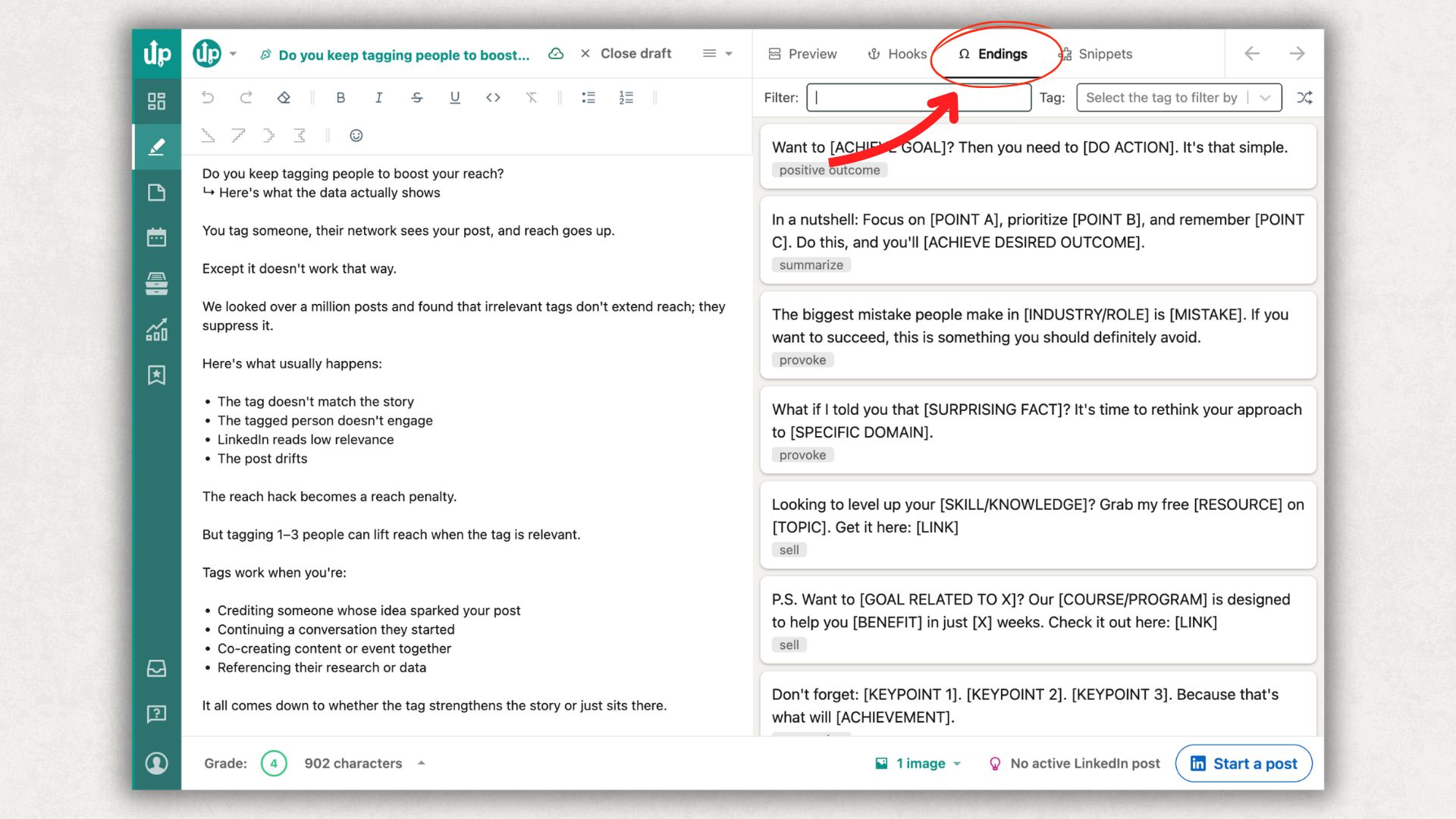
If every post ends with a question, your audience starts tuning it out. Mix engagement CTAs, lead gen CTAs, and anti-CTAs throughout your content calendar. When you're drafting posts in AuthoredUp, the CTA library gives you 150+ options organized by type, so you can avoid repeating the same ending.
Be direct, not desperate
There's a difference between "I'd love to hear your take" and "PLEASE comment and share this with everyone you know!!!" Confidence is quiet. The best CTAs read like a conversation, not a street vendor.
Reply to the responses you get
A CTA doesn't end when you post. If you ask a question and 12 people answer, reply to every one -especially in the first hour. The algorithm weighs early comment threads heavily, and your replies keep the conversation alive. This is where CTAs compound: ask → reply → more comments → more reach.
How to Track If Your CTAs Are Working
Varying your CTAs only works if you track what performs.
Look at three metrics:
- Comments per post. If engagement CTAs are working, this number goes up. Compare posts that end with a question vs. posts that don't.
- Click-through (for link CTAs). If you're driving people to a newsletter or resource, track link clicks in the first comment. LinkedIn doesn't show click data natively, but UTM parameters on your links will show up in Google Analytics.
- Profile views and connection requests. After posts with network-growth CTAs, check if your profile views spike. LinkedIn shows this in your dashboard.
Track these over 10-15 posts to see patterns. A single post tells you nothing -you need a sample. AuthoredUp's analytics lets you compare posts side by side, filter by engagement rate, and see exactly which CTAs correlated with higher reach.

FAQ: LinkedIn Post CTAs
What is a CTA on LinkedIn?
A CTA (call to action) is a line in your LinkedIn post that tells the reader what to do next: comment, share, visit a link, send a DM, or follow you. It's usually at the end of the post, but it can also appear in the opening lines or as a P.S. Good CTAs are specific and match the post's tone.
Where should I put the CTA in my LinkedIn post?
At the end for short posts (under 200 words). For longer posts, consider placing it in the first 2 lines so it's visible before the "see more" cutoff, or use a "P.S." line to make it stand out. You can preview where the fold hits using a post preview tool before publishing.
Do LinkedIn posts with CTAs get more engagement?
Yes. Posts that end with a clear next step (a question, an invitation, a request) consistently outperform posts that end with a statement. The difference is especially visible in comments: people respond when you give them something to respond to.
Should I put links in my LinkedIn post or in the comments?
In the comments. LinkedIn's algorithm deprioritizes posts with external links in the body because they send people off-platform. Mention "Link in the comments" in your post, then drop the URL in your first comment immediately after publishing.
What's the best CTA for LinkedIn engagement?
Questions. Open-ended questions ("What's been your experience with this?") and opinion-based prompts ("Agree or disagree?") drive the most comments. Specific questions outperform vague ones. "What's the one tool you can't work without?" beats "What do you think?"
How many CTAs should I include in one post?
One. Give people a single, clear action. When you ask them to comment and subscribe and share and visit your profile, you create decision fatigue and most people do nothing. Pick the one thing that matters most for this post.
Is "Like if you agree" a good CTA?
No. LinkedIn treats this as engagement bait and may reduce your post's reach. The algorithm is designed to surface genuine conversation, not reactions harvested by low-effort prompts. Ask a real question instead.
Can I use the same CTA on every post?
You can, but you shouldn't. If every post ends with "What do you think?", your audience starts ignoring it. Rotate between engagement CTAs, lead gen CTAs, network CTAs, and the occasional post with no CTA at all. The variety keeps your audience paying attention.
.svg)
.png)
.svg)
.png)
.png)
