

.svg)

.png)
Most lists of LinkedIn accounts rank people by how many followers they have. That tells you who is popular. It does not tell you who is worth reading.
These 17 were picked on a different test: each one publishes regularly, writes about something specific, and posts at a rate you could realistically match. Our data puts that rate at four to five posts a week, and most of them sit in that band.
Between them, they cover writing and storytelling, marketing and sales, data and research, business operations, product, and AI.
What the posting data says about who is worth following
Before naming anyone, here is the thing that shaped the whole list. We looked at our database to see what the best practice is for personal profiles. Here is the data grouped by how much they publish.
Two numbers matter here.
The first: 68.47% of people on LinkedIn manage about one post a week. That is the real baseline, and it is much lower than the advice industry implies.
The second: engagement rate peaks at 4–5 posts a week, then falls. Push past eight and your impressions keep climbing while your engagement rate drops to 2.33%, below where you started. More volume buys you more reach and a thinner response to it.
Engagement rate peaks at four to five posts a week
Median engagement rate by posting frequency, personal LinkedIn profiles. Select a bar for the full breakdown.
Source: AuthoredUp internal data, personal profiles.

| Posts per week | Share of profiles | Median engagement rate | Median impressions |
|---|---|---|---|
| 1 | 68.47% | 2.40% | 700 |
| 2 to 3 | 22.31% | 2.50% | 831 |
| 4 to 5 | 6.48% | 2.60% | 924 |
| 6 to 7 | 1.87% | 2.41% | 1376 |
| 8 or more | 0.86% | 2.33% | 1420 |
None of that is an argument for posting more. In LinkedIn and Edelman's B2B Thought Leadership research, nine in ten decision-makers said they are more receptive to a company that consistently produces high-quality thought leadership, while only 15% rated the thought leadership they actually see as very good. Consistency and quality are the scarce things. Volume is not.
That band, roughly four to seven posts a week, is where most of the people below sit. It is about 8% of LinkedIn. Not because volume is a virtue on its own, but because that is what showing up looks like when someone has something to say and a system for saying it.
So the bar for this list is not "famous". It is: posts regularly, and has something specific to say. Two people here post less often than the rest, and I have said so plainly in their entries rather than pretending otherwise.
Writing, storytelling and personal brand
1. Jasmin Alić
[VISUAL 3: profile screenshot, linkedin.com/in/alicjasmin/, alt="jasmin alic linkedin profile"]

Jasmin Alić is a copywriter turned LinkedIn coach who has taught a large share of the creators you already follow. He runs Link Up Community, which he has grown past 1,000 members across more than 80 countries, and now works mostly with founders trying to turn expertise into income.
Why you should follow him:
- He shows the mechanics, not the theory. He takes a real opening line and explains where the tension sits, what the second line has to do, and which single word is carrying the sentence.
- The business side gets covered too. How coaching becomes a community, and how a community becomes revenue, is the part most LinkedIn advice skips entirely.
- Useful the same afternoon. If you have written a post you thought was good and watched it die quietly, his teardowns tend to explain why, and they pair well with these LinkedIn hook examples.
2. Lara Acosta
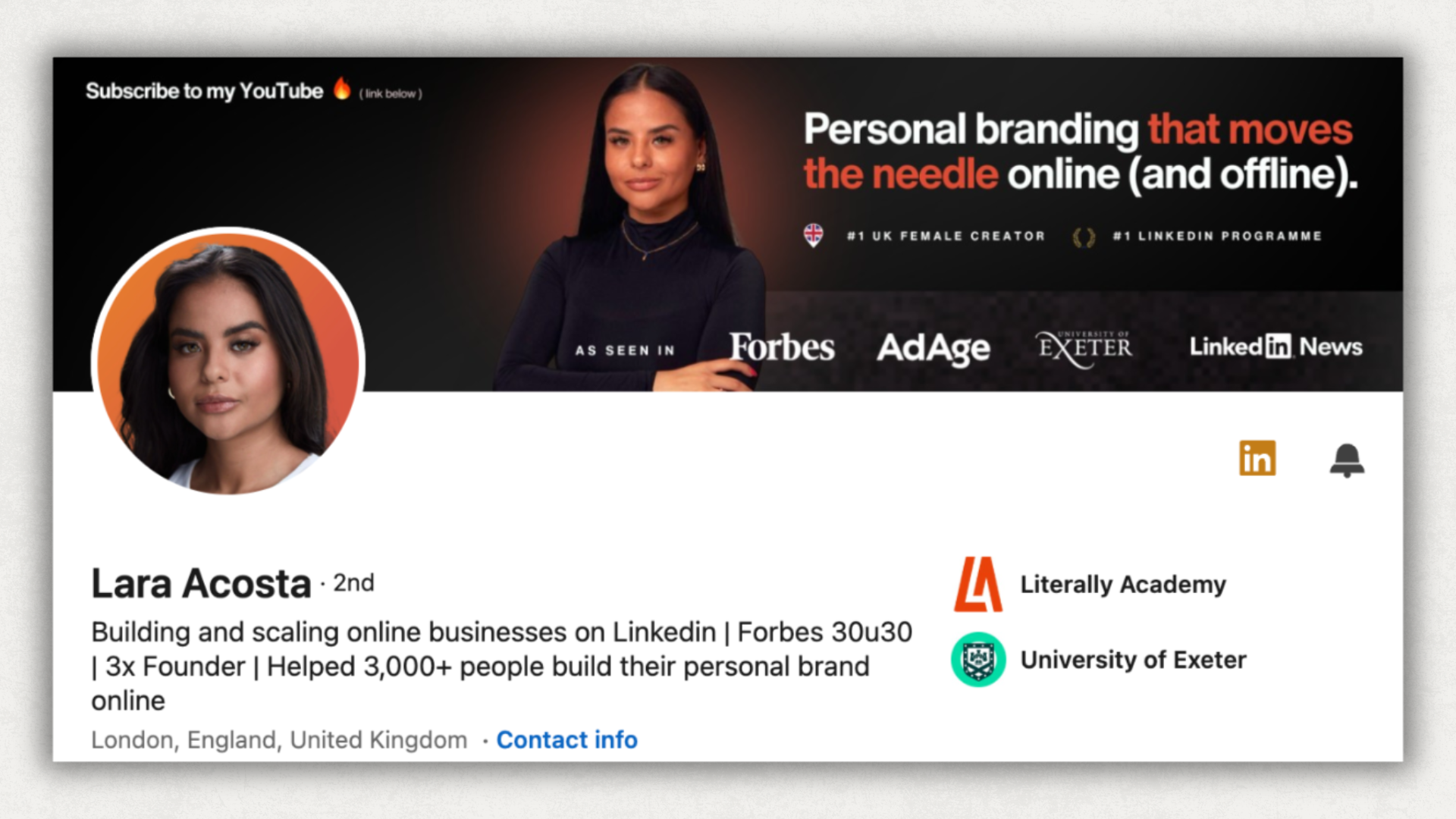
Lara Acosta built her name teaching personal branding on LinkedIn, and has taken more than 3,000 people through her programme by her own count. She is Forbes 30 Under 30, has founded three companies, and posts daily, which puts her in the roughly 3% of LinkedIn publishing six or more times a week.
Why you should follow her:
- Content systems that survive a busy week. Her focus is LinkedIn specifically rather than social media in general, which makes the advice concrete.
- She writes about the middle stretch. The months where nothing is growing yet and most people quit get as much attention as the wins.
- The feed is the evidence. She publishes at a volume almost nobody sustains, so you can test her claims against her results in the same scroll.
3. John Cook
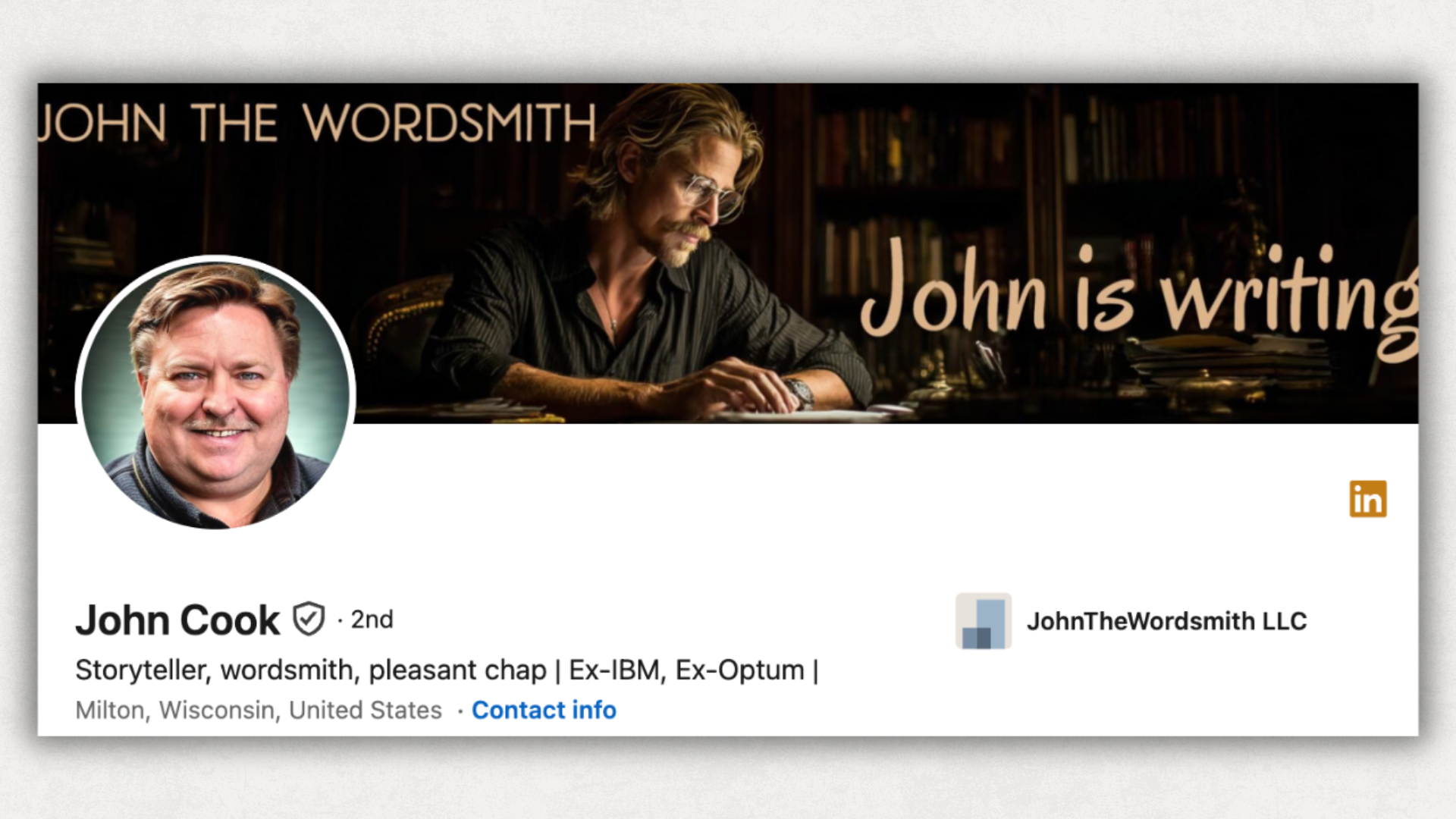
John Cook is a storyteller and copywriter who spent years at IBM and Optum before writing full time. His profile describes him as a "Storyteller, wordsmith, pleasant chap", which is accurate on all three counts.
Why you should follow him:
- He writes about language itself. One recent post pulled apart why a film called The Kid Detective lands differently than The Boy Detective would, and what that one swapped word does to the whole story.
- Rhythm and word choice get real attention. Almost nobody on LinkedIn covers this, because it is harder than listing tactics.
- It transfers directly to your posts. Most advice is about timing and formats. His is about sentences, and sentences are the thing people actually read.
4. Kait LeDonne

Kait LeDonne is a personal branding strategist who works with speakers, authors and thought leaders rather than with beginners. Around 57,000 people receive her personal brand playbooks.
Why you should follow her:
- She solves a different problem. Getting an existing body of work seen is not the same job as starting from nothing, and she is one of the few people writing for the first case.
- Media and PR angles. Becoming a source journalists can actually find, and what a media-ready profile looks like, come up often. One recent post covered how large a share of journalists check LinkedIn first when sourcing experts.
- Books and keynotes become content. If you have something that took years to build and needs an audience, she is the most directly useful account here.
Marketing, sales and employee advocacy
5. Beatrice Vladut
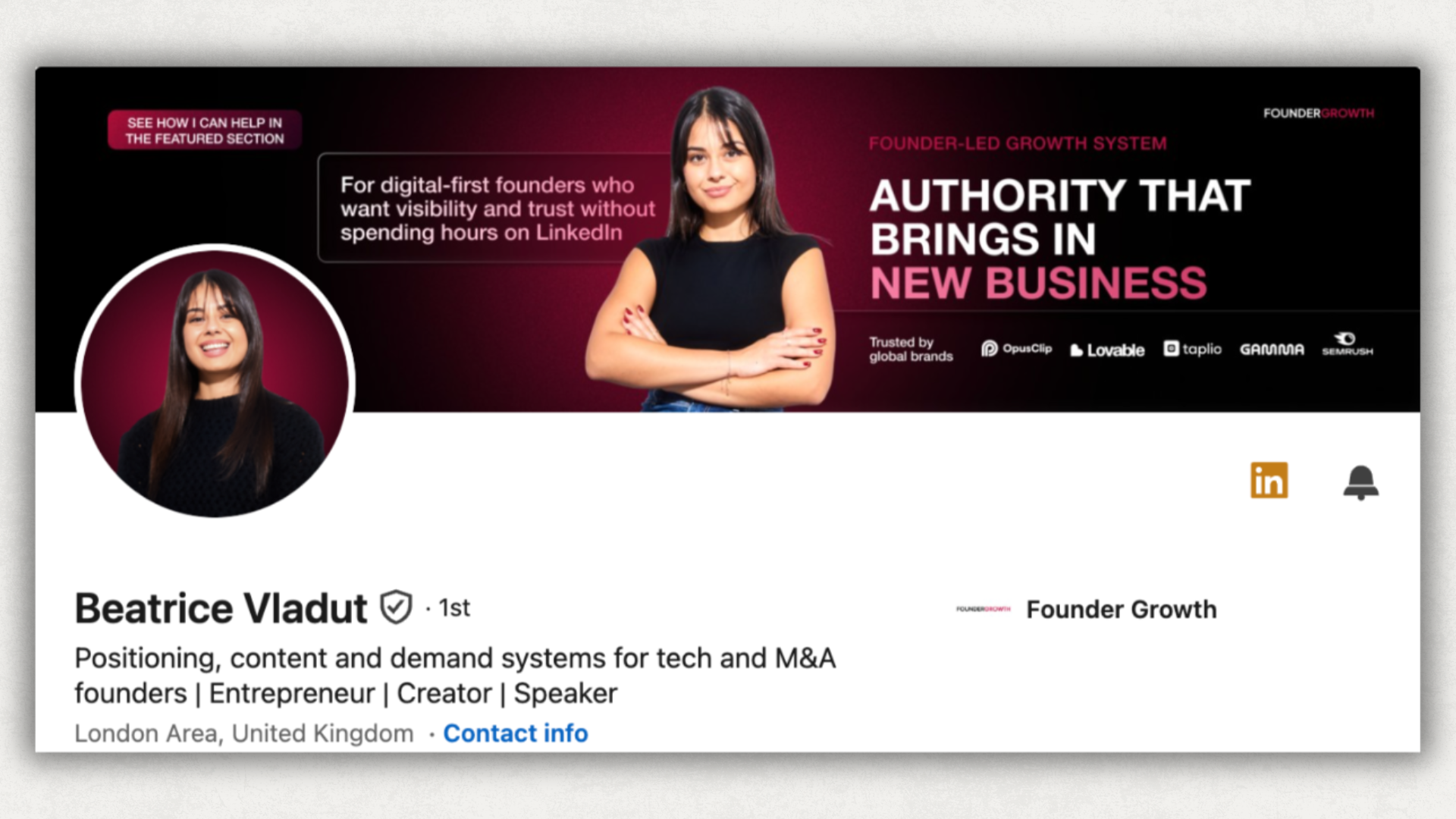
Beatrice Vladut builds positioning, content and demand systems for technology and M&A founders. She works on the strategy layer above individual posts, which is where most content problems actually start.
Why you should follow her:
- Positioning before publishing. Her subject is the decision that comes first: what you are going to be known for at all.
- Demand generation without paid. She writes about pipeline that comes from content rather than budget, and how founders should sound when they are the brand.
- AI in a real workflow. She has been publishing specifics on running an agency where AI agents handle a genuine share of the work, including which tasks she handed over and which she kept. Useful alongside building a LinkedIn content calendar.
6. Giulio Segantini
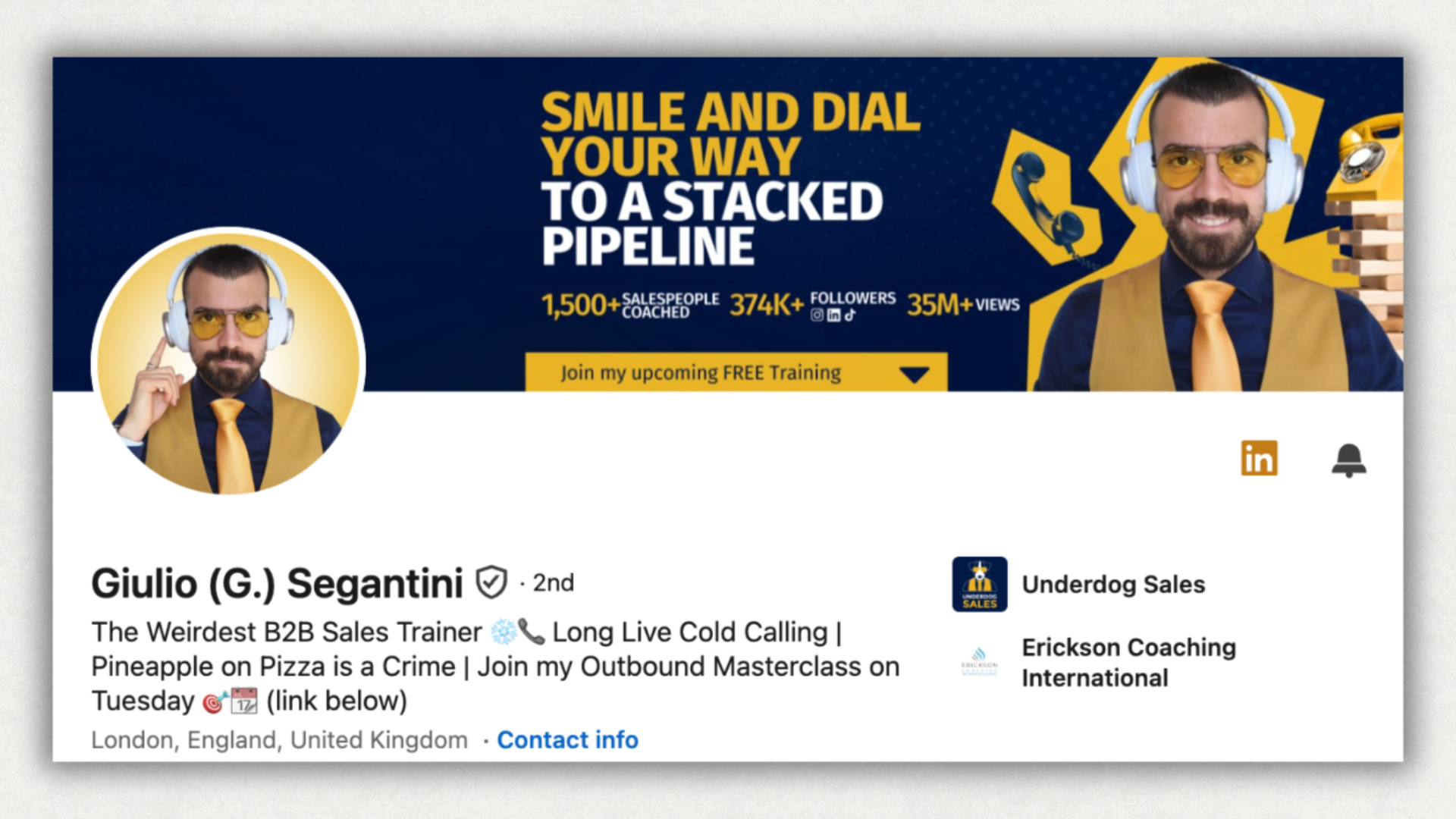
Giulio Segantini is a B2B sales trainer who calls himself "The Weirdest" one and has built his audience defending cold calling to a market that mostly buried it. He is one of two people here who posts less often than the rest, roughly every other week.
Why you should follow him:
- Real objections, worked line by line. Including the ones that end most calls, with the actual language he uses rather than a framework diagram.
- He is funny about rejection, which matters more than it sounds when the subject is getting hung up on all day.
- Nobody else here covers outbound. He earns the slot despite the slower cadence, because what he does publish is long, specific and testable on your next call.
7. Melanie Goodman

Melanie Goodman is a lawyer who runs CPD-accredited LinkedIn training for regulated professionals and works on social media policy. She is one of the most frequent publishers on this list.
Why you should follow her:
- Posting when compliance can veto you. Her subject covers most of legal, financial services and healthcare, where the usual advice simply does not apply.
- Employee advocacy people actually join. She writes about programmes that get take-up, and social media policy that does not strangle the content it governs.
- The assumption is different. Most LinkedIn advice quietly assumes you answer to nobody. Hers assumes you do, which makes it usable by a far larger group. Start with our guide to employee advocacy on LinkedIn.
Growth, data and research
8. Peter Walker
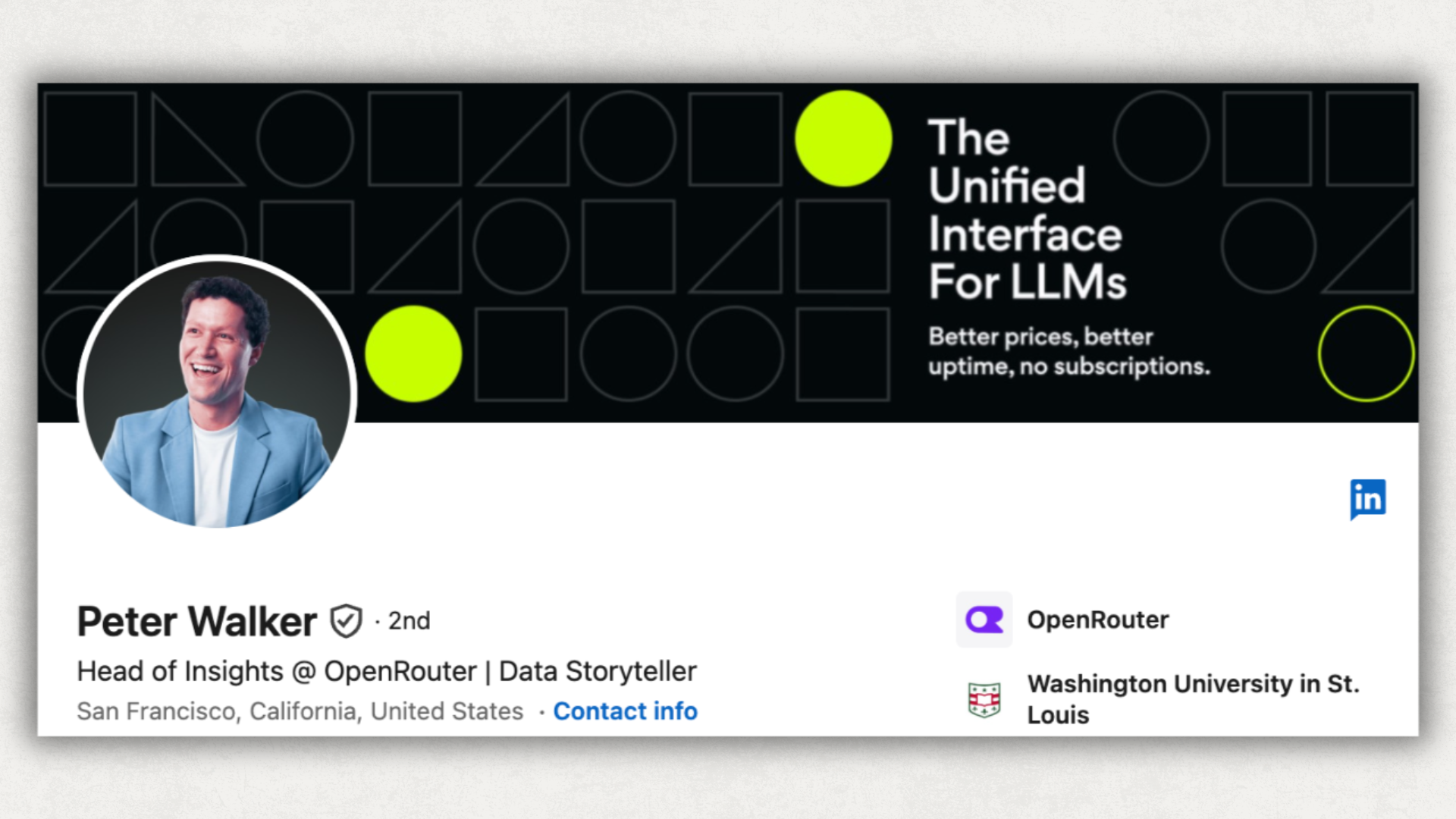
Peter Walker is Head of Insights at OpenRouter and describes himself as a data storyteller. He built his following doing the same thing to startup funding and hiring data before moving to AI usage.
Why you should follow him:
- Original data, not opinion. He is the only account here whose posts routinely carry analysis he ran himself.
- Charts you can cite. A recent example breaks down which AI models people actually spend money on, split by task from coding to content writing to code review.
- The slower cadence is the point. Original analysis costs time, and the tradeoff shows in the quality of what arrives.
9. Katelyn Bourgoin

Katelyn Bourgoin works on buyer psychology, which is the layer sitting underneath every post you will ever publish. Her headline is three words long: "Idea owners get richer."
Why you should follow her:
- Why people buy, with evidence. Buying triggers, and the research questions that surface what a customer actually wants rather than what they say they want.
- Customer research on no budget. Practical methods for talking to buyers when you cannot fund a study.
- What stays scarce as AI content floods in. She has been landing on trust and owning one specific association in a buyer's mind, which is a sharper answer than most.
10. Matt Lerner

Matt Lerner is the founder and CEO of SYSTM and the author of Growth Levers. Before that he was a General Manager at PayPal and a seed-stage VC partner, and that operating background is visible in everything he writes. He is the other exception on cadence here, publishing every few weeks rather than every few days.
Why you should follow him:
- Depth instead of frequency. He is the clearest exception on this list, and the interval is part of what makes the posts worth reading.
- The two or three levers that matter. His central argument is that a handful of things move a business and the rest is noise, and he shows the work.
- Failed experiments included. Messaging tests, growth experiments that did not work and what they cost, and the ways early teams misread their own numbers. Read the archive as much as the feed.
Business and operations
11. Leila Hormozi
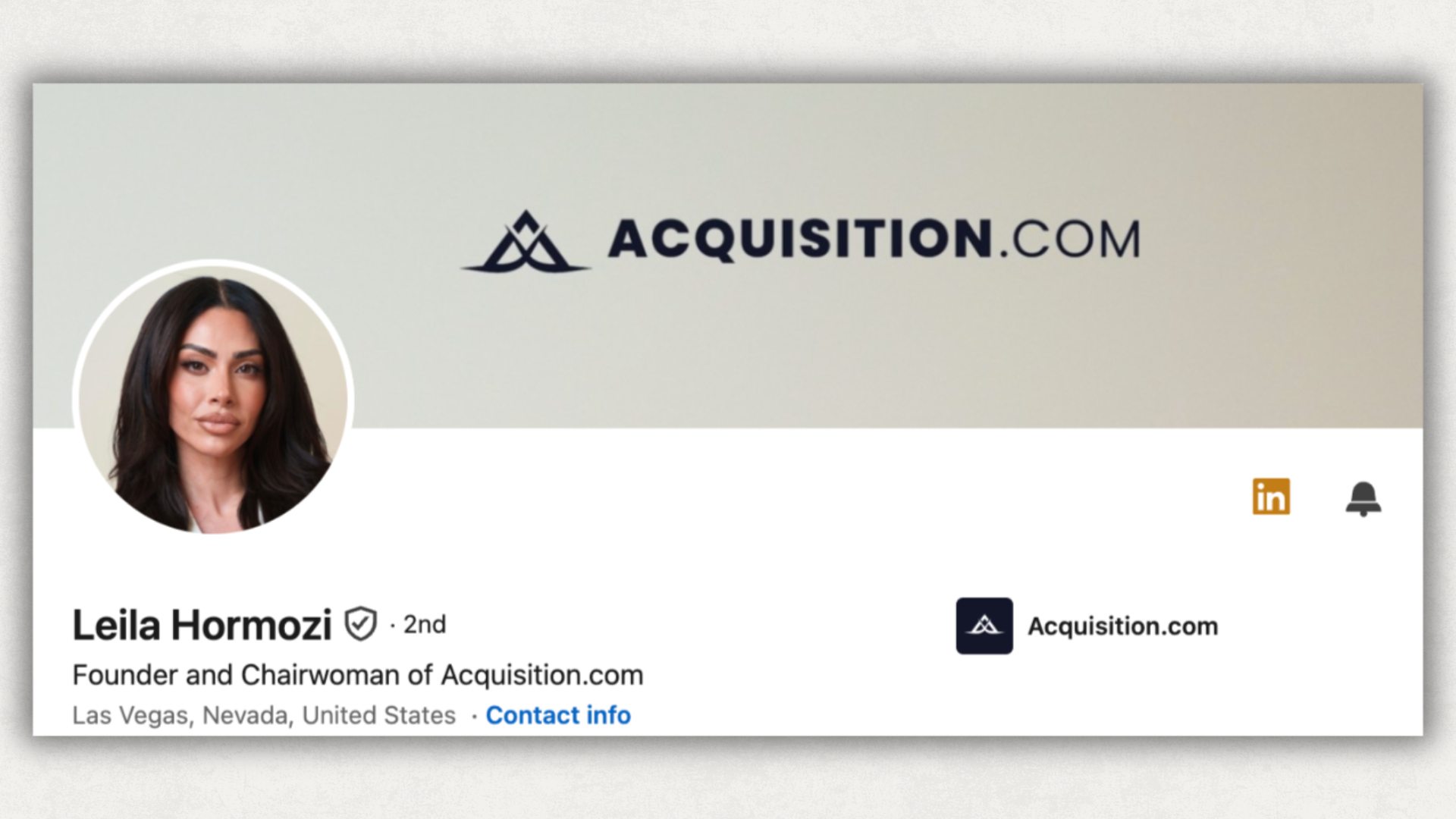
Leila Hormozi is the founder and Chairwoman of Acquisition.com. She posts more than once a day, which almost nobody running a company at that scale does personally.
Why you should follow her:
- The unglamorous half of building a company. Hiring and firing decisions, and the standards a team is genuinely held to rather than the ones written on a wall.
- Systems that work without you. Management structures that keep running when the founder is not in the room.
- She names her own mistakes, including expensive ones, which is rare from someone at her level. It reads like it was written between meetings rather than from a stage.
12. Bojan Radojicic

Bojan Radojicic works on AI and technology strategy for CFOs, runs Corporate Finance Hub and is CEO of WTS Tax & Finance. He is one of the largest finance accounts on the platform.
Why you should follow him:
- Finance that non-finance people can follow. FP&A, financial modelling, company valuation and the metrics boards actually ask about.
- AI applied to accounting work. He has been building tooling that runs US GAAP and IFRS treatments in parallel, and publishing what it produces.
- Study him as a format, not just a source. He is one of the best visual explainers on LinkedIn, and his comparison tables are worth copying as a structure, much like a LinkedIn carousel post.
13. Noor V. Barrage

Noor V. Barrage writes as "The Systems Girl" and built a framework she calls Intentional Productivity. Her argument is that the business should not require you to burn yourself down to run it.
Why you should follow her:
- Systems behind consistent output. How to publish every day without it eating the entire week.
- A running argument with hustle. She pushes back on the way most of us were taught to define work and success, and does it with specifics.
- She is the counterweight on this page. If four posts a week currently sounds impossible, hers is the account that makes it look survivable.
Product, AI and career
14. Aakash Gupta

Aakash Gupta spent a decade in product, rising to VP of Product at a unicorn, and now writes full time about careers and applied AI. He runs a newsletter and a podcast alongside the feed.
Why you should follow him:
- Career guides that are actually actionable. How to position yourself for the next role, and what interview loops are really testing.
- AI experiments with published results. He runs large tests on AI tooling and reports what came back, including the approaches that did not hold up.
- Specific about tradeoffs rather than cheerleading, which makes him useful whether or not you work in product. If you want to try the same tooling, start with these ChatGPT prompts for LinkedIn posts.
15. Dr Bart Jaworski

Dr Bart Jaworski is a product management expert, author, mentor and instructor. He writes about the job as it is actually done rather than as it is described in frameworks.
Why you should follow him:
- Refinement sessions that go badly, and how to rescue them, which is the kind of thing people usually only discuss privately with a trusted peer.
- Stakeholders who will not decide. Prioritising when everything is urgent, and the daily friction of working with engineering.
- Useful even if you are not a PM. If you work alongside one, this is the clearest window into what they are dealing with.
16. Charlie Hills

Charlie Hills has a four-word headline that does a lot of work: "I help you (actually) use AI." The bracket is the whole point, and the posts back it up.
Why you should follow him:
- He ships instead of forecasting. Working tools, step-by-step setups and workflows you can copy the same afternoon, including free skills he has built and released.
- It reads like a lab notebook. Here is what I built, here is what broke, here is the version that works.
- Most AI content is commentary about AI, written by people who have not opened the thing they are describing. His is not.
17. Justin Wright
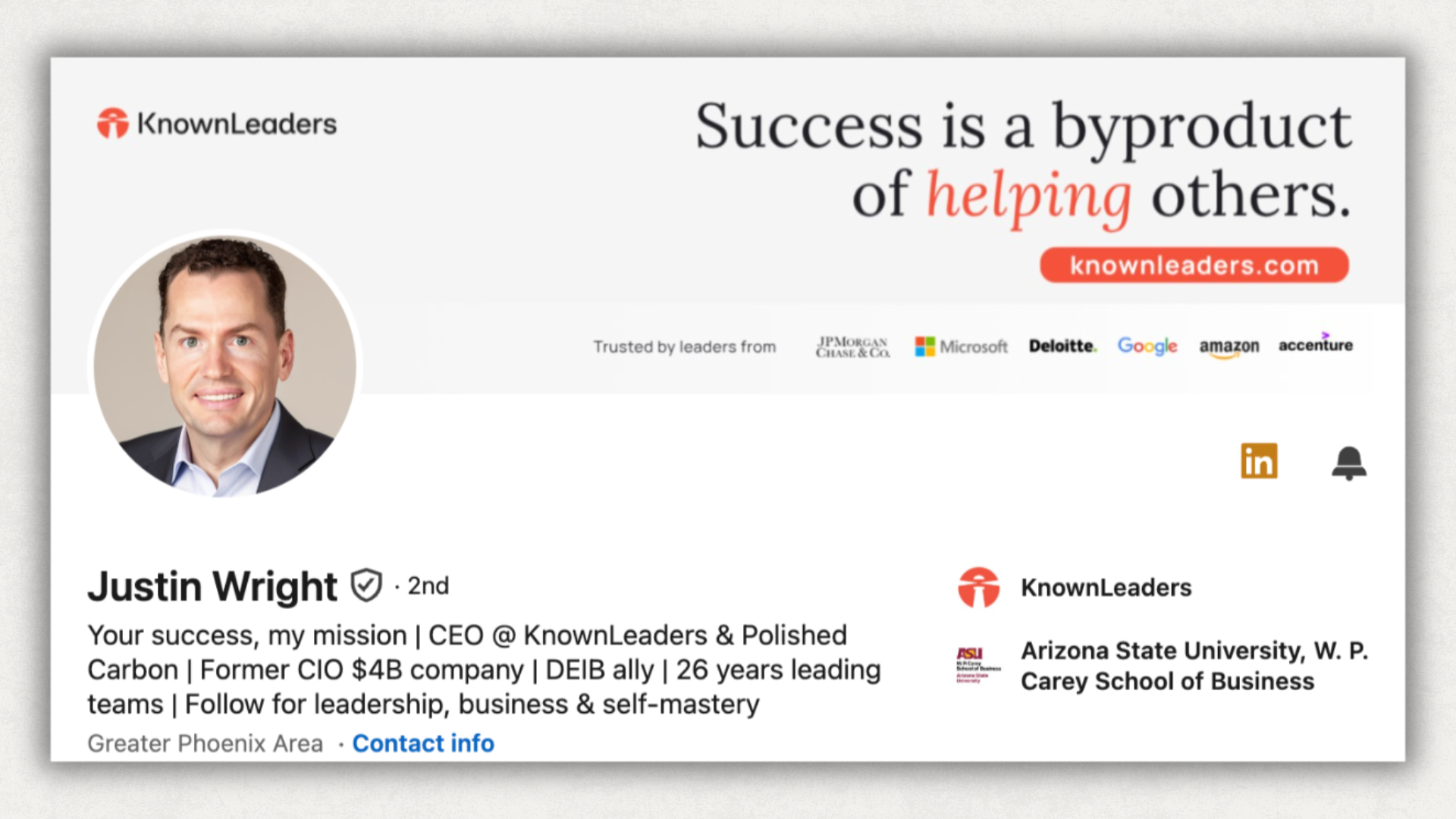
Justin Wright is the CEO of KnownLeaders and Polished Carbon, and was previously CIO of a $4bn company. He has 26 years of leading teams behind him, and it shows in what he chooses to write about.
Why you should follow him:
- Leadership from someone who carried the weight first. Managing teams through change, written from operating experience rather than theory.
- Career growth without becoming someone else. He writes for people who want to progress without performing a personality they do not have.
- The comments still read like a conversation, which is genuinely rare on an account with an audience that size.
Turn what you read into posts of your own
Following good accounts changes what you see. It does not change what you publish, and the gap between those two is where most people stall.
Here is a loop you can run every week, starting with the feed you just improved.
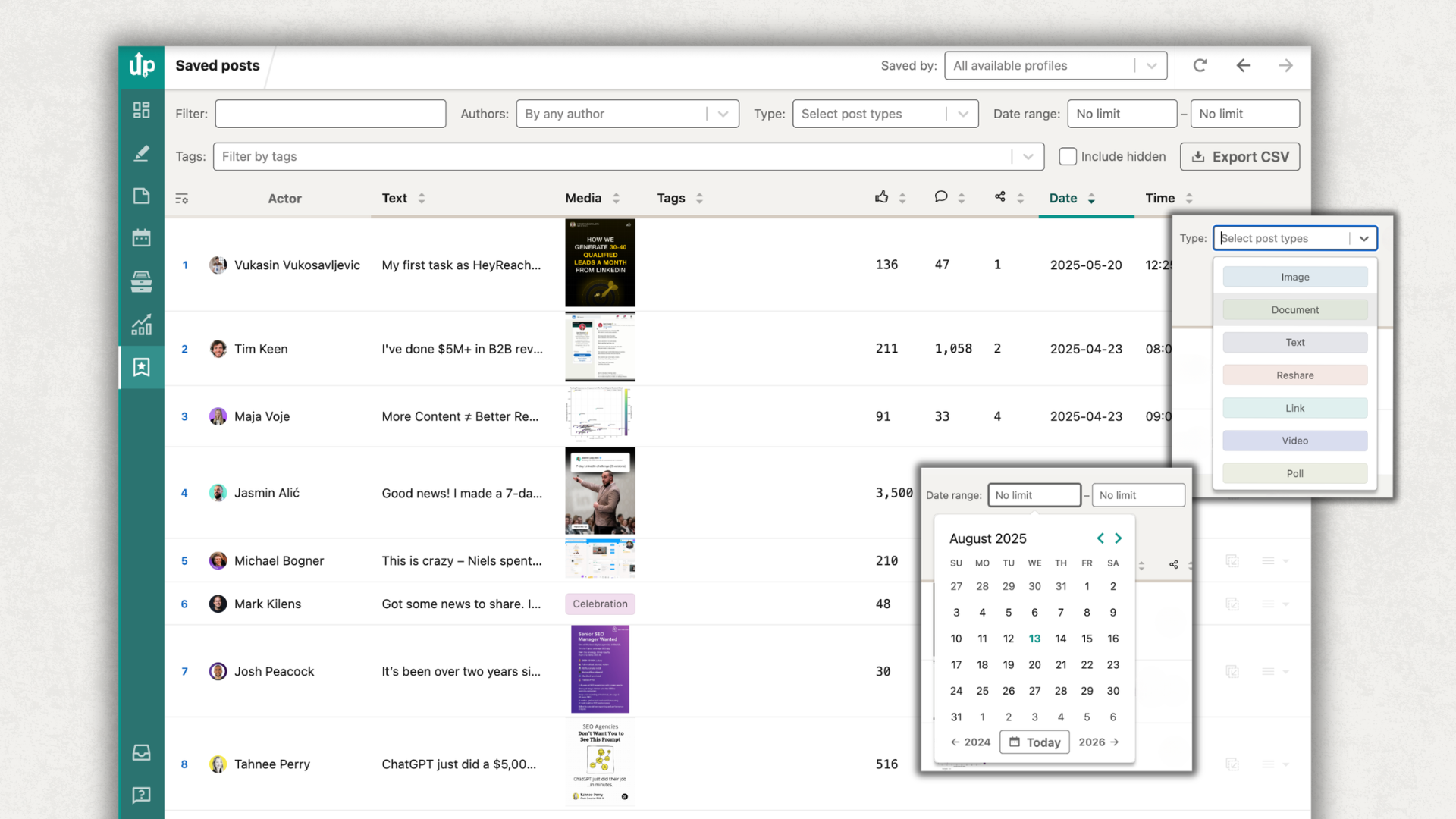
Save the posts that stop you. When something from one of these 17 makes you pause mid-scroll, save it. Not a screenshot in a folder you will never open again, but a searchable library you can filter when you are staring at an empty box on a Tuesday. With saved posts you can keep anything from your feed, tag it, and find it later. It turns the people you follow into a working reference instead of passive reading.
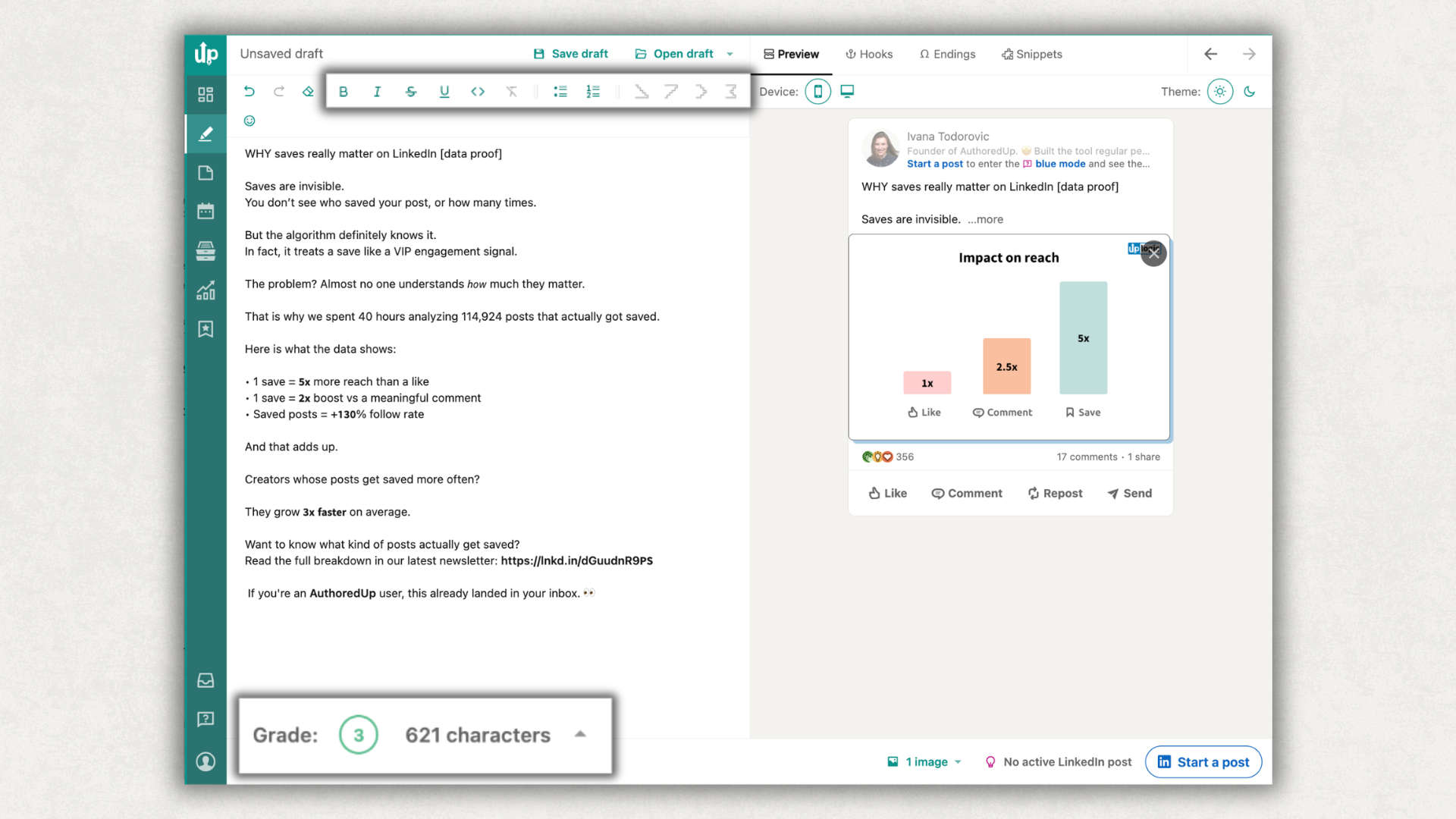
Write the draft while the thought is warm. Ideas rarely survive the trip to next week. Keep the half-formed ones in drafts, annotate them as they develop, and switch between them without losing your place.
Then format it so it gets read. Bold, italics, line breaks and bullet points are not decoration on LinkedIn. They are the difference between a post someone reads and a block someone scrolls past. You can format as you write in the editor, and preview exactly how the post will look before it goes out. If you only want to see what a difference it makes, our free LinkedIn text formatter does the formatting part on its own.
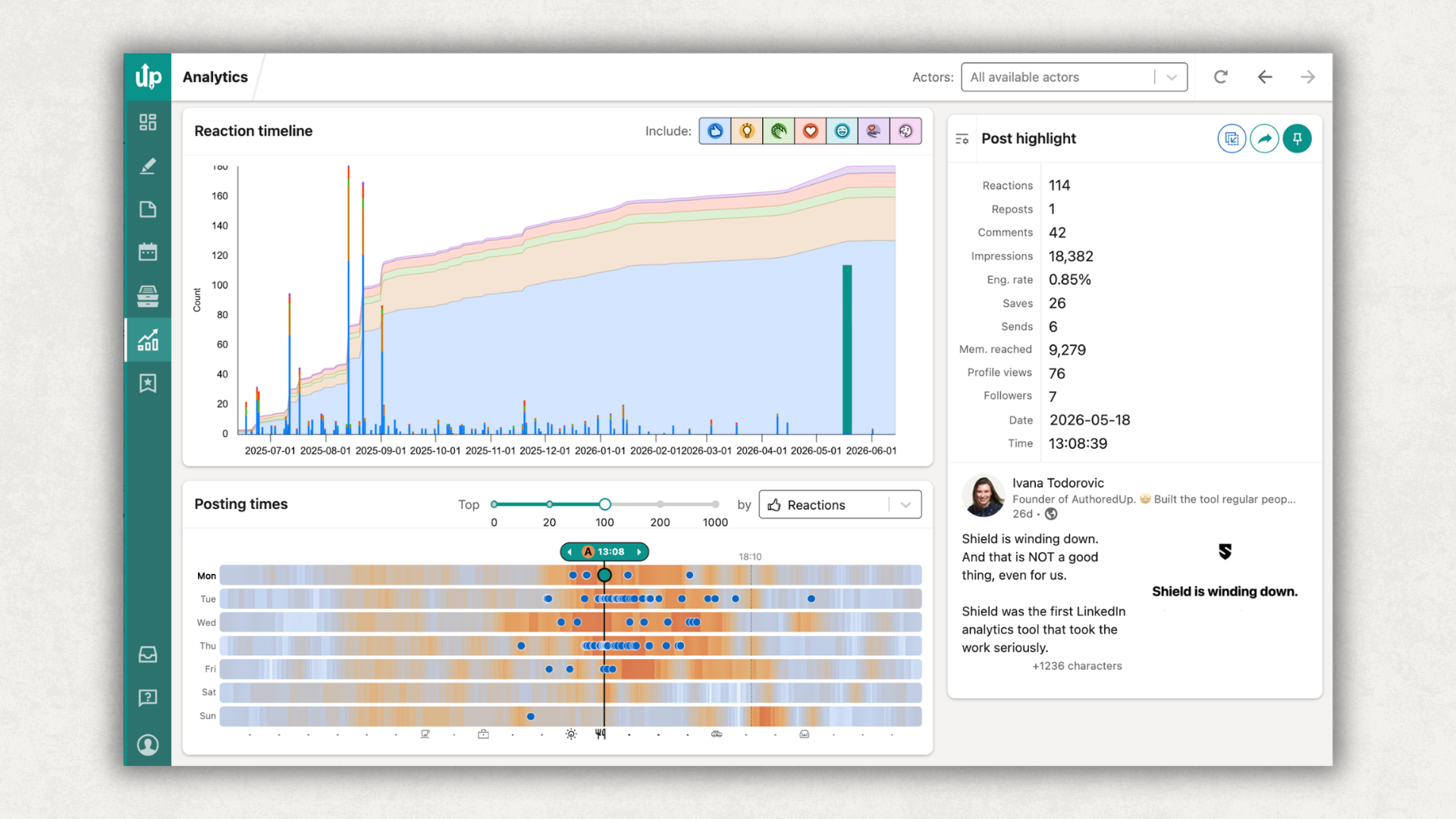
Then find out whether it worked. This is the step almost everyone skips. In analytics you can see engagement rate and impressions per post, compare two posts side by side, and check your own numbers against the 2.60% median at the top of this page. That is how you find out whether four to five posts a week is right for your audience, rather than assuming it.
Frequently asked questions
What is the most followed LinkedIn account?
Among individuals, the most followed accounts belong to figures such as Bill Gates, with tens of millions of followers. Among company pages, LinkedIn's own list of the most followed pages is topped by large employers including Amazon, Google and TED. Those are the largest audiences on the platform. This list answers a different question: whose posting habits are worth learning from.
What is the 3/2/1 rule on LinkedIn?
It is an informal posting formula: three pieces of value-driven content, two engagement or conversation posts, and one promotional post, per week. It is not a LinkedIn policy and the platform has never endorsed it. Treated as a rough balance rather than a law, it is a reasonable starting split, and at six posts a week it sits just above the 4–5 band where our data shows engagement rate peaking. The feed itself ranks on relevance rather than any fixed content mix, as LinkedIn's engineers describe in their 360Brew paper. We break the ranking down further in our guide to how the LinkedIn algorithm works.
Who are some of the best LinkedIn profiles?
If you mean profiles worth following, that is the list above. If you mean profiles worth copying as examples when writing your own, that is a different question and a different page: see our LinkedIn profile summary examples, and these LinkedIn headline examples.
Should you follow company pages too?
Yes, for company news, hiring and product updates. But company pages and personal profiles behave very differently, and personal profiles reliably earn more engagement. If you are looking for accounts to learn posting from, follow people. For running a page well, our LinkedIn company page best practices covers it.
How often should these accounts be posting?
Based on our data, four to five posts a week is where median engagement rate peaks. Below that you are in the band with roughly 68% of LinkedIn. Above eight, impressions rise but engagement rate falls back. Our guide to how often to post on LinkedIn goes deeper on frequency.
Where to go next by industry
This page is deliberately cross-industry. If you want the specialists, we keep separate lists for business influencers, marketing and sales influencers, tech influencers, HR influencers, finance influencers and cybersecurity influencers, plus real estate influencers.
Beyond individual accounts, LinkedIn newsletters, podcasts and communities are all worth a look: the best LinkedIn newsletters, LinkedIn podcasts and LinkedIn communities.
.svg)
.png)

.svg)
.png)
.png)